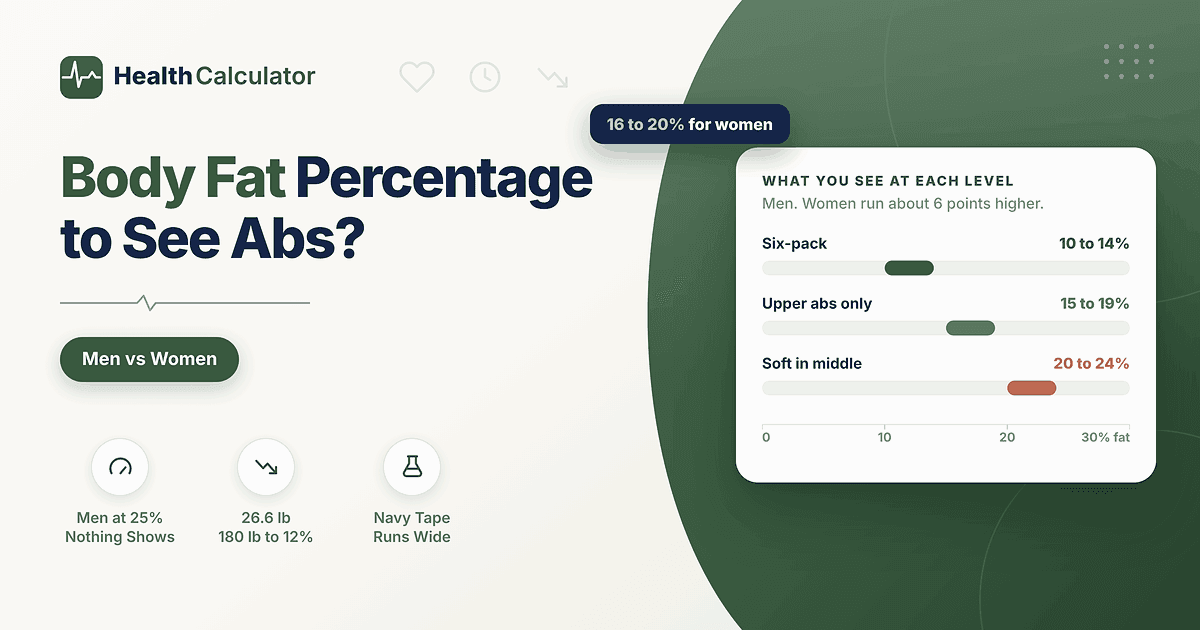
Most men see abs between 10 and 14 percent body fat, most women between 16 and 20, with faint outlines a few points higher. Search what body fat percentage to see abs and every page hands you a version of those ranges. None of them mention that your own reading can be off by seven points.
What Body Fat Percentage to See Abs: the Real Ranges
There is no single body fat percentage for abs, and these bands are our own synthesis of what the ranking guides and the DXA providers report, not a published standard. No guideline body sets an “abs” threshold, because visibility is not a clinical outcome.
| Body fat | Men | Women |
|---|---|---|
| 25%+ (men), 30%+ (women) | Nothing visible | Nothing visible |
| 20 to 24% / 25 to 29% | Soft through the middle | Soft through the middle |
| 15 to 19% / 21 to 24% | Upper-ab outline for some | Flat, definition rare |
| 10 to 14% / 16 to 20% | Clear six-pack for most | Clear definition for most |
| Under 10% / under 16% | Stage-lean, hard to hold | Stage-lean, health cost |
Read those as tendencies, not gates. The rest of this page is about why.
Your Number Has More Slack in It Than the Target Does
Here is the part that changes how you should read the table above.
Three methods, one man, a six point spread
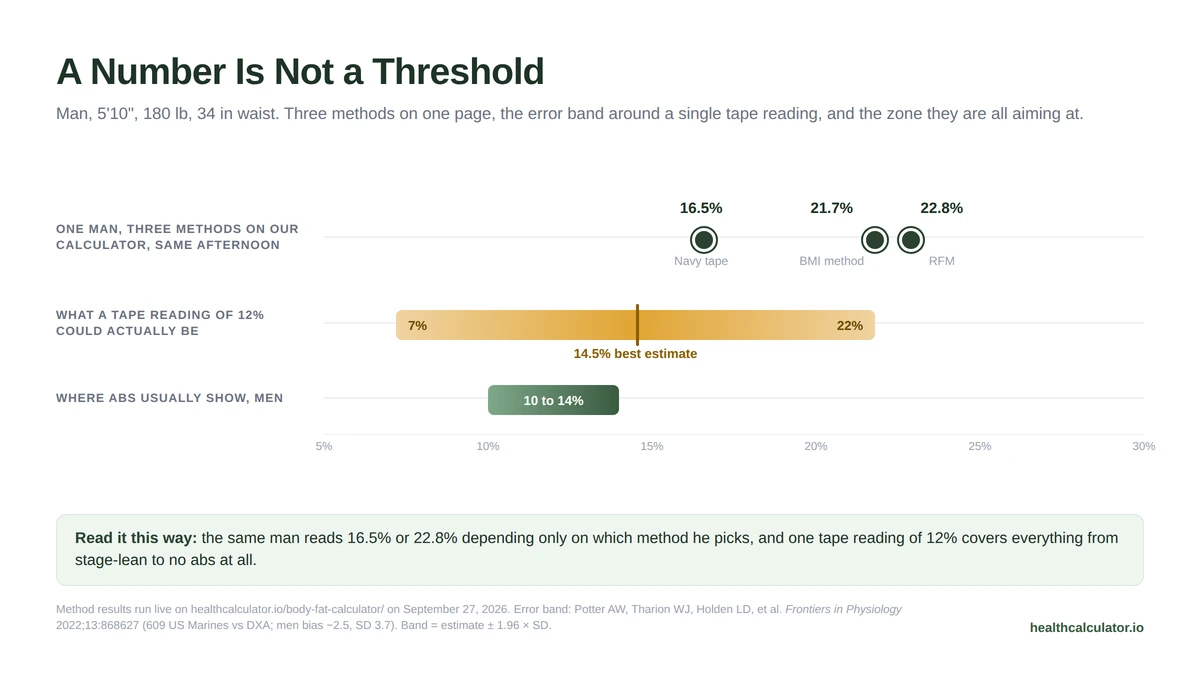
We ran one person through three methods on our own body fat calculator on September 27, 2026. A man, 5’10”, 180 pounds, age 30, waist 34 inches at the navel, neck 15.5 inches. Nothing about him changed between clicks:
| Method | Result | The label it gave him |
|---|---|---|
| U.S. Navy tape | 16.5% | Fitness |
| BMI-based (Deurenberg) | 21.7% | Acceptable |
| Relative Fat Mass | 22.8% | Acceptable |
A 6.3 point spread, and it lands on both sides of the abs threshold. At 16.5% he is closing in on an outline. At 22.8% he is nowhere near. Same man, same tape, same afternoon. For a fourth reading that reports risk rather than a fat percentage, the body roundness index uses the same waist and height.
You can repeat that yourself in about ninety seconds. That is the point.
What the tape is really telling you
Tape equations were checked against DXA in 609 U.S. Marines. The tape read men about 2.5 points low and women 1.3 to 2.3 points high, with a standard deviation near 4 points in both directions. The authors put it bluntly: the method “is not suitable for applications requiring quantitative body composition assessment.”
Run those figures forward and the arithmetic is uncomfortable:
- A man whose tape says 12% is most likely nearer 14.5%, and the 95% range around that runs from about 7% to 22%.
- A woman whose tape says 20% is most likely nearer 18%, with a range of roughly 9% to 28%.
Seven percent is competition condition. Twenty-two percent shows nothing at all. One reading covers both.
Smart scales are not the fix
Fifteen bioelectrical impedance devices, fourteen of them consumer models, were tested against a laboratory four-compartment model in 73 adults. Their body fat readings sat anywhere from 3.5 points below to 11.7 points above the reference.
But look at the second half of that study, because it is the useful half. When the same people came back twelve to sixteen weeks later, the devices tracked their change with a constant error of only −0.4 to +1.3 points.
So the scale is poor at telling you where you are and good at telling you which way you are going. Treat it that way.
Why Two People at the Same Number Look Different
Body fat percentage is a whole-body average. Abs are a local question: how thick is the subcutaneous fat sitting on top of the rectus abdominis, and how thick is the muscle underneath.
Three things move that independently of the average.
Where you store it. Female bodies tend to store fat in the gluteofemoral depot, male ones in the truncal and visceral depot. Two people at 18% can carry very different amounts of it across the stomach, and that difference is largely out of your hands.
How thick the muscle is. A trained rectus abdominis sits higher and casts a deeper shadow through the same fat layer. This is the one lever on the list you fully control, and our FFMI calculator will tell you how much muscle you are carrying for your height.
How many segments you have. The bands crossing the muscle are tendinous intersections, and they are fixed anatomy. Three pairs is the usual pattern: 52 of 54 cadavers in one dissection study, and 30 of 32 in a second. Three bands read as a six-pack, a fourth as an eight-pack, two as a four-pack. How often that extra band turns up differs from sample to sample, which is rather the point. It was settled before you ever picked up a weight.
How Many Pounds Is That, Really?
Percentages are abstract. Pounds are not. Hold lean mass steady and the math is simple: goal weight equals lean mass divided by one minus your goal.
| Starting point | Goal | Ends up at | Fat to lose |
|---|---|---|---|
| Man, 180 lb at 25% | 12% | 153 lb | 26.6 lb |
| Man, 180 lb at 20% | 12% | 164 lb | 16.4 lb |
| Man, 170 lb at 16% | 12% | 162 lb | 7.7 lb |
| Woman, 150 lb at 32% | 20% | 127 lb | 22.5 lb |
| Woman, 150 lb at 28% | 20% | 135 lb | 15.0 lb |
| Woman, 135 lb at 25% | 20% | 127 lb | 8.4 lb |
That last column is the honest version of “get abs.” For a man at 25%, it is not a six-week cut. It is around twenty-seven pounds of fat. Our body recomposition calculator will put a timeline on your own numbers, and it accounts for the muscle you add along the way, which shortens the distance.
What Actually Works, and the One Thing That Doesn’t
Crunches do not burn belly fat. A 2022 meta-analysis pooled 13 trials and 1,158 people who trained one limb and left the other alone. Across 37 comparisons, 17 favored the trained side and 20 favored the untrained side, for a pooled effect of −0.03 that went nowhere near significance. The authors’ conclusion: “there was no spot reduction”, regardless of population or program.
An earlier trial aimed the same question straight at the stomach. Forty overweight women, twelve weeks, half doing abdominal resistance training on top of their diet, fat thickness measured by ultrasound. Adding the ab work did not reduce abdominal fat compared with diet alone.
So train abs to make the muscle thicker, which really does help them show. Do not train abs to strip the fat off them. Different jobs.
Do not out-cut the research. A meta-regression of resistance training in a deficit found that lean mass gains stopped once the deficit reached about 500 calories a day. Strength held up, which is the trap: your lifts keep climbing while the muscle underneath stops growing. Stay under that line and you keep the thickness that makes abs visible in the first place.
How Lean Is Too Lean
The commonly quoted essential-fat floors, roughly 3 to 5 percent for men and 8 to 12 percent for women, come from textbooks rather than from any guideline body. Treat them as folklore with a grain of truth in it.
What is published, and recent, is the International Olympic Committee’s 2023 consensus on Relative Energy Deficiency in Sport. It defines REDs as a syndrome “caused by exposure to problematic (prolonged and/or severe) low energy availability”, and lists what gives way: energy metabolism, reproductive function, musculoskeletal health, immunity, glycogen synthesis, cardiovascular and haematological health.
One line from that statement is worth sitting with if you are chasing a number for looks. The IOC recommends body composition assessment “only for medical purposes” in athletes under 18.
Women reach that edge sooner. The same leanness that shows abs on a man can cost a woman her menstrual cycle, and that is a signal to back off, not push.
What the Top Abs Guides Say, Side by Side
We read the pages ranking for this search on September 27, 2026 and wrote down the number each one gives.
| Page | Men, clear abs | Women, clear abs | What the number rests on |
|---|---|---|---|
| Healthline | 10 to 14% | 10 to 14% | Two named personal trainers |
| BodySpec | 6 to 12% | 16 to 20% | Men’s Health UK, Healthline, its own pages |
| Arboleaf | 12 to 14% | 16 to 18% | Two study links |
| BodyScan UK | shows a man with abs at 17.6% | not given | Its own DXA scans |
| This page | 10 to 14% | 16 to 20% | The measurement studies above, each opened |
Look at the men’s column: the threshold runs from 6% to 14% depending on which of the top results you land on. The women’s column runs from 10% to 20%, a ten point spread, which is most of the usable range.
And then there is BodyScan, the only page in the set showing real scan data. Their client Dave has visible abs at 17.6% body fat. Their client Peter, at 14.4%, does not.
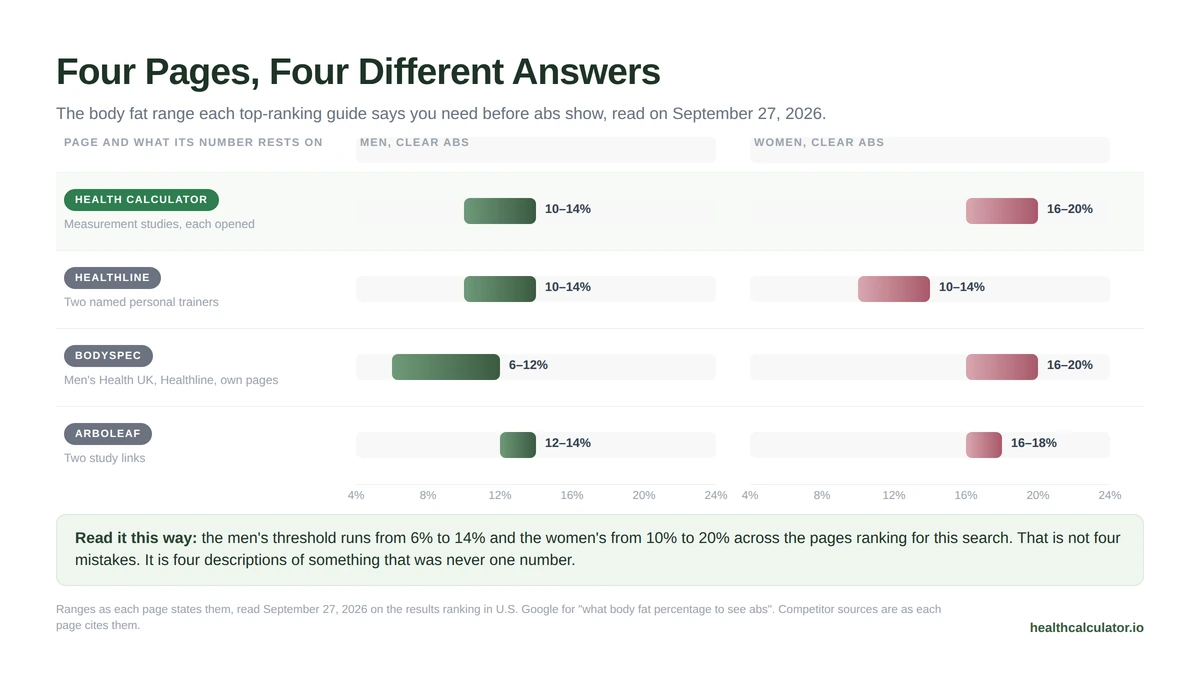
That is not four sites making mistakes. It is four sites describing something that was never a single number.
Track These Three Things Instead
- One method, forever. Pick the Navy tape or one scale and never compare across methods. The BIA study is clear that devices track change far better than they measure position.
- A tape measure at a fixed landmark. Same spot on your waist, same time of day, same breath. It moves with abdominal fat specifically, which is what you actually care about.
- A photo every four weeks. Same light, same pose, same time of day. It is the only one of the three that shows you what you are really chasing.
When the tape at your navel drops and the photo sharpens, it is working. The percentage is a label you attach afterward.
This article is for informational purposes only and does not constitute medical advice or diagnosis. Always consult a qualified healthcare professional.
Frequently Asked Questions
Most men see clear abs between 10 and 14 percent body fat, most women between 16 and 20 percent, with outlines a few points above that. The honest caveat on any answer to what body fat percentage to see abs: your own reading carries several points of error, so treat the range as a direction rather than a gate.
Usually 16 to 20 percent, with faint outlines from about 21 to 23. Women sit higher than men because they store more fat in the hips and thighs and carry more essential fat. Be careful below the mid-teens: the IOC links prolonged low energy availability to disrupted reproductive function and bone health.
Three reasons. Your fat may sit away from the midsection rather than on it. Your abdominal muscles may be thicker, so they push through the same fat layer. And one or both numbers may be wrong: tape and scale estimates routinely miss by several points, which is enough to swap the two of you.
No. A 2022 meta-analysis of 13 trials and 1,158 people found no spot reduction at all, and a 12-week trial in 40 women found that adding abdominal training to a diet did not shrink abdominal fat any faster than the diet alone. Train abs to thicken the muscle, not to strip the fat.
Poor for the absolute number, decent for the trend. Fifteen impedance devices tested against a four-compartment model read anywhere from 3.5 points low to 11.7 points high, but tracked change over three months to within about one point. Use it to see direction, not to judge whether you have hit a threshold.
It depends on where you start, and it is usually more than people expect. A 180 pound man at 25 percent needs to lose about 27 pounds of fat to reach 12 percent. The same man at 20 percent needs 16 pounds. A 150 pound woman going from 32 to 20 percent needs about 22 pounds.
For most men in the low teens and women around 20 percent, yes, holding it year round is fine if you eat enough. The risk is not the percentage itself but sustained underfueling to keep it. The IOC ties prolonged low energy availability to problems with metabolism, reproduction, bone, immunity and cardiovascular health.
Sources
Every figure on this page is drawn from peer-reviewed research or a consensus statement, each one opened and read. Last verified September 2026.
- Potter AW, Tharion WJ, Holden LD, et al. Circumference-based predictions of body fat revisited: preliminary results from a US Marine Corps body composition survey. Frontiers in Physiology. 2022;13:868627. doi:10.3389/fphys.2022.868627.
- Siedler MR, Rodriguez C, Stratton MT, et al. Assessing the reliability and cross-sectional and longitudinal validity of fifteen bioelectrical impedance analysis devices. British Journal of Nutrition. 2023;130(5):827-840. doi:10.1017/S0007114522003749.
- Boulet N, Briot A, Galitzky J, Bouloumié A. The sexual dimorphism of human adipose depots. Biomedicines. 2022;10(10):2615. doi:10.3390/biomedicines10102615.
- Anita, Haque M, Gupta A, Nasar A. Variation in tendinous intersections of rectus abdominis muscle in North Indian population with clinical implications. Journal of Clinical and Diagnostic Research. 2015;9(6):AC05-AC07. doi:10.7860/JCDR/2015/14027.6028.
- Broyles JM, Schuenke MD, Patel SR, Vail CM, Broyles HV, Dellon AL. Defining the anatomy of the tendinous intersections of the rectus abdominis muscle and their clinical implications in functional muscle neurotization. Annals of Plastic Surgery. 2018;80(2):176-179. doi:10.1097/SAP.0000000000001193.
- Ramirez-Campillo R, Andrade DC, Clemente FM, Afonso J, Pérez-Castilla A, Gentil P. A proposed model to test the hypothesis of exercise-induced localized fat reduction (spot reduction), including a systematic review with meta-analysis. Human Movement. 2022;23(3):1-14. doi:10.5114/hm.2022.110373.
- Kordi R, Dehghani S, Noormohammadpour P, Rostami M, Mansournia MA. Effect of abdominal resistance exercise on abdominal subcutaneous fat of obese women: a randomized controlled trial using ultrasound imaging assessments. Journal of Manipulative and Physiological Therapeutics. 2015;38(3):203-209. doi:10.1016/j.jmpt.2014.12.004.
- Murphy C, Koehler K. Energy deficiency impairs resistance training gains in lean mass but not strength: a meta-analysis and meta-regression. Scandinavian Journal of Medicine & Science in Sports. 2022;32(1):125-137. doi:10.1111/sms.14075.
- Mountjoy M, Ackerman KE, Bailey DM, et al. 2023 International Olympic Committee’s (IOC) consensus statement on Relative Energy Deficiency in Sport (REDs). British Journal of Sports Medicine. 2023;57(17):1073-1097. doi:10.1136/bjsports-2023-106994.