Dr. Farah Taqueer is a pediatrician based in Karachi with more than 14 years of clinical experience. She qualified with an MBBS from Liaquat University of Medical and Health Sciences and holds an MD in Pediatrics, and is registered with...
Mean Arterial Pressure (MAP) is the average pressure in your arteries across one full cardiac cycle, a single number that tells you how well your organs are being perfused. Use our free MAP calculator to get your result instantly from your systolic and diastolic blood pressure readings, along with what it means in plain English. For most healthy adults, MAP lands between 70 and 100 mmHg, a conventional clinical band anchored by a 60 mmHg minimum for organ perfusion and values above 100 mmHg being considered hypertensive.
No sign-up. No data stored. Everything runs right here in your browser.
How to Use This MAP Calculator
Using the calculator takes under 30 seconds:
Enter your systolic blood pressure: the top number from your blood pressure reading (e.g., 120).
Enter your diastolic blood pressure: the bottom number (e.g., 80).
Read your MAP result: your mean arterial pressure appears instantly in mmHg, along with your category (Normal, Low, or Elevated).
Your values are not saved or transmitted. The formula runs locally in your browser.
Tip: For the most accurate MAP calculation, use a reading taken after 5 minutes of seated rest. Avoid caffeine, smoking, or exercise in the 30 minutes before measuring.
What Is Mean Arterial Pressure and Why It Matters
What Is Mean Arterial Pressure?
Mean arterial pressure is the average pressure pushing blood through your arteries over one heartbeat. Unlike a standard blood pressure reading, which gives you two separate numbers (systolic over diastolic), MAP collapses them into a single value that reflects how well your organs are being perfused.
It is considered a better indicator of tissue and organ perfusion than systolic blood pressure alone, which is why it's used at the bedside in intensive care and emergency medicine.
A MAP Calculator provides a quick and reliable way to estimate arterial pressure using systolic (squeeze) and diastolic (resting) blood pressure values.
Your kidneys, brain, and heart all need a minimum pressure to receive oxygen-rich blood. In general, most people need a MAP of at least 60 mm Hg to ensure enough blood flow to vital organs such as the heart, brain, and kidneys (StatPearls, NCBI). A consistently low MAP risks organ damage from inadequate perfusion; a consistently high MAP forces the heart to work harder and stresses arterial walls.
Blood pressure rarely acts alone, so it helps to keep an eye on the things that push it up. Carrying extra weight is a big one, and you can check yours with our BMI calculator. Since your kidneys and blood pressure are closely linked, our GFR calculator can estimate how well your kidneys are filtering. And because dehydration nudges pressure around too, staying topped up (our water intake calculator helps) is an easy win. And because your MAP comes straight from your blood pressure reading, it helps to know what a normal blood pressure is for your age and gender.
MAP Formula: How Mean Arterial Pressure Is Calculated
MAP Formula Explained
The standard estimation formula weights diastolic pressure twice as heavily as systolic, because the heart spends about two-thirds of each cycle in diastole:
MAP = (2 × DBP + SBP) ÷ 3
This is mathematically the same as: MAP = DBP + (SBP − DBP) ÷ 3
Both forms appear in clinical references and produce the same result. The MAP calculator above runs this formula automatically the moment you enter your systolic and diastolic values.
SBP = Systolic blood pressure: the pressure in your arteries when your heart beats and pushes blood out.
DBP = Diastolic blood pressure: the pressure in your arteries when your heart rests between beats.
MAP = (2 × 60 + 90) ÷ 3 = (120 + 90) ÷ 3 = 210 ÷ 3 = 70 mmHg → Low end of normal
MAP Ranges and What They Mean
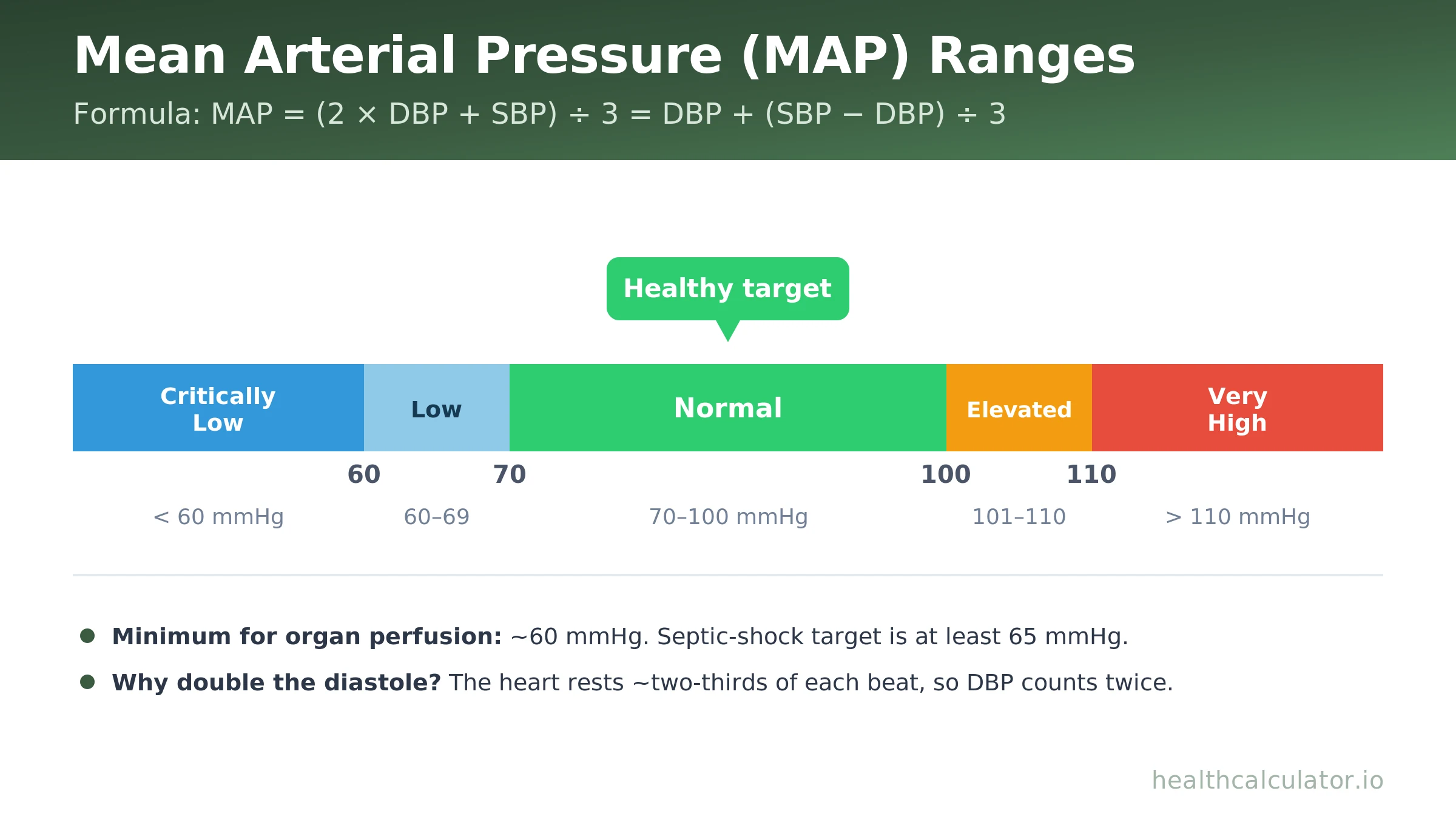
These are the commonly used adult MAP categories. They are clinical reference points, not a diagnosis.
MAP (mmHg)
Category
What it generally means
Below 60
Critically Low
May be too low to perfuse vital organs, urgent if it's a real, repeated reading
60–69
Low
Below the ideal range; often fine at rest, but worth watching
70–100
Normal
Adequate blood flow to your organs
101–110
Elevated
Above ideal; your heart and arteries are working harder
Above 110
Very High
Significant strain, get your blood pressure evaluated
MAP is a second opinion, never a first one. Because the formula counts your diastolic twice, 180/60, 170/65 and 160/70 all return a MAP of exactly 100, the top of the normal band, and all three are stage 2 hypertension. If your systolic is 140 or higher, or your diastolic is 90 or higher, you have high blood pressure whatever this number says. Why a normal MAP can hide high blood pressure →
These bands are conventional clinical reference points rather than thresholds fixed by any single guideline. The evidence-based anchors: roughly 60 mmHg as the minimum for organ perfusion, a figure MDCalc applies as well, and above 100 mmHg as potentially hypertensive. Screening reference points, not diagnostic thresholds.
MAP is commonly used to assess tissue and organ perfusion rather than diagnose hypertension. Blood pressure categories are generally determined using systolic and diastolic blood pressure measurements rather than MAP values alone.
MAP vs Blood Pressure
Although they are related, mean arterial pressure and blood pressure are not the same measurement.
Blood Pressure
Mean Arterial Pressure (MAP)
Reported as systolic and diastolic values
Reported as a single value
Used to diagnose hypertension
Used to assess organ perfusion
Example: 120/80 mmHg
Example: 93 mmHg
Measures peak and resting arterial pressure
Measures average arterial pressure throughout the cardiac cycle
Because MAP reflects average arterial pressure, clinicians often use it to determine whether vital organs are receiving enough blood flow.
Limitations of MAP: When It Can Be Misleading
MAP is an estimate when calculated from a cuff reading. The gold-standard measurement is direct, through an arterial line, not a sleeve on your arm. In the direct approach, mean arterial pressure can be calculated exactly using an arterial catheter with a transducer; the cuff-based formula is a less exact, less invasive approximation. The formula also assumes a normal resting heart rate; in tachycardia, bradycardia, or significant arrhythmia, it loses accuracy. MAP is a screening number, not a diagnosis.
Instant: your MAP appears the moment you enter systolic and diastolic values.
Standard formula: uses the weighted equation accepted in clinical practice.
Private: no account, no email, no data saved; calculation runs in your browser.
Mobile-friendly: works on any phone or desktop.
Plain-language interpretation: your number is shown alongside the standard range.
Health Risks of High and Low MAP
High MAP
A persistently elevated MAP means your arteries are under sustained stress. The 2025 AHA/ACC guideline ties uncontrolled high blood pressure to heart attack, stroke, kidney disease, and newly emphasized, cognitive decline and dementia. The underlying driver is usually chronic hypertension.
A MAP below 60 mm Hg means organs may not be getting enough oxygen-rich blood, a state clinicians call hypo-perfusion.
According to theSurviving Sepsis Campaign 2026 guidelines, clinicians commonly target an initial MAP of at least 65 mmHg in adults with septic shock, with individualized targets based on the patient's condition. That 65 mmHg floor isn't guesswork. It comes from large trials: SEPSISPAM found that aiming higher, at 80 to 85 mmHg, gave no survival benefit over a 65 to 70 mmHg target in septic shock, and the 65 Trial showed that letting MAP sit at 60 to 65 mmHg was as safe as usual care in patients over 65. Causes of low MAP outside critical care include dehydration, blood loss, heart-rhythm problems, and certain medications.
Tips for Accurate Blood Pressure Monitoring
Your MAP is only as good as the blood pressure behind it, so:
Sit quietly for about 5 minutes first, feet flat and back supported.
Skip caffeine, nicotine, and exercise for 30 minutes beforehand.
Use a properly fitted cuff at heart level.
Take a couple of readings a minute or two apart and use the average.
Measure around the same time of day for fair comparisons.
A MAP Calculator works best when blood pressure readings are accurate and measured correctly.
Medical Disclaimer
This calculator is for educational and screening purposes only and does not replace professional medical advice, diagnosis, or treatment. A single MAP reading outside the normal range is not a diagnosis, and a reading within the normal range does not rule out a condition. Always consult a qualified healthcare professional to interpret your result in the context of your full clinical picture.
Frequently Asked Questions
For most adults, a normal MAP is between 70 and 100 mmHg. A MAP of about 60 mmHg is generally considered the minimum needed to perfuse vital organs, while a MAP above 100 mmHg suggests elevated pressure and increased cardiovascular strain. MAP is a clinical reference point, not a stand-alone diagnosis.
Multiply your diastolic pressure by 2, add your systolic pressure, then divide by 3. For example, with a BP of 120/80: (2 × 80 + 120) ÷ 3 = 93.3 mmHg. An equivalent form is diastolic plus one-third of the pulse pressure (the gap between systolic and diastolic).
A MAP below 60 mmHg is generally considered too low to maintain adequate blood flow to vital organs. In sepsis and septic shock, current guidelines target an initial MAP of at least 65 mmHg, since prolonged readings below this threshold are associated with organ damage. Any reading consistently in this range warrants urgent medical evaluation.
A blood pressure reading gives you two values, systolic and diastolic, that capture the highest and lowest pressures in your arteries. MAP collapses both into a single number representing the average pressure over a full cardiac cycle. MAP is often a better indicator of how well blood is reaching your organs than systolic pressure alone.
Because your heart spends roughly two-thirds of each beat in diastole (the relaxation phase) and one-third in systole (the contraction phase). The formula reflects how long the arteries actually experience each pressure, so diastolic pressure has more influence on the average than systolic.
Not quite. A simple average of systolic and diastolic would treat both phases as equal, but they're not. MAP is a weighted average that accounts for the longer time spent in diastole, which is why the formula uses 2 × DBP rather than just adding the two and dividing by 2.
A MAP of 65 mmHg sits at the lower edge of the normal range and is used as the clinical target floor in sepsis management. For a healthy adult at rest it is generally considered acceptable, but a consistent reading at this level warrants attention, particularly if you feel lightheaded, fatigued, or unwell. Discuss any persistently low MAP with your doctor.
You should seek medical advice if your MAP is consistently below 60 mmHg or above 110 mmHg across multiple readings, or if your blood pressure reading is accompanied by symptoms such as dizziness, chest pain, shortness of breath, or severe headache. A one-time abnormal reading in isolation is less concerning than a pattern, but any result that worries you is worth discussing with a healthcare provider.
Yes, and this is MAP's biggest weakness. Because the formula counts diastolic twice, 180/60, 170/65, 160/70 and 150/75 all return a MAP of exactly 100 mmHg, the top of the normal band. All four are stage 2 hypertension under the 2025 AHA and ACC guideline. Always read your systolic and diastolic first.
Sources
Every figure on this page is drawn from government health statistics or peer-reviewed research. Last verified September 2026.