
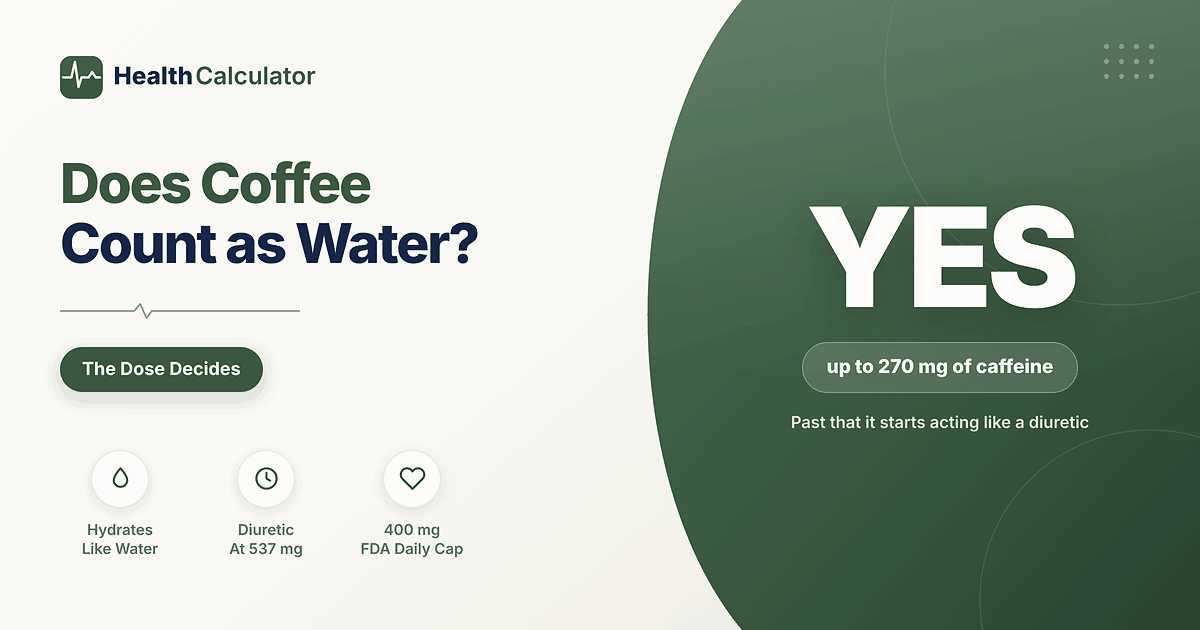
Does coffee count as water? Yes. In a randomized trial, coffee at about 270 mg of caffeine produced slightly less urine than plain water, and only at roughly 540 mg did output rise sharply. For habitual drinkers at four cups a day, total body water did not change at all.
The Trials On This Are Unusually Clear
Most hydration questions come down to weak evidence and strong opinions. Not this one.
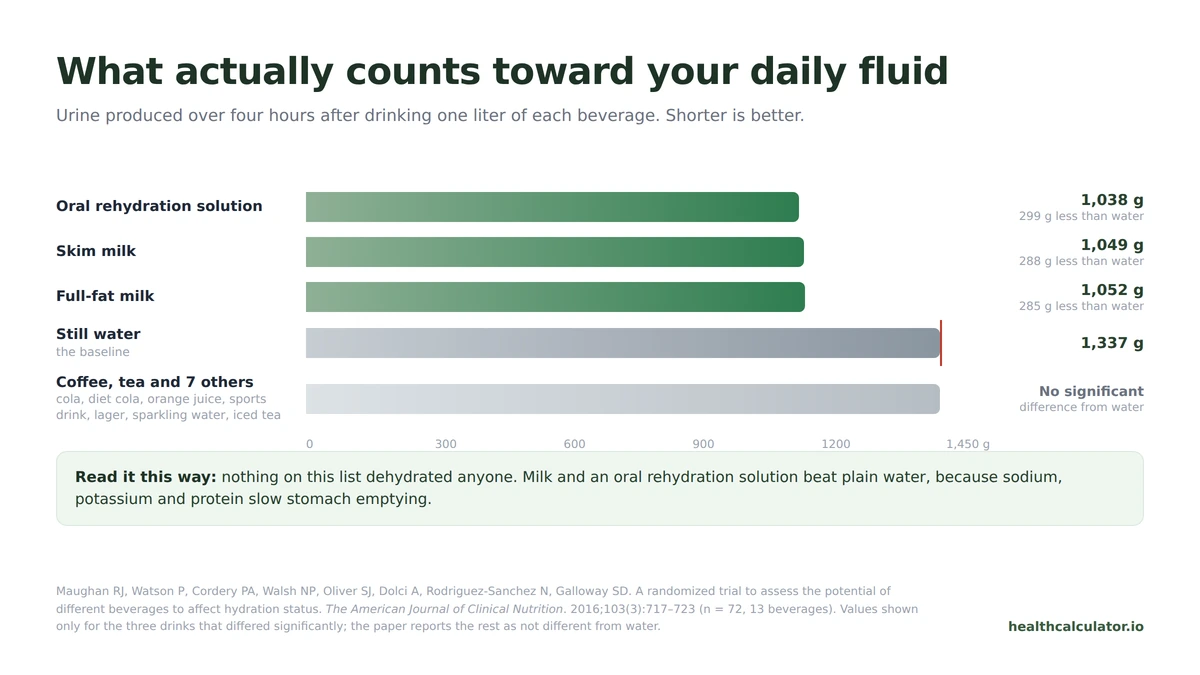
Researchers gave 72 men one liter of each of 13 different drinks and then collected every drop of urine for four hours. Coffee came out no different from still water. So did hot tea, iced tea, cola, diet cola, orange juice, a sports drink, sparkling water and lager. Two things beat water: milk and an oral rehydration solution.
A separate trial went further and measured body water directly. Fifty habitual coffee drinkers spent three days on four 200 ml cups of coffee a day, then three days on four cups of water, with a ten-day gap between. Total body water was measured with deuterium oxide, which is the reference method rather than a bathroom scale. The result: 51.5 kg on coffee, 51.4 kg on water. No difference. Twenty-four hour urine volume came in at 2,409 ml on coffee and 2,428 ml on water, so the coffee days actually produced marginally less urine.
That is about as direct an answer as nutrition research gets. Coffee counts.
The Dose Where Coffee Starts Acting Like A Diuretic
Here is the part every page on this topic skips. Caffeine really is a diuretic. It just needs a dose, and the dose is higher than your morning cup.
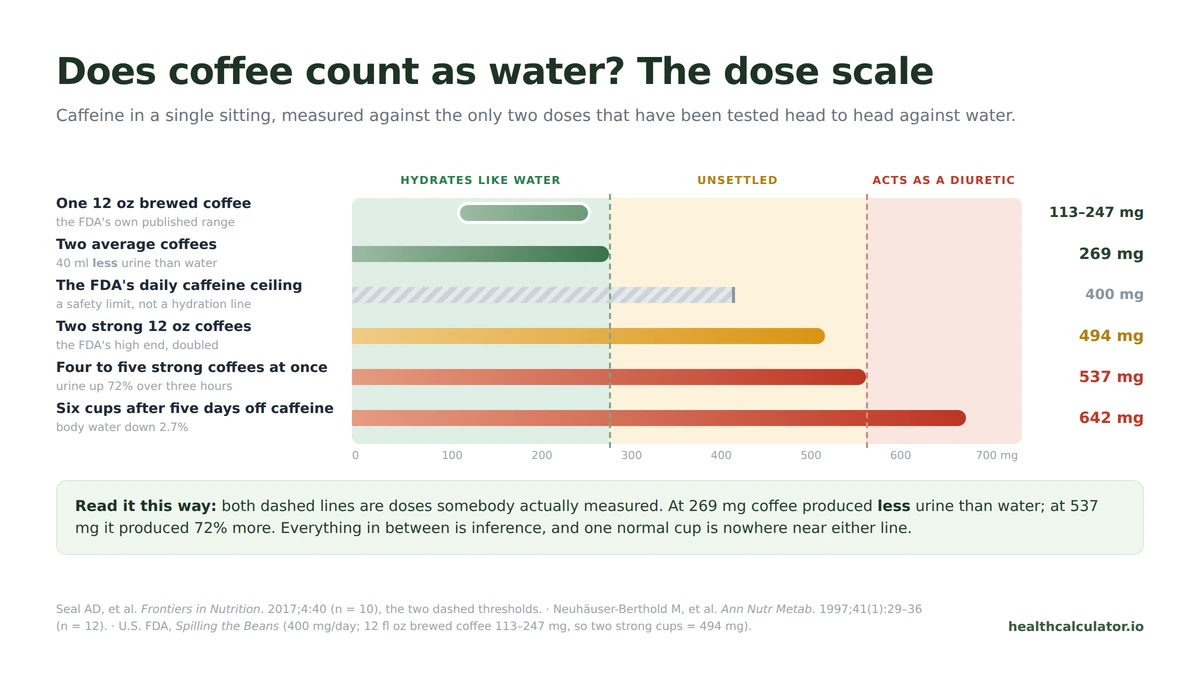
One trial settled it by testing two strengths of coffee against water in the same people. Over the three hours after drinking, urine output was 356 ml after water, 316 ml after coffee containing 269 mg of caffeine, and 613 ml after coffee containing 537 mg. The low-caffeine coffee produced 40 ml less urine than water. The high-caffeine coffee produced about 70% more.
So the switch flips somewhere between roughly 270 and 540 mg in one sitting.
| Caffeine in one sitting | Roughly | What happened to urine output | Evidence |
|---|---|---|---|
| 269 mg | 2 average coffees | 40 ml less than water over 3 hours | Seal 2017 |
| 308 mg spread over a day | 4 small cups, habitual drinkers | No change over 3 days. Body water unchanged | Killer 2014 |
| 250 to 300 mg | 2 to 3 coffees, but only after days without caffeine | Short-term rise | Maughan review 2003 |
| 537 mg | 4 to 5 strong coffees at once | 257 ml more than water over 3 hours | Seal 2017 |
| 642 mg after 5 days off caffeine | 6 cups, worst case tested | 753 ml more urine, body water down 2.7% | Neuhäuser-Berthold 1997 |
Compare rows one and three and the whole topic is in front of you. Nearly the same caffeine dose, opposite results, and the only difference is whether the drinker had caffeine in their system to begin with.
Worth being straight about one wrinkle: a meta-analysis of 16 studies covering 379 people found that caffeine dose alone did not explain the differences between studies, even though doses ranged from 114 to 741 mg. Across all of them the average extra urine was 109 ml, which is under half a cup. So treat the 270-to-540 mg window as the best single-study estimate rather than a hard physiological line.
Why Counting Cups Tells You Almost Nothing
“Two to three cups” is the advice everywhere. It is close to useless, and the FDA’s own numbers show why.
The FDA puts a 12 fl oz serving of regular brewed coffee at 113 to 247 milligrams of caffeine. That is a better than twofold spread inside the same drink description. Run the two ends:
- Two weak 12 oz coffees: 226 mg. Under every threshold in the table above.
- Two strong 12 oz coffees: 494 mg. Nearly at the dose that made urine output jump.
Same “two cups.” One is unremarkable, the other is most of the way to a genuine diuretic dose. The instant coffee in the three-day body water trial worked out at about 77 mg per 200 ml cup, which is derived by dividing its stated 308 mg mean across four cups. A large drip coffee can carry three times that.
If you want to know where you sit, the number to find is milligrams, not mugs. Most chains publish it, and the Starbucks calorie calculator puts caffeine next to calories: a grande Pike Place Roast runs 315 to 390 mg, which clears the no-effect dose in the table above without reaching the one that raised urine output.
What Changes If You Do Not Drink Coffee Regularly
Whether your body has seen caffeine recently may matter as much as the dose. The evidence here is genuinely mixed, so here is both sides of it.
The standing review of this literature concluded that a rise in urine output happens at 250 to 300 mg in people who have been off caffeine for days or weeks, that a profound tolerance develops with regular use, and that doses matching normal servings of tea, coffee and soft drinks appear to have no diuretic action at all.
The study that found real dehydration makes the point by design. Twelve volunteers gave up all methylxanthines for five days, then drank six cups of coffee delivering 642 mg in a day. Urine excretion rose by 753 ml, total body water fell by 1.1 kg, and sodium excretion rose 66%. That is a genuine effect, honestly measured. It also describes almost nobody: five days of total abstinence followed by six cups.
Two practical reads of this. If you drink coffee most days, the diuretic question is largely settled in your favor. If you are coming back after a week off and plan a big session, the first day is the one where the effect is most likely to be real.
One honest caveat, because it cuts against the tolerance story: a 2025 trial that stratified people by habitual caffeine intake found no difference in fluid retention between caffeine-naive and regular users. See the section below.
The Study Everyone Quotes Has Two Limits Worth Knowing
The three-day body water trial is the strongest evidence that coffee hydrates like water, and it is the study Mayo Clinic, Cleveland Clinic and most coffee brands are leaning on whether they cite it or not. It deserves two disclosures that almost nobody makes.
It was funded by the coffee industry. The paper states that funding came from the Institute for Scientific Information on Coffee and that the funders had no role in design, analysis or publication. The design is genuinely strong, the measurement method is the reference standard, and the finding has held up in independent work. Industry funding is a reason to read the methods, not to discard the result.
It studied men only. Women were excluded because the menstrual cycle can shift fluid balance. Which leaves the two most repeated caveats on this topic resting on thinner ground than you would guess from how confidently they get stated.
Every article tells you tolerance protects habitual drinkers, and several tell you women are more affected. Check the two best datasets and they disagree with each other:
| Question | Meta-analysis of 16 studies, 2015 | Randomized trial, September 2025 |
|---|---|---|
| Does sex change the diuretic response? | Yes. Effect size 0.75 in women vs 0.13 in men | Yes, but the opposite way. Women retained more fluid than men |
| Does habitual intake protect you? | Not tested directly | No effect. Index 0.92 in caffeine-naive vs 0.93 in regular users |
The 2025 trial gave 14 men and 14 women 280 mg of caffeine in an energy drink and stratified them by habitual intake. Habituation made no difference at all, and the sex effect ran the other direction from the meta-analysis. It tested energy drinks rather than coffee, so it is not a direct replacement, but it is the newest controlled data on both questions.
None of this overturns the headline. Coffee counts as fluid, and that finding rests on several independent trials. But if a page tells you flatly that tolerance makes you immune, or that women need to be more careful, it is picking one dataset and not mentioning the other.
Here is how the pages currently ranking for this question handle the dose question:
| Source | What it says about the diuretic dose | Studies cited on the page |
|---|---|---|
| Mayo Clinic, updated August 19, 2025 | “Balances the diuretic effect of typical caffeine levels.” No figure for typical or high. | None named |
| Cleveland Clinic health essentials | Gives only the 400 mg daily caffeine ceiling, which is a safety limit rather than a diuresis threshold | None named |
| This page | 269 mg no effect, 537 mg clear effect, 250 to 300 mg in caffeine-naive people | Seven trials and reviews, listed below |
What Else Counts Toward Your Daily Fluid
Since the same 13-drink trial measured all of them, this is answerable rather than guesswork. Urine produced over four hours after one liter of each drink, against 1,337 g for still water:
| Drink | Four-hour urine output vs water | Verdict |
|---|---|---|
| Skim milk | 1,049 g, 288 g less | Better than water |
| Full-fat milk | 1,052 g, 285 g less | Better than water |
| Oral rehydration solution | 1,038 g, 299 g less | Better than water |
| Coffee | No significant difference | Counts fully |
| Hot tea and iced tea | No significant difference | Counts fully |
| Cola and diet cola | No significant difference | Counts fully |
| Orange juice | No significant difference | Counts fully |
| Sports drink | No significant difference | Counts fully |
| Lager | No significant difference | Counts fully, at that volume |
| Sparkling water | No significant difference | Counts fully |
Milk outperforming water surprises most people. The sodium, potassium and protein slow gastric emptying and give the kidneys a reason to hold onto the fluid rather than dump it.
Tea has its own trial. Twenty-one men drank either four or six 240 ml cups of black tea, delivering 168 or 252 mg of caffeine, against matched volumes of boiled water. There were no significant differences between tea and water across any blood or urine measure.
One caveat on the lager row: that was one liter of a single lager in healthy young men at rest. It is a finding about that test, not a general endorsement of beer as a hydration strategy, and stronger drinks were not tested.
Age changes the picture too. In a trial of 12 young and 11 older men given water, fruit juice, a sports drink or low-fat milk, the older group retained more fluid in the first two hours after almost every drink, which the authors read as an age-related loss of the ability to regulate fluid balance rather than as better hydration.
Does Coffee Dehydrate You During Exercise?
Less than at rest, which is the opposite of the usual advice.
The meta-analysis split its results by condition. The diuretic effect size was 0.54 at rest and statistically clear, but 0.10 during exercise and not statistically significant. Exercise raises the hormonal signals that tell your kidneys to conserve water, and that response appears to swamp caffeine’s.
So the pre-workout coffee is not quietly draining you. Judge it on sleep, jitters and gut comfort instead. What you lose in that session is sweat, not coffee, and the sweat rate calculator measures it from a weigh-in.
Putting A Number On Your Own Day
Three things follow from all of this.
Count your coffee as fluid. All of it. Beverages supply roughly 81% of total water intake in US survey data, with food providing the other 19%, and there is no basis for excluding the caffeinated ones from your total.
Track milligrams if you drink a lot. The threshold that matters is a caffeine dose in one sitting, not a cup count, and the FDA’s 400 mg daily ceiling is a separate question about caffeine safety rather than hydration.
Then check the total against what your body actually needs, which depends on your size, activity and climate rather than on a fixed number of glasses. The water intake calculator works that out and shows the hourly pace to go with it. If you are wondering about the other end of the scale, how much water is too much covers the rate at which fluid stops helping.
MEDICAL DISCLAIMER: This article is for general information and does not replace medical advice. Caffeine affects people differently, and anyone with a heart condition, high blood pressure, a kidney problem, or who is pregnant should ask their clinician what caffeine intake is right for them rather than relying on population averages.
Frequently Asked Questions
Yes. Does coffee count as water is now a settled question: when 72 men drank a liter each of 13 different beverages, coffee produced no more urine than still water over the following four hours. Count every cup toward your daily fluid total.
Yes, and so does tea, milk, juice and soda. In US survey data, beverages supply about 81% of total water intake and food the other 19%. The eight-glasses rule has no official basis anyway, so the more useful figure is your own daily target.
Not at normal doses. Coffee containing 269 mg of caffeine produced slightly less urine than water over three hours. At 537 mg output rose about 70%. The dehydrating version of coffee is four or five strong cups at once, not your usual morning one.
Neither, at ordinary strengths. Black tea carries roughly half the caffeine of coffee per cup, and a trial giving men up to 252 mg of caffeine as tea found no difference from water on any blood or urine marker. Both count as fluid.
Yes, and milk slightly outperforms water. In the 13-beverage trial, skim and full-fat milk both produced around 285 g less urine over four hours than still water. The sodium, potassium and protein slow stomach emptying and help the body hold onto the fluid.
One liter of lager produced no more urine than water in that same trial, so at low strength and modest volume it does contribute fluid. That is a narrow finding in young men at rest. Stronger drinks and larger volumes were not tested, and alcohol has its own reasons for moderation.
You would meet your fluid needs but likely overshoot caffeine. Reaching 2.5 liters entirely through coffee means eight to ten cups, which can push past the FDA’s 400 mg daily reference point. The limit you hit first is caffeine tolerance, not hydration. Mix in water or decaf.
Judge it by caffeine in one sitting rather than cups. Below roughly 300 mg there is no measurable diuretic effect. Around 540 mg there clearly is. Since the FDA puts a 12 oz brewed coffee anywhere from 113 to 247 mg, two large strong coffees can reach that zone.
Sources
Every figure on this page is drawn from randomized trials, meta-analyses or government health guidance. Last verified September 2026.
- Maughan RJ, Watson P, Cordery PA, Walsh NP, Oliver SJ, Dolci A, Rodriguez-Sanchez N, Galloway SD. A randomized trial to assess the potential of different beverages to affect hydration status: development of a beverage hydration index. The American Journal of Clinical Nutrition. 2016;103(3):717-723. doi:10.3945/ajcn.115.114769. (n = 72; 13 beverages.)
- Killer SC, Blannin AK, Jeukendrup AE. No evidence of dehydration with moderate daily coffee intake: a counterbalanced cross-over study in a free-living population. PLOS ONE. 2014;9(1):e84154. doi:10.1371/journal.pone.0084154. (n = 50 habitual male coffee drinkers; funded by the Institute for Scientific Information on Coffee.)
- Seal AD, Bardis CN, Gavrieli A, Grigorakis P, Adams JD, Arnaoutis G, Yannakoulia M, Kavouras SA. Coffee with high but not low caffeine content augments fluid and electrolyte excretion at rest. Frontiers in Nutrition. 2017;4:40. doi:10.3389/fnut.2017.00040. (n = 10; 269 mg vs 537 mg.)
- Zhang Y, Coca A, Casa DJ, Antonio J, Green JM, Bishop PA. Caffeine and diuresis during rest and exercise: a meta-analysis. Journal of Science and Medicine in Sport. 2015;18(5):569-574. doi:10.1016/j.jsams.2014.07.017. (16 studies, 28 effect sizes, 379 adults.)
- U.S. Food and Drug Administration. Spilling the Beans: How Much Caffeine is Too Much? FDA Consumer Updates. (400 mg/day reference point; 12 fl oz brewed coffee 113–247 mg.)
- Maughan RJ, Griffin J. Caffeine ingestion and fluid balance: a review. Journal of Human Nutrition and Dietetics. 2003;16(6):411-420. doi:10.1046/j.1365-277x.2003.00477.x.
- Neuhäuser-Berthold M, Beine S, Verwied SC, Lührmann PM. Coffee consumption and total body water homeostasis as measured by fluid balance and bioelectrical impedance analysis. Annals of Nutrition and Metabolism. 1997;41(1):29-36. (n = 12; 642 mg after 5 days’ abstinence.)
- Millard-Stafford M, Hack B, Harp A, Smith E. Caffeinated energy drink formulations differentially impact hydration versus water: does habitual caffeine intake or biological sex matter? Nutrients. 2025;17(18):2913. doi:10.3390/nu17182913. (n = 28; author discloses beverage-industry funding and consulting.)
- Ruxton CHS, Hart VA. Black tea is not significantly different from water in the maintenance of normal hydration in human subjects: results from a randomised controlled trial. British Journal of Nutrition. 2011;106(4):588-595. doi:10.1017/S0007114511000456. (n = 21; 168 or 252 mg caffeine.)
- Rodriguez-Sanchez N, Galloway SDR. A randomised trial to assess fluid and electrolyte balance responses following ingestion of different beverages in young and older men. European Journal of Applied Physiology. 2023;123(10):2331-2340. doi:10.1007/s00421-023-05241-0. (12 young and 11 older men; coffee not tested.)
- National Academies of Sciences, Engineering, and Medicine. Dietary Reference Intakes for Water, Potassium, Sodium, Chloride, and Sulfate, Chapter 4: Water. National Academies Press; Food and Nutrition Board. (Beverages 81%, food 19% of total water intake.)
- Mayo Clinic Staff. Caffeine: Is it dehydrating or not? Mayo Clinic; updated August 19, 2025. (Quoted in the comparison table.)
- Cleveland Clinic. Does Coffee Really Dehydrate You? Health Essentials. (Quoted in the comparison table.)