
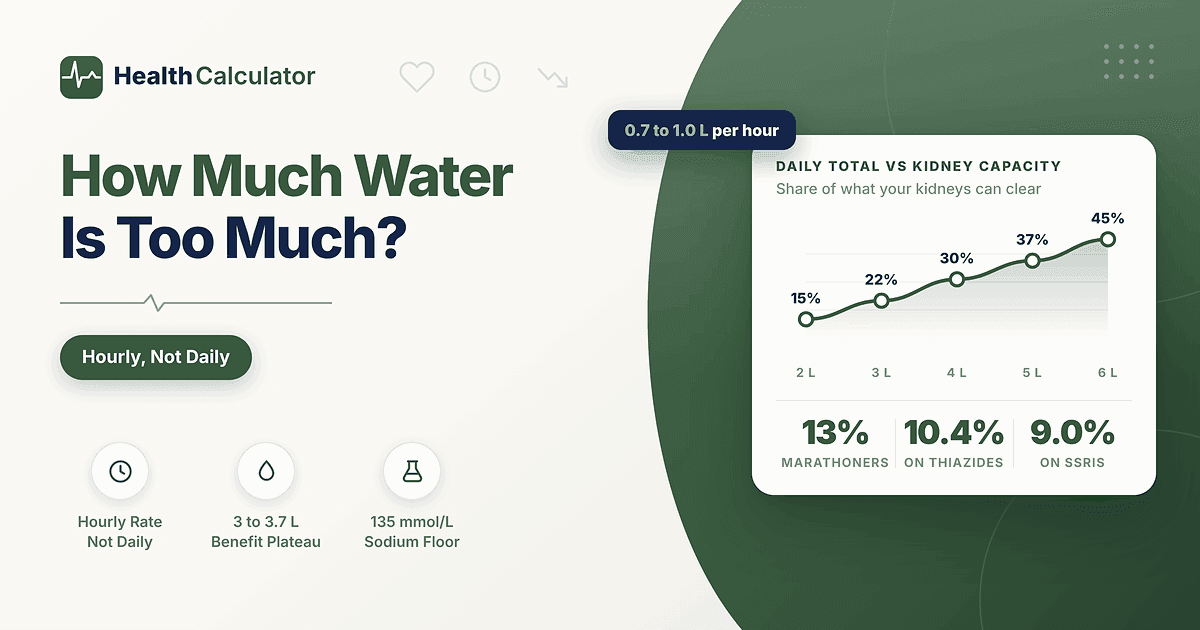
How much water is too much depends on the hour, not the day. For most healthy adults the limit is about 1 liter, or 32 oz, in a single hour, which is the fastest your kidneys can clear plain water. Drink past it hour after hour and your blood sodium falls. Daily totals matter much less.
The Number That Matters Is Per Hour, Not Per Day
Too Much Is About 1 Liter An Hour, Not A Daily Total
Your body has no storage tank. Water you drink either leaves as urine, sweat and breath, or it stays in your bloodstream and thins it out. So the real limit is a speed limit.
The National Academies put the kidney’s maximum excretion capacity at about 0.7 to 1.0 liters an hour. That is the fastest a healthy adult can get rid of plain water. Drink at that rate and you break even. Drink above it, hour after hour, and the surplus has nowhere to go except your blood.
Two things shift that ceiling, and neither is willpower. The first is what you are losing. NIOSH tells workers in heat to drink about 24 to 32 oz an hour, taken as one cup every 15 to 20 minutes, and then sets a hard line: do not drink more than 48 oz, or one and a half quarts, in an hour. That cap sits above the kidney’s clearance rate on purpose, because somebody sweating heavily is losing fluid almost as fast as they take it in. The second is sodium. Water leaves through your kidneys carrying solute with it, so if you are drinking plain water and sweating out salt, your ceiling drops.
This is why the daily framing misleads people. Four liters spread across sixteen waking hours is 250 ml an hour, somewhere between a quarter and a third of what your kidneys can clear. The same four liters in two hours is a genuine medical problem.
There Are Two Different Kinds Of Too Much
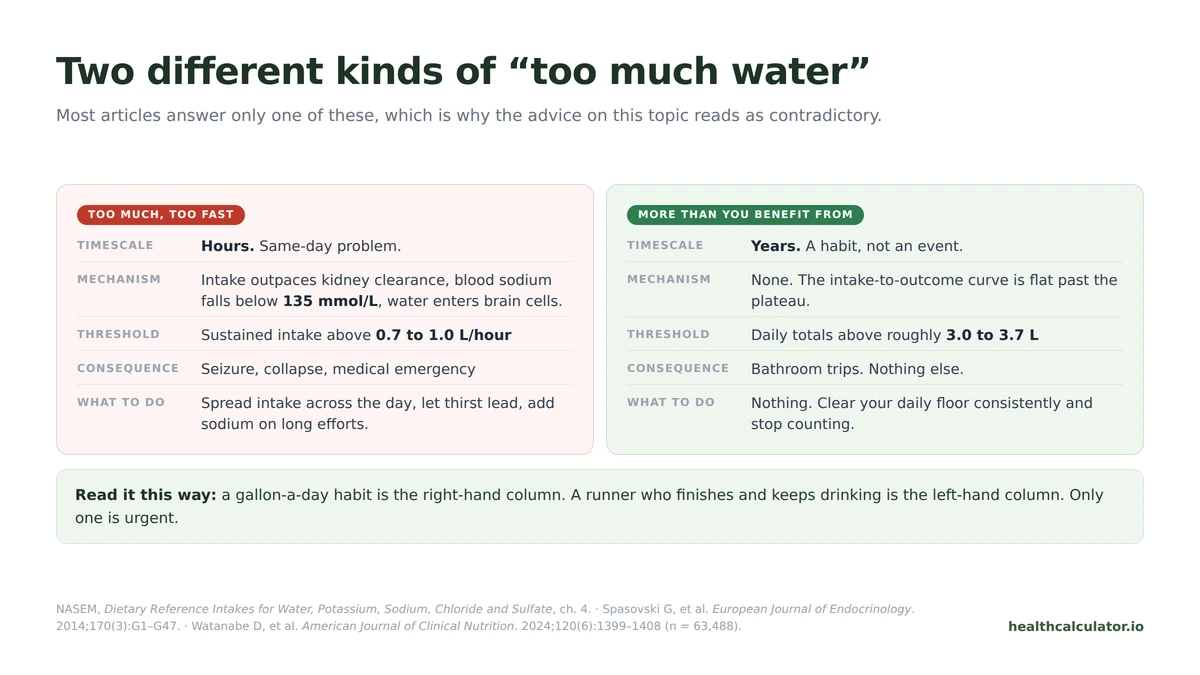
Almost every article on this topic answers only one of these, which is why the advice feels contradictory.
Too much, too fast is an acute problem measured in hours. You outpace your kidneys, your blood sodium falls, and water moves into your cells, including the cells in your brain. This one can put you in an emergency room the same afternoon.
More than you benefit from is a chronic pattern measured in years. You are nowhere near your hourly ceiling, you feel fine, and the extra water is simply doing nothing. This one costs you bathroom trips and nothing else.
Keep them apart and the whole topic gets simple. The gallon-a-day habit is almost always the second kind. The marathon runner who finishes and keeps drinking is the first.
What Too Much, Too Fast Actually Looks Like
The clinical threshold is specific. Hyponatremia is a serum sodium concentration below 135 mmol/L, and clinicians separate acute cases, meaning under 48 hours, from chronic ones, because the acute drop is what swells brain tissue.
A case published in 2026 shows how ordinary the setup can be. A 38-year-old man drank roughly 8 liters of water over three hours while waiting for a bladder flow test, then lost consciousness and had a seizure. His sodium came back at 120 mEq/L. He needed hypertonic saline and five days in hospital, and he recovered fully. Nobody in that story was doing a challenge or chasing a fitness goal. He was following an instruction to arrive with a full bladder and had no idea there was a rate involved.
Endurance sport is where this has been counted properly. Researchers drew blood from 488 finishers of the 2002 Boston Marathon and found that 13% had hyponatremia, with 0.6% in the critical range at or below 120 mmol per liter. Drinking more than 3 liters during the race was one of the associated factors, along with gaining weight while running and finishing in over four hours. Weight gain carried an odds ratio of 4.2, and a finish time past four hours carried 7.4 compared with under three and a half.
Gaining weight during exercise is the tell. If you weigh more at the end of a long run than at the start, you drank more than you lost. That is also why overconsumption of fluids, not dehydration, is the problem sports medicine has been warning distance runners about since 2001.
How To Tell If You Have Had Too Much
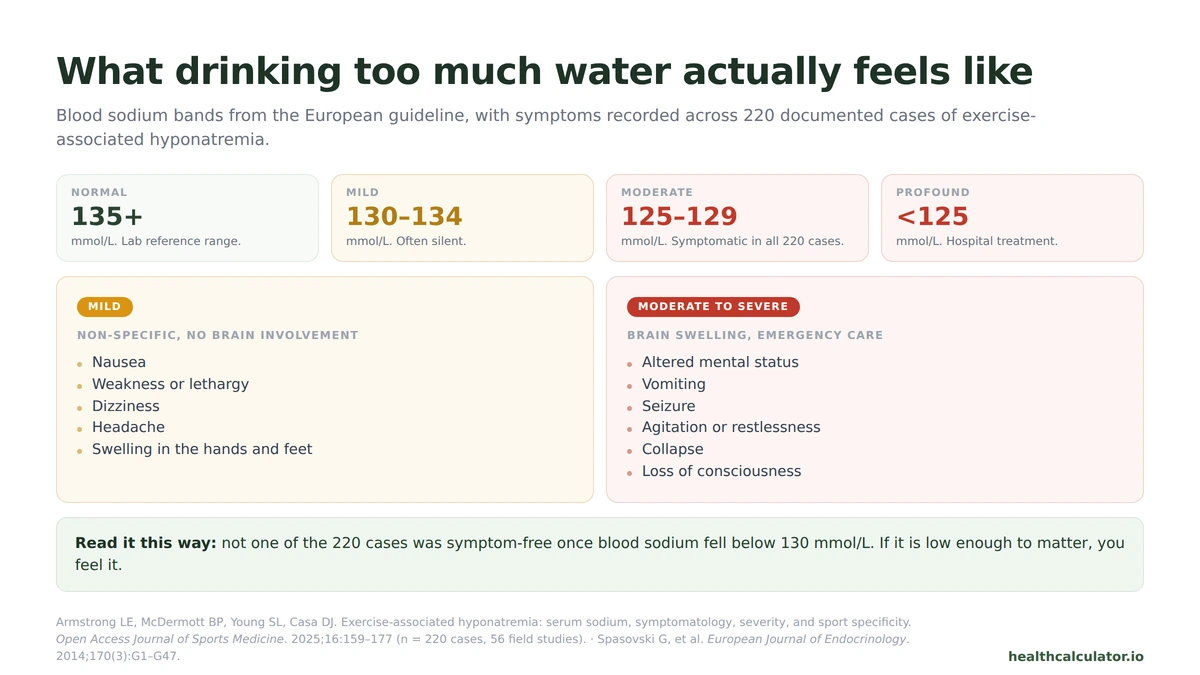
A 2025 review pooled 56 field studies and 220 documented cases of exercise-associated hyponatremia, which makes it the best symptom record available. Two findings are worth knowing.
The mild complaints were nausea, weakness or lethargy, dizziness, headache and swelling in the hands and feet. The moderate to severe ones, meaning the brain is affected, were altered mental status, vomiting, seizure, agitation, collapse and loss of consciousness.
And not one of the 220 cases was symptom-free once sodium fell below 130 mmol/L. That cuts both ways, and both directions are useful. If your sodium is genuinely low enough to matter, you will feel it. And if you feel fine after a big drinking day, you are almost certainly fine.
Here is where those numbers sit against the clinical bands, which the European guideline defines by measurement rather than by how you feel:
| Blood sodium | Guideline label | What it means in practice |
|---|---|---|
| 135 mmol/L and above | Normal | The reference range in most labs |
| 130 to 134 mmol/L | Mild | Often silent, and usually found by accident on a routine blood test |
| 125 to 129 mmol/L | Moderate | Every documented exercise case at this level or lower had symptoms |
| Below 125 mmol/L | Profound | Brain swelling risk. Treated in hospital |
Worth knowing why the guideline says “profound” instead of “severe” for the low numbers: it reserves “severe” for symptoms, because the reading and the presentation do not track each other reliably. The 2025 review says the same thing in the other direction, that the sodium value on its own is not a dependable index of how sick someone is. Which is exactly why this is a blood test and a clinical judgment, not something to estimate at home.
What you cannot do is read your sodium from the toilet bowl. Pale or clear urine tells you that you are drinking more than you need right now, not that your blood is dangerously dilute. The two often go together, but only one of them is an emergency, and only a blood test separates them. If someone is confused, vomiting or unsteady after drinking heavily, that is a call for emergency care, not a wait-and-see.
Is 4 Liters A Day Too Much? Is 5?
For a healthy adult with working kidneys, spreading either amount across a normal day is not dangerous. It is usually just more than you need.
| Daily intake | Spread over 16 waking hours | Share of kidney capacity | Verdict for a healthy adult |
|---|---|---|---|
| 2 L | 125 ml per hour | About 15% | Comfortable for most sedentary adults |
| 3 L | 188 ml per hour | About 22% | Typical for an active adult in a warm climate |
| 4 L | 250 ml per hour | About 30% | Safe, and more than most people need |
| 5 L | 313 ml per hour | About 37% | Safe on paper, but worth asking why |
| 6 L | 375 ml per hour | About 45% | Above this, replace electrolytes, not just water |
| 4 L in 4 hours | 1,000 ml per hour | 100% or more | Risky, even for a healthy adult |
Percentages use 850 ml an hour, the midpoint of the NASEM range, so you can reproduce every row.
The bottom row is the point. The same daily number is fine or dangerous depending entirely on the clock.
Two caveats change this. A steady intake above about 6 liters a day means you are excreting a large amount of solute along with the water, so sodium and potassium need to come from food or an electrolyte drink. And any of these numbers is wrong for you if your kidneys or heart are not working normally, which is the next section.
For your own figure rather than a generic one, the Water Intake Calculator applies your weight, age, activity and climate and shows the hourly pace that goes with the total.
Who Is Actually At Risk, And It Is Not Gym-Goers
This is the part most pages skip, and it is the part that matters clinically. Low blood sodium is a feature of 15 to 20% of emergency hospital admissions and occurs in up to 30% of hospitalized patients. Almost none of those cases are healthy people who drank too much water.
The real risk sits in four groups:
- People whose kidneys cannot excrete a water load. Chronic kidney disease, heart failure and liver disease all reduce free water clearance, which pulls the hourly ceiling down without any warning sign.
- People on medications that hold on to water or waste sodium. Thiazide diuretics and SSRI antidepressants are the two best documented. Across 1.25 million older Medicare patients, hyponatremia was present in 10.4% of thiazide users and 9.0% of SSRI users, rising to about 13% in people taking both. That is a far bigger group than every marathon field in the world combined.
- People with SIADH or primary polydipsia. Here the drinking drive or the hormone signal is the disorder, and the water is the symptom.
- Endurance athletes over four hours. The Boston data is clear that slower finishers, not faster ones, carry the risk, because they have more hours in which to overdrink.
Older adults sit awkwardly across several of these at once. They are the group most often told to drink more, they are the likeliest to be on a thiazide or an SSRI, and their minimum daily requirement is a clinical floor rather than a target to beat. Drinking to the floor is the goal. Drinking past it is not safer.
If a blood test has already flagged low sodium, the reading itself needs context before it means anything, which is what a corrected sodium calculation is for.
Why Every Page Gives You A Different Hourly Number
Search this question and you will get four different limits in the first four results. They are not all wrong. They are measuring different things, and none of the pages says which.
| Source | The number given | What it is actually measuring |
|---|---|---|
| National Academies (NASEM) | 0.7 to 1.0 L per hour | Maximum kidney excretion capacity. A physiological ceiling, not a recommendation. NASEM sets no upper limit for water intake. |
| NIOSH worker heat guidance | Do not exceed 48 oz per hour | An operational cap for people sweating hard, who are losing fluid nearly as fast as they drink it. |
| NIOSH working range | 24 to 32 oz per hour | The target during heavy work in heat, as one cup every 15 to 20 minutes. |
| Cleveland Clinic | Over 32 oz per hour is probably too much | A rounded reading of the same physiology. No study or guideline is cited on the page. |
| Hospital blog posts | About 1 L per hour | Usually stated as a kidney processing rate with no source attached. It happens to sit at the top of the NASEM range. |
| Exercise-associated hyponatremia consensus panel | No number at all | Seventeen experts across nine specialties, and they deliberately decline to set a rate. |
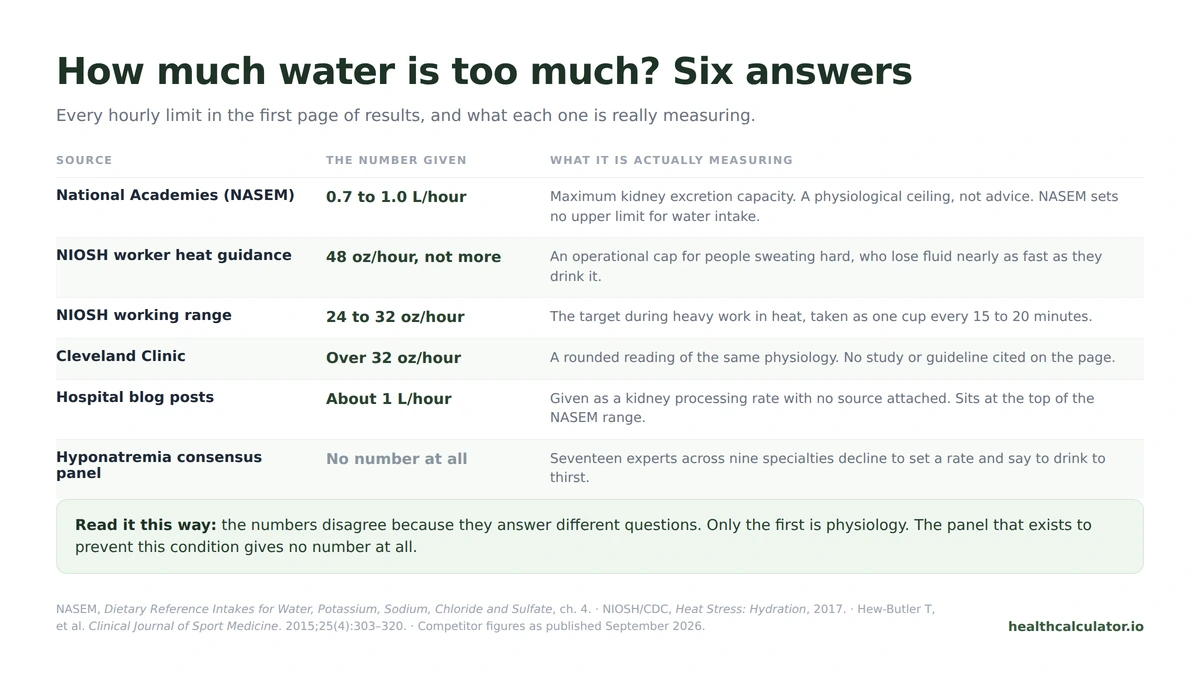
That last row is the most useful line in the table. The panel that exists specifically to prevent this condition concluded that the safest strategy is to drink palatable fluids when thirsty, and that drinking to thirst prevents both dilutional hyponatremia and meaningful dehydration in most cases. They gave no milliliters per hour because the right rate depends on a sweat rate that varies from roughly 0.3 to 2.4 liters an hour between individuals. The same goes for how much water a body actually uses in a day. Across 5,604 people in 23 countries, daily water turnover tracked age, body size and composition, activity, athletic status, pregnancy and climate. There is no single correct rate because there is no single body.
So if you want one instruction that holds up against every source above: drink when you are thirsty, and do not follow a fixed schedule that overrides it.
The Other Ceiling: More Than You Benefit From
Past a point, extra water stops buying anything. That shows up in three places.
Large cohort studies now describe the intake to mortality relationship as L-shaped rather than linear. Risk falls sharply as you move away from a genuine shortfall, then flattens, and in 63,488 Japanese adults the flat part began around 3,000 to 3,700 ml a day depending on sex. A 2026 analysis of 9,332 US adults found the same shape for chronic kidney disease. Closing a real deficit helped. Overshooting did not.
Blood sodium itself behaves the same way. Following 11,255 adults for 25 years, the lowest-risk band was 138 to 142 mmol/L, with risk rising at both ends rather than only the high one.
Trial evidence points the same way. A 2024 review of randomized trials found that increased water intake has real, specific benefits, most clearly for recurrent kidney stones and repeat urinary tract infections, and thin or absent evidence for most of the general claims made about it. More water is a treatment for a few defined problems, not a dose-dependent upgrade to everything.
Which is the honest summary of the whole topic. There is a floor worth clearing every day, a plateau where extra water does nothing, and a rate above which it becomes a problem. Nearly everyone reading this is somewhere in the middle.
What To Do Instead Of Watching A Number
Three habits cover it.
Spread it out. The same volume that is a problem in two hours is unremarkable across a day, so the useful figure is your intake per waking hour rather than your daily total.
Let thirst lead, especially during exercise. If you are going long, weigh yourself before and after. Losing a little is normal. Gaining is the signal to drink less next time. The sweat rate calculator turns those two weights into an hourly figure.
Add sodium when the volume is genuinely high or the session is genuinely long. Plain water in large amounts is the version of this that causes trouble.
If you want a starting figure built from your own body and climate instead of a rule of thumb, run it through the water intake calculator and use the hourly pace it gives you rather than the daily total.
MEDICAL DISCLAIMER: This guide is for general information and does not replace medical advice. Blood sodium can only be measured with a laboratory test, and low sodium has many causes other than drinking water. If you take diuretics or antidepressants, or you have kidney, heart or liver disease, ask your clinician what fluid intake is right for you before changing it.
Frequently Asked Questions
For a healthy adult, no daily total is automatically too much. How much water is too much is set by the rate: healthy kidneys clear about 0.7 to 1.0 liters an hour, so 4 liters across a day is unremarkable while 4 liters in four hours is not. Past roughly 6 liters a day, replace electrolytes too.
For most healthy adults, yes, although it is more than you need. Spread over 16 waking hours it works out to about 313 ml an hour, roughly 37% of your kidneys’ clearance capacity. It stops being safe if you have kidney, heart or liver disease, or if you drink most of it in one or two sittings.
Early signs are nausea, headache, dizziness, weakness and puffy hands or feet. A 2025 review of 220 documented cases found none were symptom-free once blood sodium fell below 130 mmol/L. Confusion, vomiting or a seizure after heavy drinking needs emergency care. Clear urine on its own means nothing.
In rare cases, yes. Severe dilution of blood sodium makes brain tissue swell, and that can be fatal. It is a medical emergency treated in hospital with controlled correction of sodium, not something to manage at home. If someone who has been drinking heavily becomes confused, vomits or has a seizure, call emergency services.
The limit is set by body size and kidney function, not by sex. Women make up a larger share of recorded cases, mostly because a smaller body means the same volume dilutes a smaller blood pool. The Boston Marathon analysis found sex was not an independent risk factor once weight gain and finish time were accounted for.
It means you are drinking more than you currently need, not that you are in danger. Urine color tracks how dilute your urine is, not how dilute your blood is, and no single urine or blood sample reliably captures hydration status on its own. Pale yellow is a reasonable target. Persistently clear just means you can ease off.
Enough to make you gain weight during the session. Drinking more than 3 liters during a marathon was one of the factors associated with hyponatremia in Boston finishers, and the consensus panel’s advice is to drink palatable fluid when thirsty rather than to a schedule. Weigh in before and after long efforts.
Stop drinking for a few hours and eat a normal meal, which contains sodium. Mild dilution corrects itself as your kidneys catch up. If there is confusion, vomiting, a seizure or a worsening headache, treat it as urgent and get emergency care, because correcting sodium safely has to be done under supervision.
Sources
Every figure on this page is drawn from government health guidance, clinical guidelines or peer-reviewed research. Last verified September 2026.
- National Academies of Sciences, Engineering, and Medicine. Dietary Reference Intakes for Water, Potassium, Sodium, Chloride, and Sulfate, Chapter 4: Water. National Academies Press; Food and Nutrition Board. (Maximum renal excretion 0.7–1.0 L/hour; no Tolerable Upper Intake Level set for water.)
- National Institute for Occupational Safety and Health. Heat Stress: Hydration. Centers for Disease Control and Prevention; 2017. (“Do not drink more than 48 oz (1½ quarts) per hour”; working range 24–32 oz per hour.)
- Spasovski G, Vanholder R, Allolio B, et al. Clinical practice guideline on diagnosis and treatment of hyponatraemia. European Journal of Endocrinology. 2014;170(3):G1-G47. doi:10.1530/EJE-13-1020.
- Almond CSD, Shin AY, Fortescue EB, et al. Hyponatremia among runners in the Boston Marathon. New England Journal of Medicine. 2005;352(15):1550-1556. doi:10.1056/NEJMoa043901. (n = 488 finishers; 13% hyponatremic.)
- Armstrong LE, McDermott BP, Young SL, Casa DJ. Exercise-associated hyponatremia: serum sodium, symptomatology, severity, and sport specificity. Open Access Journal of Sports Medicine. 2025;16:159-177. doi:10.2147/OAJSM.S556848. (220 cases across 56 field studies.)
- Hew-Butler T, Loi V, Pani A, Rosner MH, et al. Statement of the Third International Exercise-Associated Hyponatremia Consensus Development Conference, Carlsbad, California, 2015. Clinical Journal of Sport Medicine. 2015;25(4):303-320. doi:10.1097/JSM.0000000000000221.
- Sharma A, Bhattarai A, Shrestha S, et al. Acute water intoxication leading to dilutional hyponatremia in a patient with urinary tract infection: a case report. Cureus. 2026;18(3):e106185. doi:10.7759/cureus.106185.
- American College of Sports Medicine; Sawka MN, Burke LM, Eichner ER, Maughan RJ, Montain SJ, Stachenfeld NS. American College of Sports Medicine position stand. Exercise and fluid replacement. Medicine & Science in Sports & Exercise. 2007;39(2):377-390. doi:10.1249/mss.0b013e31802ca597.
- Noakes TD. Overconsumption of fluids by athletes. South African Medical Journal. 2001;91(10):852-857.
- Watanabe D, Nanri A, Yoshida K, et al. Water turnover and all-cause mortality: a prospective cohort study. American Journal of Clinical Nutrition. 2024;120(6):1399-1408. (n = 63,488; median follow-up 19.4 years.)
- Inoue Y, Watanabe D, Kimura M, et al. Water deficit and chronic kidney disease in US adults. British Journal of Nutrition. 2026;135(1):108-119. (NHANES, n = 9,332.)
- Dmitrieva NI, Gagarin A, Liu D, Wu CO, Boehm M. Middle-age high normal serum sodium as a risk factor for accelerated biological aging, chronic diseases and premature mortality. eBioMedicine. 2023;87:104404. doi:10.1016/j.ebiom.2022.104404. (ARIC cohort, n = 11,255, 25-year follow-up.)
- Hakam N, Guzman Fuentes JL, Nabavizadeh B, et al. Outcomes in randomized clinical trials testing changes in daily water intake: a systematic review. JAMA Network Open. 2024;7(11):e2447621. doi:10.1001/jamanetworkopen.2024.47621.
- Yamada Y, Zhang X, Henderson MET, et al. Variation in human water turnover associated with environmental and lifestyle factors. Science. 2022;378(6622):909-915. doi:10.1126/science.abm8668. (n = 5,604 across 23 countries.)
- Volkert D, Beck AM, Cederholm T, et al. ESPEN practical guideline: clinical nutrition and hydration in geriatrics. Clinical Nutrition. 2022;41(4):958-989. (Recommendation 61: minimum daily drink intake for older adults.)
- Matsuura T, Tawfik AG, Ben-Umeh KC, Hansten PD, Malone DC. Evaluation of hyponatremia among older adults exposed to selective serotonin reuptake inhibitors and thiazide diuretics. Pharmacotherapy. 2025;45(3):169-176. doi:10.1002/phar.70004. (Medicare 2017–2019; n = 551,298 SSRI users and 701,007 thiazide users.)
- Armstrong LE. Assessing hydration status: the elusive gold standard. Journal of the American College of Nutrition. 2007;26(5 Suppl):575S-584S.