Dr. Farah Taqueer is a pediatrician based in Karachi with more than 14 years of clinical experience. She qualified with an MBBS from Liaquat University of Medical and Health Sciences and holds an MD in Pediatrics, and is registered with...
Low albumin drags your total calcium reading down even when the calcium your body actually uses is perfectly normal. This calculator applies the Payne formula to give you back an albumin-adjusted number in mg/dL or mmol/L. It also tells you something most calculators leave out: a 2025 study of 22,658 patients found this correction is least trustworthy in exactly the patients it was built for.
Enter your two lab values in the calculator and you will have your answer in a second. Then read on, because the number alone will not tell you whether to trust it.
What Corrected Calcium Actually Measures
Corrected calcium (also written as adjusted calcium or corrected Ca) is an estimate of what your total blood calcium would read if your albumin were normal. It is a calculation, not a lab test. Nobody draws a tube of "corrected calcium."
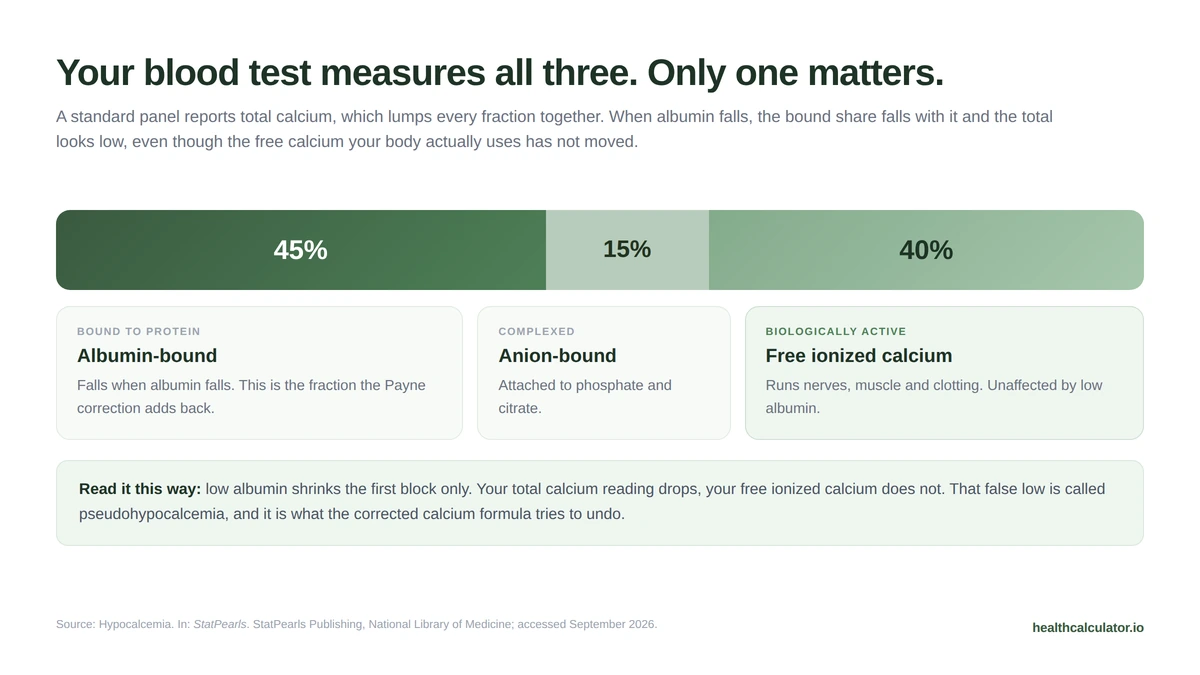
Calcium travels in your blood in three states. Around 45% is bound to plasma proteins, mostly albumin, roughly 15% is attached to small anions like phosphate and citrate, and about 40% floats free as ionized calcium. Only that free ionized fraction does biological work: nerve signalling, muscle contraction, clotting, bone turnover.
Here is the catch. A standard calcium panel measures total calcium, which lumps all three fractions together. So when albumin drops, the protein-bound share drops with it and total calcium falls, even though the ionized calcium your cells depend on has not moved at all. That false low reading is called pseudohypocalcemia, and it is common. Among 9,428 hospital patients, 42.9% had mild and 9.6% had marked hypoalbuminemia at admission alone.
Why albumin matters so much here
Albumin is the taxi. Calcium is the passenger. Fewer taxis on the road means fewer passengers counted at the terminal, but it says nothing about how many passengers are walking around freely.
Normal serum albumin runs 35 to 50 g/L, which is 3.5 to 5.0 g/dL. Below that, liver disease, nephrotic syndrome, malnutrition, burns, sepsis and long hospital stays are the usual suspects. Inflammation is the most common driver of all, which is why eating more protein rarely moves the number. Our guide to what low albumin actually means covers the causes, what the mortality data really shows, and why age changes the answer.
Worked example, with the exact numbers this tool returns
Say your panel comes back with total calcium 8.2 mg/dL and albumin 2.8 g/dL. Your report flags the calcium as low.
How far below 4.0 is the albumin? 4.0 − 2.8 = 1.2 g/dL
Multiply by 0.8: 1.2 × 0.8 = 0.96 mg/dL of correction
Add it back: 8.2 + 0.96 = 9.16 mg/dL
That moves you from "low" into the normal band. Switch the calculator to mmol/L and enter 2.046 mmol/L calcium with 28 g/L albumin, and you get 2.286 mmol/L, which converts back to the same 9.16 mg/dL. The two modes agree to the decimal, which is not true of every tool on this topic.
There are two Payne formulas, and they disagree
This is the part almost nobody explains, and it is the reason two "corrected calcium" calculators can hand you two different answers for the same blood test.
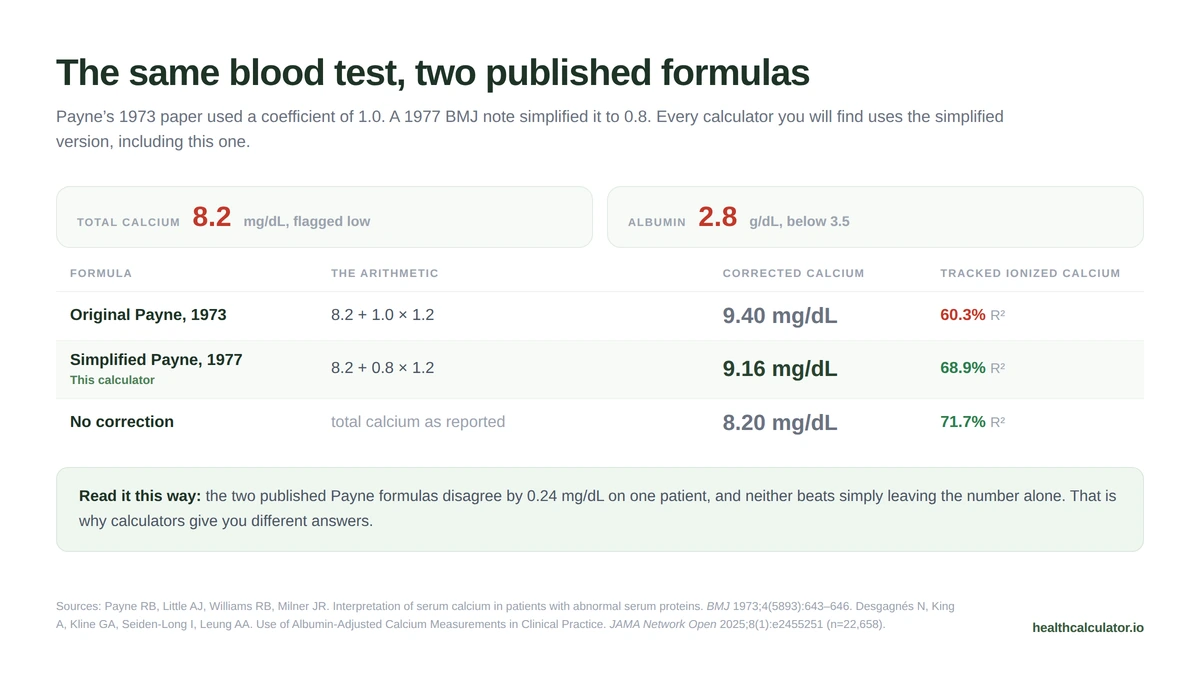
Payne's 1973 paper used a coefficient of 1.0. A 1977 BMJ note simplified it to 0.8, and that rounder version is the one clinicians actually use. The JAMA Network Open team tested both against directly measured ionized calcium in 22,658 people and scored them separately:
Version
The actual equation
How well it tracked ionized calcium (R²)
Original Payne (1973)
total calcium − albumin + 4 (both in conventional units), so a coefficient of 1.0
60.3%
Simplified Payne (1977)
Ca + 0.8 × (4.0 − albumin g/dL), or Ca + 0.02 × (40 − albumin g/L)
68.9%
No correction at all
total calcium exactly as the lab reported it
71.7%
James formula
a coefficient derived locally in the Calgary Health Region
76.7%
Run our earlier patient through both. Total calcium 8.2 mg/dL, albumin 2.8 g/dL. The original gives 8.2 + 1.0 × 1.2 = 9.40 mg/dL. The simplified gives 8.2 + 0.8 × 1.2 = 9.16 mg/dL. Same blood test, two published formulas, a 0.24 mg/dL gap. That is why calculators disagree.
This calculator uses the simplified Payne formula in both unit modes. That is the version MDCalc, Perinatology and Omni Calculator use, and it is the better performing of the two Payne variants. We are not going to pretend it beats leaving the number alone, because the data says it does not.
Corrected Calcium Ranges and What They Mean
Corrected calcium
mmol/L
Category
What it usually means
Below 8.5 mg/dL
Below 2.12
Hypocalcemia
Tingling around the mouth or fingers, cramps, muscle twitching
8.5 to 10.2 mg/dL
2.12 to 2.55
Normal
Nothing to act on from this number alone
10.5 to 11.9 mg/dL
2.62 to 2.98
Mild hypercalcemia
Often silent, picked up on routine bloods
12.0 to 13.9 mg/dL
3.00 to 3.47
Moderate hypercalcemia
Thirst, frequent urination, constipation, fatigue
14.0 mg/dL and above
3.50 and above
Hypercalcemic crisis
Confusion, vomiting, arrhythmia risk, needs urgent care
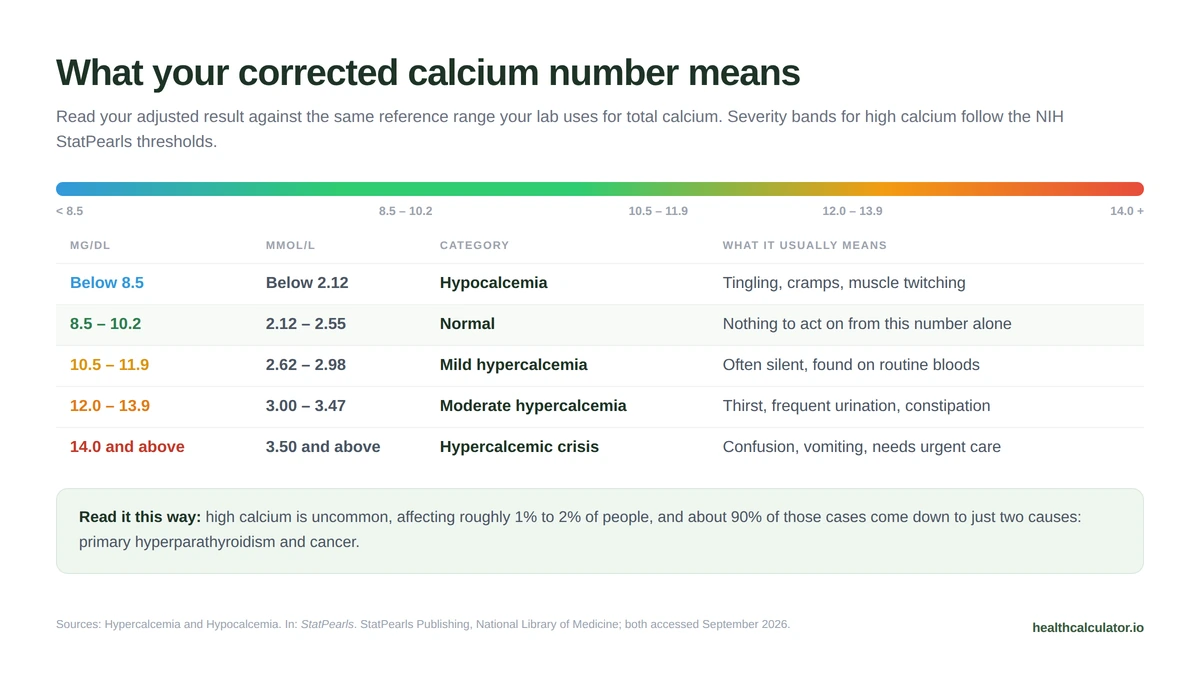
Severity bands follow the NIH StatPearls hypercalcemia thresholds. Hypercalcemia affects roughly 1% to 2% of the general population, and about 90% of cases trace back to just two causes: primary hyperparathyroidism and cancer.
When This Formula Is Reliable, and When It Stops Being
This is the section you came for even if you did not know it. Here is an honest reliability rule, built from the two largest studies that tested the formula against directly measured ionized calcium.
Your situation
How much to trust the corrected number
What to do
Albumin 3.0 g/dL or higher (30 g/L+), outpatient, stable
Reasonable as a cross-check
Use it alongside the raw total calcium, not instead of it
Albumin below 3.0 g/dL (under 30 g/L)
Low
Treat it as a prompt to ask for an ionized calcium, not as an answer
Critically ill or in ICU
Very low
Ask for ionized calcium directly
Chronic kidney disease or on dialysis
Very low
Nephrology guidance and ionized calcium
Pregnancy
Uncertain
Reference ranges shift by trimester, so interpret with your clinician
The hypoalbuminemia paradox
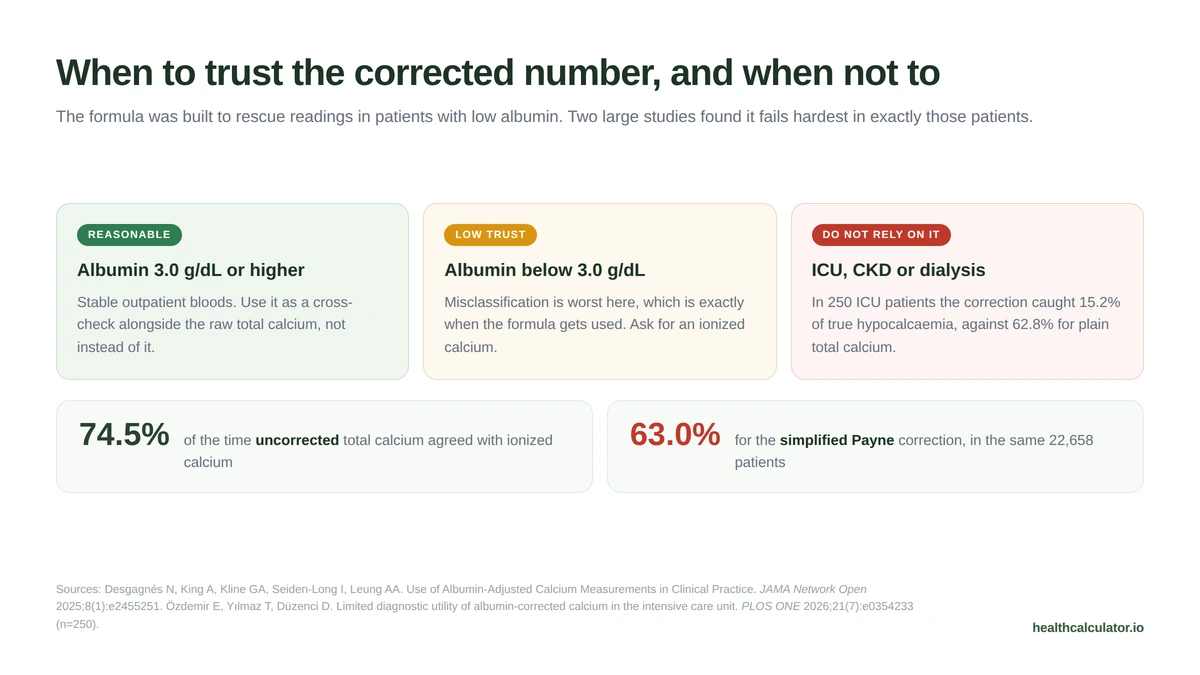
The formula was invented to rescue readings in patients with low albumin. The JAMA analysis found it fails hardest in exactly those patients. Misclassification with the adjustment formulas was worse when albumin fell below 30 g/L, which is precisely when clinicians reach for it.
The mechanism is not mysterious. Payne's correction assumes calcium binds albumin at a fixed ratio. In reality the calcium-to-albumin binding ratio rises as albumin falls, so a fixed 0.8 coefficient systematically over-corrects the wrong way.
The numbers are stark. Using the original Payne formula, 30.3% of patients with genuine hypocalcemia were reclassified as normal. Leaving the calcium uncorrected got that wrong only 15.3% of the time. In a 2026 ICU study of 250 patients, Payne-corrected calcium identified only 15.2% of truly hypocalcaemic patients compared with 62.8% for plain total calcium.
Half of the people this formula is meant to help are being told their calcium is fine when it is not.
The albumin assay problem nobody puts on a calculator page
Here is a second failure point, and this one is invisible on your lab report.
Labs measure albumin with one of two dyes: bromocresol green (BCG) or bromocresol purple (BCP). They do not agree. Across 165 samples, BCG read 6.4 g/L higher than BCP on average, and the gap widened as albumin fell.
That matters because the correction is driven entirely by the albumin number. If your albumin is reported too high, you get too little correction. Work it through:
Albumin status
BCG reads higher by
Albumin overstated by
Correction you never receive
Normal
3.07 g/L
0.31 g/dL
0.25 mg/dL
Mild hypoalbuminemia
6.33 g/L
0.63 g/dL
0.51 mg/dL
Moderate
7.50 g/L
0.75 g/dL
0.60 mg/dL
Severe
9.92 g/L
0.99 g/dL
0.79 mg/dL
In severe hypoalbuminemia, the dye your lab happens to use can shift your corrected calcium by nearly 0.8 mg/dL. That is the entire width of the gap between "borderline low" and "solidly normal," decided by a reagent choice printed nowhere on your report. If your result sits near a decision threshold, it is fair to ask your lab which albumin method they run.
Calcium is not the only value this affects. The anion gap is corrected for albumin the same way, using the same reported number, so a dye difference shifts that result too. Sodium is the interesting exception: there is no albumin correction for it at all, and our corrected sodium calculator explains why arithmetic cannot fix a distorted sodium the way it can a distorted calcium.
If ionized calcium is better, why is it not routine? Because it is fussy to collect. It needs rapid analysis of an anaerobic sample kept on ice, since air exposure and delays shift blood pH and pH changes the reading. In the Alberta dataset, total calcium was ordered over 7 million times while ionized calcium was ordered fewer than a million, and the two were drawn together in only 0.5% of cases.
So the practical answer is not "always demand ionized calcium." It is: know when the shortcut is safe, and know when to ask for the real thing.
Four Things That Move Your Real Calcium Without Moving This Number
The corrected calcium formula only knows about albumin. These four factors change your ionized calcium and the formula cannot see any of them.
Blood pH. Alkalosis makes albumin bind calcium more tightly, dropping free calcium while total calcium holds steady. Hyperventilating during a panic attack can do it.
Magnesium. Low magnesium blunts parathyroid hormone release and causes hypocalcemia that will not correct until the magnesium is replaced.
Citrate. Massive transfusion and plasma exchange load the blood with citrate, which chelates calcium. Total calcium can look normal while ionized calcium falls.
Paraproteins. In myeloma, abnormal proteins bind calcium and skew both the total calcium and the albumin measurement, which MDCalc flags in its own pearls and pitfalls.
Kidney function sits underneath most of this. If your eGFR is in question, our GFR calculator will give you a current estimate before you interpret any calcium result. Dehydration is also a common driver of high calcium readings, and our water intake calculator can tell you whether your daily intake is where it should be.
How This Calculator Compares to MDCalc and Other Corrected Calcium Tools
We checked each of these tools directly rather than describing them from memory. Here is what they actually do.
Tool
Formula used
Normal albumin assumed
Unit toggle
Tells you when the formula fails
This calculator
Simplified Payne
4.0 g/dL / 40 g/L
mg/dL and mmol/L
Yes, with study figures
MDCalc
Simplified Payne
4 g/dL / 40 g/L
Yes
Partly. It advises confirming with ionized calcium and flags pH, critical illness and paraproteinemia
Perinatology
Simplified Payne
4 g/dL / 40 g/L
Both shown
Minimal, one line advising clinical interpretation
Omni Calculator
Simplified Payne
4 g/dL
Yes
Flags CKD and end stage renal disease only
The honest summary: every serious tool on this list runs the same arithmetic, so the number you get will match. Where they differ is what they tell you about that number. MDCalc is the strongest of the alternatives and its own creator notes the formula "may misclassify true calcium status" in patients with abnormal pH, critical illness or paraproteinemia. We agree, and we have put the actual misclassification rates on this page so you can judge for yourself.
If you want a clinician-facing tool inside a hospital workflow, MDCalc is excellent. If you are a patient or student trying to understand a result on your own report, this page was built for you.
Why Use Our Corrected Calcium Calculator
Both unit systems, and they agree with each other to the decimal
Input validation that catches typos before they produce a nonsense result
A category, a range bar and the correction amount, not just one bare number
Shareable result link, so you can send it to a family member or save it for an appointment
No sign-up, no email, nothing stored
When to Call Your Doctor
Get medical help the same day if a high calcium result comes with confusion, persistent vomiting, severe weakness or an irregular heartbeat. For low calcium, the warning signs are seizures, sustained muscle spasm, spasm of the hands and feet, or difficulty breathing.
For a mildly abnormal result with no symptoms, the sensible next step is a repeat test with albumin drawn at the same time, plus PTH, vitamin D, magnesium and kidney function. Your clinician will decide which of those you need.
Corrected Calcium Is Not a Diagnosis
This calculator is for informational and screening purposes only and does not constitute medical advice or diagnosis. Always consult a qualified healthcare professional. The corrected calcium formula is an estimate that performs poorly in critical illness, kidney failure and severe hypoalbuminemia, and it cannot account for blood pH, magnesium, phosphate, vitamin D or parathyroid hormone.
Browse the rest of our health calculators for related lab and body metrics.
Frequently Asked Questions
Corrected calcium = measured total calcium + 0.8 × (4.0 − albumin in g/dL). In SI units it is total calcium + 0.02 × (40 − albumin in g/L). Both are the simplified Payne formula and give the same answer. NIH StatPearls states that calcium falls about 0.8 mg/dL per 1 g/dL drop in albumin.
Most labs report normal total calcium as 8.5 to 10.2 mg/dL, which is 2.12 to 2.55 mmol/L. Corrected calcium is read against the same range. Reference ranges vary slightly between laboratories, so check the range printed on your own report before comparing it with any calculator.
That is pseudohypocalcemia. Because about 45% of blood calcium rides on plasma proteins, low albumin drops the total reading while the free ionized calcium your body actually uses stays normal. The corrected calcium calculation exists to estimate around this effect.
Yes. MDCalc's calcium correction tool uses the same simplified Payne formula with normal albumin set to 4 g/dL or 40 g/L, so both tools return the same number. The difference is what we tell you about that number, including the published misclassification rates.
No. Albumin-adjusted calcium correlates poorly with ionized calcium in kidney failure and dialysis, and the accuracy of the albumin measurement itself drops in kidney failure. If you have CKD or are on dialysis, ask your nephrology team for a directly measured ionized calcium rather than relying on a corrected value.
Look at both. In 22,658 patients, unadjusted total calcium agreed with ionized calcium 74.5% of the time versus 63.0% for the simplified Payne correction. Use the corrected value as a flag that something needs checking, not as the final word.
The Payne formula was derived in adults, and paediatric calcium reference ranges are wider and shift with age. The arithmetic will still run, but the result should not be interpreted against adult ranges. For a child's calcium result, take the raw values to a paediatrician instead.
No. Low calcium has many causes, including vitamin D deficiency, low magnesium, hypoparathyroidism and kidney disease, and each one is treated differently. Supplementing without knowing the cause can be useless or harmful. Take the result to your doctor and let them work out why.
Sources
Every figure on this page is drawn from government health statistics or peer-reviewed research. Last verified September 2026.