Navy Body Fat Calculator
Last updated:

Written by
Muhammad Hamza
, Founder & Content Researcher
Muhammad Hamza is the founder of Health Calculator, dedicated to building accurate and easy-to-use health tools for everyone.
Last updated:
Muhammad Hamza is the founder of Health Calculator, dedicated to building accurate and easy-to-use health tools for everyone.
If you came looking for the old Navy body fat calculator, the one that asked for your neck and hips, that test is gone. Since January 2026 the Navy runs a two-step Body Composition Assessment: a waist-to-height screening first, and a body fat calculation only if you miss it. Enter your height and waist above and this calculator applies the official rounding rules and tells you the maximum waist allowed for your height.
Not in the military? This page answers a pass or fail question against Navy rules. If you just want to track your body fat over time, the body fat calculator offers four general methods instead.
The Navy's Guide-4 Body Composition Assessment sets out the current procedure. It implements OPNAVINST 6110.1L, the Physical Readiness Program instruction signed 29 December 2025, which the Navy announced to the fleet in NAVADMIN 264/25. If you trained against the old circumference formula, here is what moved:
| What changed | Old method | Current method (2026) |
|---|---|---|
| Screening | Height and weight tables | Waist-to-height ratio for everyone |
| Measurements | Height, neck, waist, hips | Height, waist at the navel, weight |
| Formula | Log-based Hodgdon-Beckett equation | Two-step: ratio first, then body fat |
| Body fat limits | 22% to 26% men, 33% to 36% women, by age | 26% men, 36% women, no age brackets |
| Alternatives | Supplemental methods existed | None permitted |
Two things worth pulling out of that table. First, the new body fat limits are the old over-40 allowances applied to everyone, so younger sailors actually gained room at Step 2. Second, the guide now states that no substitute methods are allowed, naming underwater weighing, skinfold calipers, body mass index, and bioimpedance specifically. The tape and the scale are the whole assessment.
The retired equation has not stopped being useful, it has just stopped being official. Developed by Hodgdon and Beckett in 1984, it remains a reasonable way to estimate body fat at home, and it is one of four general methods we still offer alongside RFM, skinfolds, and BMI. Just do not treat the number it produces as your Navy result, because the Navy no longer computes it that way.
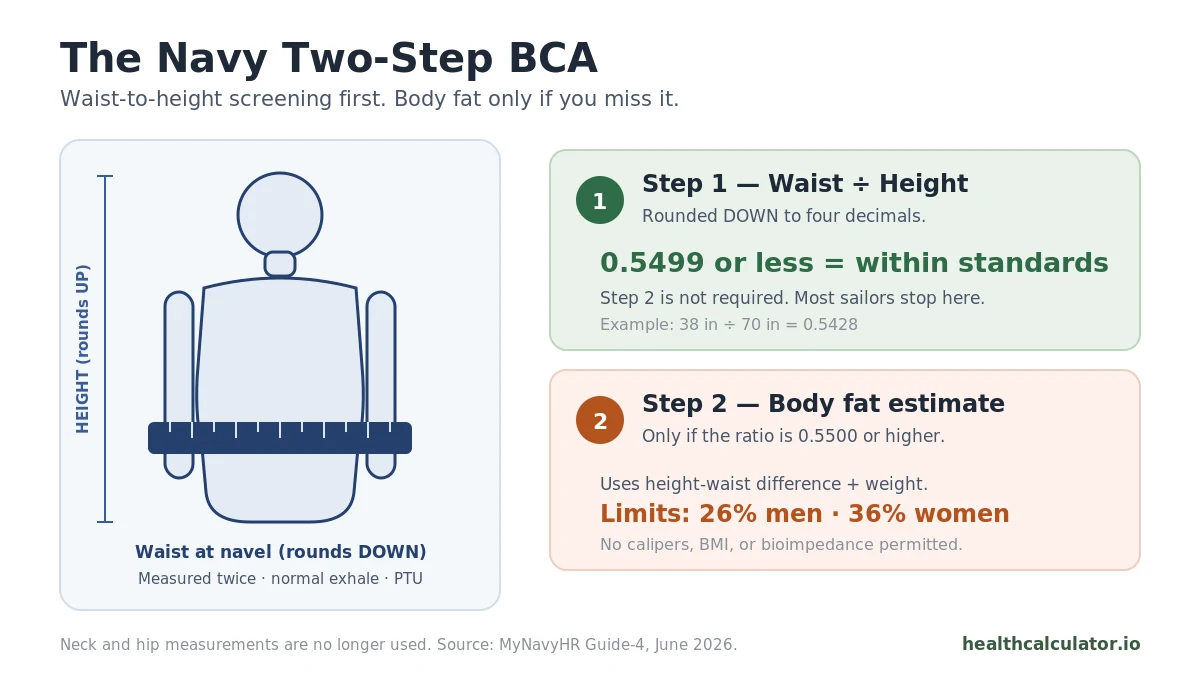
Step 1 is the screening. Divide your waist measurement by your height, using the same unit for both. The Navy records the result to four decimal places and rounds it down, so a sailor at exactly 0.54991 is recorded as 0.5499 and passes. Hit 0.5500 and you move to Step 2. Most sailors stop here.
Take a sailor who is 70 inches tall with a 38-inch waist: 38 ÷ 70 = 0.5428. Within standards, and 38 inches happens to be exactly the ceiling for that height. At 71 inches the ceiling rises to 39 inches.
Step 2 reads your body fat off a table. It uses your height-waist difference, which is simply height minus waist in inches, together with your weight. A taller sailor with the same waist gets a larger difference and a lower reading. Men must come in at or under 26%, women at or under 36%.
Our calculator runs Step 1 exactly as written, including the official rounding, then reads Step 2 out of the Navy's printed table rather than approximating it, and shows it only when you need it.
The rounding is not symmetrical, and it is not in your favour on both ends:
Two other rules catch people out. Your BCA must be done within 45 days of the PRT but no less than 24 hours before it, and retests are not authorised: the first official BCA of the cycle is the only one. If a measurer suspects you have altered your result through dehydration or similar, you wait 72 hours before re-attempting.
Worth knowing what "the cycle" now means. From 2026 the Navy runs two assessment cycles a year, January to June and July to December, rather than one. So a failed BCA is not the end of your year, but it does sit on your record: three failed cycles inside a rolling four-year period now triggers mandatory administrative separation. That clock started fresh on 1 January 2026, though — failures before that date do not count toward it.
One more detail worth knowing: only a certified Command Fitness Leader or trained Assistant CFL may conduct an official BCA, and at least two of them must be present and sign the score sheet. Measurements taken by medical or MWR staff do not count, and one-on-one measurements are prohibited.
The Navy publishes a screening table so a sailor can check the ceiling without doing any arithmetic. A sample:
| Height | Max waist | Height | Max waist |
|---|---|---|---|
| 62 in | 34.0 in | 71 in | 39.0 in |
| 64 in | 35.0 in | 73 in | 40.0 in |
| 66 in | 36.0 in | 75 in | 41.0 in |
| 68 in | 37.0 in | 77 in | 42.0 in |
| 70 in | 38.0 in | 79 in | 43.0 in |
The calculator above holds the complete official table, every half inch from 48 to 83.5 inches, and shows how much margin you have left.
Waist-to-height ratio targets central fat, the kind stored around the organs, and it needs one tape measurement instead of three. The health evidence behind it is solid without being dramatic. A systematic review in the International Journal of Obesity found a higher ratio raised all-cause mortality risk by 23% in categorical comparisons across 20 cohort studies, with cardiovascular mortality up 39%.
Whether it beats the alternatives is where honesty matters. The largest cohort study to date, following 50,618 women and 43,783 men from 1997 to 2018, found a ratio at or above 0.55 carried a relative risk of death of 1.23 in women and 1.11 in men. That same PLOS One analysis reported BMI and waist circumference predicting mortality at a similar magnitude.
So the ratio is a genuine risk marker whose real advantage is speed and consistency, not a dramatic accuracy gain over BMI. For a fleet-wide assessment run by thousands of fitness leaders, that consistency is worth a lot.
Falling outside standards on both steps does not excuse you from the PRT or CFT, though you must get medical clearance before participating. The official BCA is final for that cycle and will not be reversed by a later medical waiver, which is why the guide tells sailors to sort out medical issues before the assessment rather than after.
If you are working the number down, the target is fat around the middle, since that is what the tape reads. Protein protects lean mass while you are in a deficit, and the protein calculator sets a sensible target. Our body recomposition calculator sets the calorie side, holding the deficit under the level where lifting stops adding lean mass. Measure yourself under consistent conditions too, because hydration swings the tape; the water intake calculator helps keep that steady. Crash dehydration before a weigh-in is both dangerous and, if detected, a 72-hour delay.
Most navy body fat calculator tools online still ask for your neck and hips, which means they are answering a test the Navy retired. Our Navy Body Fat Calculator implements the current two-step BCA: the Step 1 ratio with the official four-decimal rounding, the complete maximum-waist table for every half inch from 48 to 83.5, and Step 2 read straight from the Navy's printed body fat tables rather than approximated by a formula.
Two different questions, two different tools:
| Your question | Use this |
|---|---|
| Do I pass my Navy BCA? | This page. Official two-step method, current rules, pass or fail. |
| What is my body fat percentage generally? | Our general body fat tool, with Navy tape, RFM, skinfold, and BMI. |
| Am I a soldier, not a sailor? | The Army body fat calculator, which uses a different standard. |
The numbers will not always agree, and that is expected. Each method uses different measurements and different equations. For tracking progress, pick one and stay with it rather than comparing across tools.
The Navy publishes Step 2 as printed lookup tables rather than a formula, so this calculator carries those tables and reads your figure out of them rather than approximating it. Worth being precise about what that figure is: the Navy titles these "BF% Estimation" tables and describes the result as an estimated body fat percentage. So the number is exactly what the Navy's table says, and what the Navy's table says is an estimate.
Enter the measurements your Command Fitness Leader records and you are reading the same cell of the same table they are. If your combination falls outside the printed range, the calculator says so instead of guessing.
What it cannot do is make that number official. Only a certified CFL running the assessment, with the result entered in PRIMS, produces your score of record. The point of this page is to let you know where you stand before you walk in, not to argue about it afterwards.
This calculator is for informational and screening purposes only and does not constitute medical advice, diagnosis, or an official Navy body composition assessment. Always consult a qualified healthcare professional about your health, and your Command Fitness Leader for official standards.
The maximum allowable body fat is 26% for men and 36% for women. That figure only applies at Step 2 of the assessment. If your waist-to-height ratio is 0.5499 or lower at Step 1, you are within standards and no body fat calculation is performed at all.
No. The current assessment collects three measurements only: height, waist at the navel, and weight. The neck and hip measurements used by the old circumference formula are no longer part of the Navy BCA, so calculators still asking for them are running a retired method.
Roughly 55% of your height. At 66 inches the ceiling is 36 inches, at 70 inches it is 38 inches, and at 74 inches it is 40.5 inches. The calculator above carries the Navy's full screening table for every half inch from 48 to 83.5 inches and shows your remaining margin.
Height rounds up to the nearest half inch and waist rounds down to the nearest half inch, while weight rounds to the nearest pound. The waist is measured at least twice; if readings differ by more than an inch a third is taken and the two closest are averaged, then rounded down.
No. Retests are not authorised. The first official BCA once the command's cycle has begun is the only one that counts, and the result will not be reversed by a later medical waiver. Any medical concerns need to be raised before the official assessment, not after it.
No. The guide names underwater weighing, skinfold calipers, body mass index, and bioimpedance as methods that are not permitted. Measurements taken by medical or MWR staff also do not override an official BCA conducted by your Command Fitness Leader.
Because they answer different questions. This page runs the Navy's current pass or fail assessment. Our everyday tracking version estimates body fat using the older Navy tape formula, skinfolds, or BMI, which are useful for tracking but are not the Navy's official method.
Every figure on this page is drawn from official U.S. Navy policy documents or peer-reviewed research. Last verified September 2026.