Every Calculator.net review grades the arithmetic and stops there. The arithmetic is fine: the body fat result matches the published equation to the decimal. The problem sits one step later, in what the site builds on top of a number that carries more uncertainty than its single decimal place admits.
Disclosure before anything else: I build health calculators, so I’m not a neutral party. Every figure below is either something I read in a primary source or something I watched happen on screen, and the inputs are Calculator.net’s own defaults so you can repeat the whole thing in two clicks.
Both calculators gave me 15.7%. That was never the question.
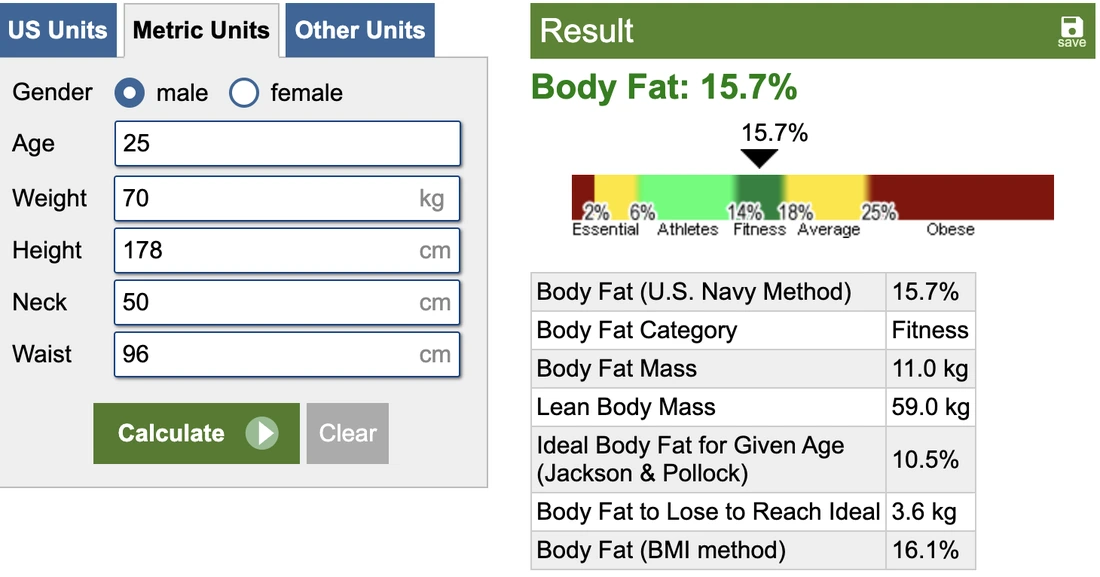
On October 11, 2026 I opened Calculator.net’s body fat calculator and changed nothing. Male, age 25, 70 kg, 178 cm, neck 50 cm, waist 96 cm, exactly as the page loads.
It returned 15.7%.
I put the same six values into our body fat calculator. Also 15.7%. Same fat mass, 11.0 kg. Same lean mass, 59.0 kg. Then I ran the equation by hand and got 15.685, which rounds to the same place.
Three independent runs, one answer. Calculator.net implements the U.S. Navy circumference formula correctly, and anyone telling you its math is broken hasn’t checked.
Move the tape two centimeters
Here’s what a single number hides.
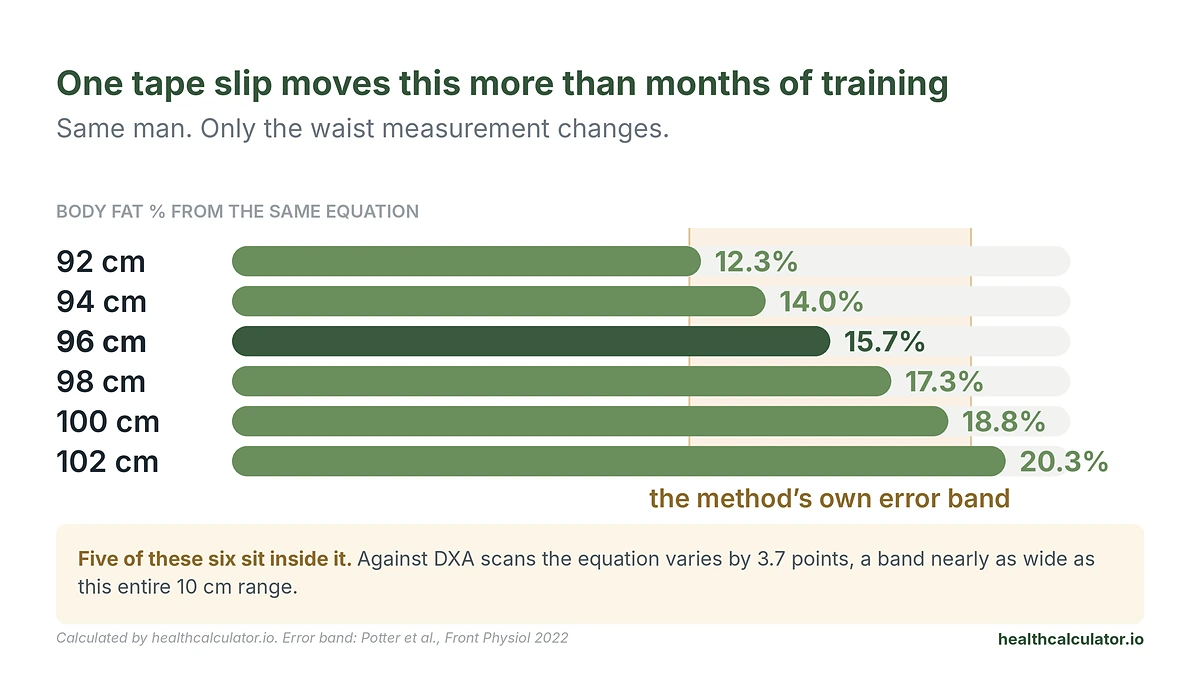
I kept height at 178 cm and neck at 50 cm, Calculator.net’s defaults, and changed only the waist. Everything in this table comes from the Hodgdon and Beckett male equation, the one both calculators run, calculated by healthcalculator.io and spot-checked against our live widget at three points.
| Waist | In inches | Body fat | Change | Category |
|---|---|---|---|---|
| 92 cm | 36.2 in | 12.3% | −3.4 | Athletes |
| 94 cm | 37.0 in | 14.0% | −1.7 | Fitness |
| 96 cm | 37.8 in | 15.7% | baseline | Fitness |
| 98 cm | 38.6 in | 17.3% | +1.6 | Fitness |
| 100 cm | 39.4 in | 18.8% | +3.1 | Acceptable |
| 102 cm | 40.2 in | 20.3% | +4.6 | Acceptable |
Two centimeters of waist, about three quarters of an inch, moves the answer 1.7 points. Four centimeters moves it 3.1 points and changes the category you land in.
That’s not a flaw in the formula. It’s what the formula is: a regression on a tape measurement, and tape measurements move. Breathe in, measure above the navel instead of at it, pull a little tighter. You’ve just changed your body fat percentage by more than most people change it in a month of training.
Which makes the decimal place on that result a promise nobody can keep.
What the Marines found when they checked it against a DXA scanner
In 2022 a team led by Adam Potter at the US Army Research Institute of Environmental Medicine put 609 Marines, 430 men and 179 women aged 18 to 57, through both the tape test and a DXA scan, which is the reference standard for body composition.
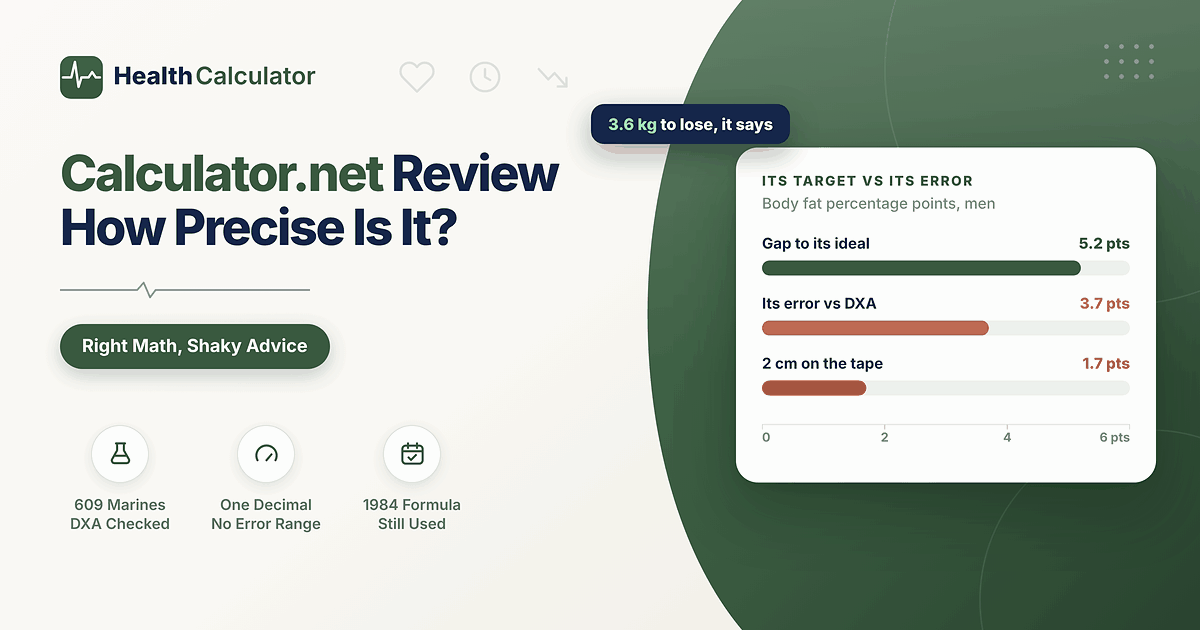
Against DXA, the circumference method underestimated men by 2.6 points in the under-30 group and 2.5 points in the over-30 group. For women it went the other way, overestimating by 2.3 and 1.3 points. Those are averages. The standard deviations were 3.7 points for men and 4.3 to 4.8 for women.
The pattern underneath matters more than the averages. Lean people were overestimated, higher-body-fat people underestimated, so the error isn’t random noise you can shrug off; it bends in a direction that depends on where you already sit.
The authors are blunt about what this means. The method, they write, does not provide research-grade quantitative body composition data, and is not suitable for applications requiring quantitative assessment. It’s a screening tool for sorting people into categories, built for exactly that job and good at it.
Calculator.net reports it to one decimal place.
The advice that number turns into
The real criticism here isn’t about the math.
Alongside the 15.7%, Calculator.net returns two more rows. Ideal Body Fat for Given Age, by the Jackson and Pollock method: 10.5%. And Body Fat to Lose to Reach Ideal: 3.6 kg.
So the site has taken an estimate, told you it’s 5.2 points above a target, and converted that gap into 3.6 kilograms of your body that should go.
Run the numbers against the validation study. The gap it wants you to close is 5.2 points. The standard deviation of the method against DXA, for men, is 3.7 points. The uncertainty in the measurement is 71 percent of the distance it is telling you to travel, and 3.7 divided by 5.2 is where that figure comes from.
A reader with a tape measure and no statistics background sees a specific weight loss goal. What they actually have is a screening estimate, a different screening estimate, and the difference between them presented as a kilogram target.
The healthcalculator.io version returns the same 15.7% and doesn’t do this. It shows a healthy range of 14 to 24%, a waist-to-height ratio of 0.5393, and a note that a ratio between 0.50 and 0.59 indicates increased central adiposity. You can see the difference on the body fat calculator with the same inputs.
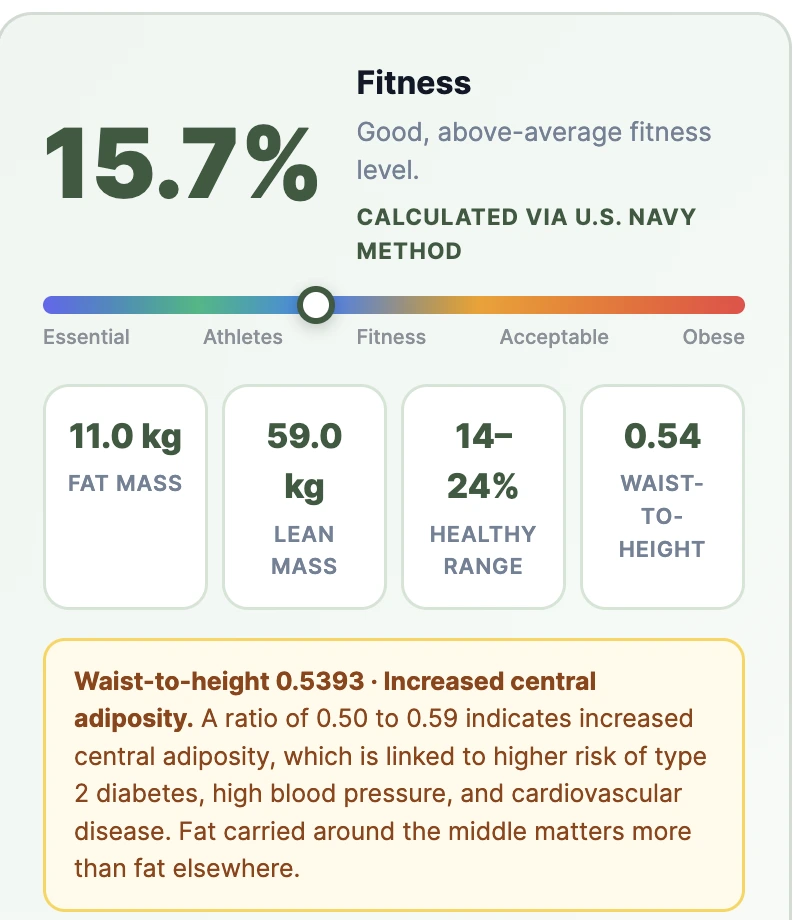
Neither framing is the only defensible one, and a risk marker is a judgment call too. But a ratio you can track is harder to misread than a kilogram target derived from the gap between two estimates.
Who is actually behind Calculator.net
For a site this size, the About page is unusually candid, and worth reading before you trust a health number from it.
Calculator.net is owned and operated by Maple Tech. International LLC. The team is described as a group of IT professionals. No individual is named anywhere on that page, and no credentials are given.
On health specifically, the page says results were reviewed and approved by local medical doctors. That’s a real review claim and it shouldn’t be dismissed. What it doesn’t include: which doctors, what qualifications, which calculators they looked at, or when. Compare that to what you can check elsewhere, where reviewers are named per tool.
Two more things from their own pages. More than 90 percent of the calculators are based on well-known formulas from textbooks, which matches what I found. And the Terms of Use state that information or calculation results on the site may be outdated.
That last line is honest. It’s also a reason to check the date on any health formula you find there.
What the Navy uses now instead
The formula Calculator.net labels the U.S. Navy method is the Hodgdon and Beckett equation from 1984. The Navy published new guidance at the end of December 2025, and it’s worth reading before trusting any page that calls that label current.
The assessment runs in two steps now. Step one is waist-to-height: a ratio of 0.5499 or lower passes, and 0.5500 or above sends you to step two. Maximum allowable body fat is 26 percent for men and 36 percent for women.
Step two is the interesting part. It estimates body fat from a table built on height, waist and weight. The Hodgdon equation, the one that needs your neck measurement, does not appear in that document anywhere. A Pentagon memo dated January 12, 2026 pushed the same ratio-first approach across the services.
Services landed differently, which is why blanket claims about this go wrong in both directions. The Marine Corps screens at a ratio below 0.52 and does still send people to a tape test or a bioelectrical impedance reading at step two.
So the label is doing more work than it should. The equation is genuinely the one the Navy used for forty years. It’s not the one the Navy uses today.
Is Calculator.net worth using?
For most of what it does, yes, and it’s completely free with no account and no paywall. It runs on advertising. The 90-percent-from-textbooks claim held up on the calculator I checked, it cites the U.S. Navy method by name and links the source document, and the math was correct every time I tested it.
| What you want | Calculator.net | Why |
|---|---|---|
| Math, finance, conversions | the right tool | Enormous catalogue, correct, free, fast |
| A health number computed | fine | The formula is implemented properly |
| To know how much to trust that number | thin | One decimal place, no error range |
| A weight-loss target | the wrong source | It derives one from two estimates stacked together |
| A named reviewer you can check | not available | No individuals named on the site |
One thing to take from this: use the number, ignore the row underneath it that tells you how many kilograms to lose. Track waist-to-height instead, measure it the same way every time, and watch the direction over weeks. The body fat calculator returns that ratio next to the percentage, and the waist-to-height reasoning sits in the abs guide.
A good calculator tells you what it doesn’t know. That’s the row Calculator.net is missing.
This article is for informational purposes only and does not constitute medical advice or diagnosis. Always consult a qualified healthcare professional.
Frequently Asked Questions
The arithmetic is accurate. I ran its body fat calculator against the published equation and our own tool on October 11, 2026 and all three returned 15.7%. The limit is the formula, not the site: against DXA scans it underestimated men by 2.6 points.
Yes. No account, no paywall, no limits on any calculator I used. The site is funded by display advertising, and there is a sign-in option that nothing I needed sat behind. No subscription exists for any tier of access.
It is owned and operated by Maple Tech. International LLC, with the team described as a group of IT professionals. Health results are said to be reviewed and approved by local medical doctors, but no individual reviewer is named and no credentials are published.
Because the formula is extremely sensitive to the tape. Holding height and neck fixed, a 2 cm waist difference moves the result 1.7 points, and 4 cm moves it 3.1 points and into a different category. Measure at the same spot, same time of day, every time.
Treat it as a rough direction, not a target. On the default inputs it derives 3.6 kg from a 5.2 point gap between two separate estimates, while the method’s own standard deviation against DXA is 3.7 points, which is 71% of that gap. The precision is not there.
Not this version of it. The Navy’s current two-step assessment screens on waist-to-height at 0.5499, then uses a table built on height, waist and weight. The neck-based Hodgdon equation does not appear in that guidance. The Marine Corps still tapes at step two.
Keep Calculator.net for general math and conversions, where it is excellent. For a health number you plan to act on, use a tool that names its reviewer, shows its formula, and gives you an error range or a trackable ratio rather than a single decimal.
For direction over time, yes, provided you measure identically each time. A method consistently off by two points still shows whether you are going up or down. For a single absolute number you want to act on, it carries more uncertainty than most pages admit.
Sources
Every figure on this page is drawn from primary sources or first-hand testing. Last verified October 2026.
- Calculator.net. Body Fat Calculator. Maple Tech. International LLC; accessed October 11, 2026.
- Potter AW, Tharion WJ, Holden LD, et al. Circumference-Based Predictions of Body Fat Revisited: Preliminary Results From a US Marine Corps Body Composition Survey. Frontiers in Physiology. 2022;13:868627. doi:10.3389/fphys.2022.868627.
- Calculator.net. About Us. Maple Tech. International LLC; accessed October 11, 2026.
- Pentagon to start measuring troops’ body fat by waist-to-height ratio. Navy Times; January 13, 2026.
- US Navy. Guide-4: Body Composition Assessment. MyNavy HR, Physical Readiness Program; December 2025.
- US Department of Defense. Body Composition Program: Commonly Asked Questions. US Marine Corps; February 2026.