
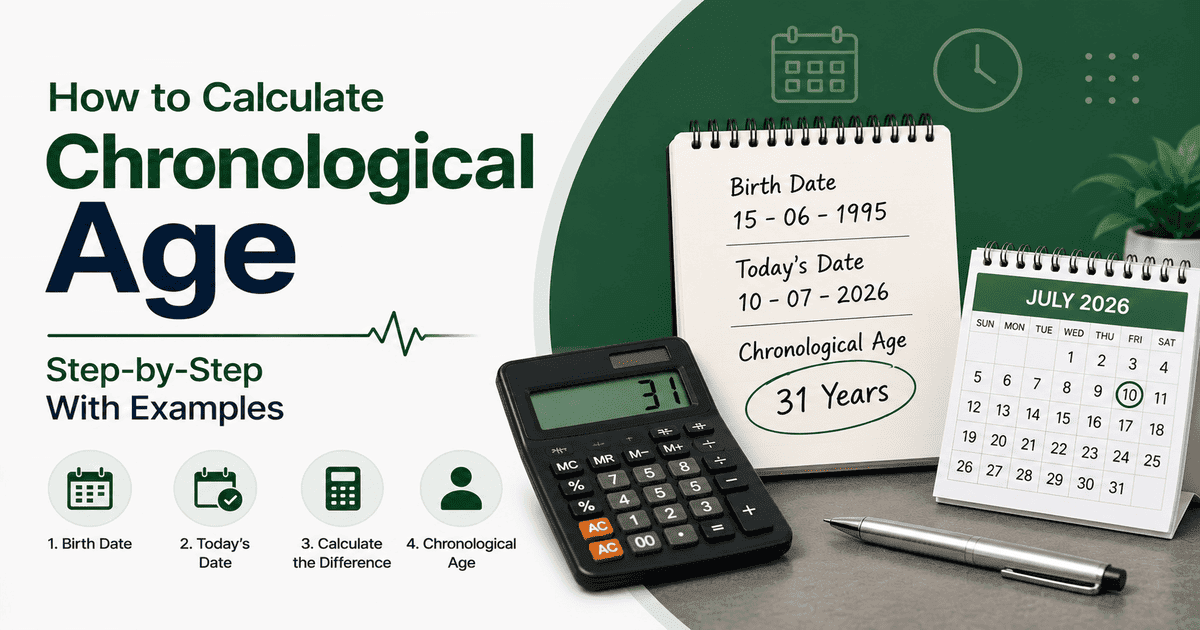
Quick answer: To calculate chronological age by hand, write the target date and the birth date as year, month, and day — then subtract each column on its own: years from years, months from months, days from days. If the days or months come out negative, borrow from the column to its left. What’s left is your exact age in years, months, and days.
Prefer to skip the pen and paper? Pick your date of birth below and you’ll get the exact figure — plus total days lived and a birthday countdown — in a split second.
Pick your date of birth — full breakdown and birthday countdown below.
That's the whole method. The rest of this guide shows you the borrowing rules, walks through a real worked example, and covers the parts people get wrong — leap years, February, premature babies, and the strict format that speech therapists and school psychologists have to use.
What Chronological Age Actually Means
Your chronological age is the calendar time between the day you were born and today — years, months, days. Nothing more complicated than that. It's the "how old are you" number on every form you've ever filled out, and the one sitting behind school placement, voting, retirement, and clinical screening.
It's also blunt on purpose. It doesn't know whether you run marathons or never leave the couch. Two people born on the same morning share the exact same chronological age forever, and that objectivity is the point. It's the one age measurement that ticks at the same rate for everyone.
Doctors lean on it hard, because age is one of the strongest single predictors of disease they have — it's a core input in clinical tools like our kidney function calculator, which combines age with a lab value to estimate GFR. A 2024 study in Nature Medicine built an aging "clock" from 204 blood proteins that tracked chronological age almost perfectly — a correlation of 0.94 — across nearly 45,000 people. Your birthday, in other words, is a genuinely powerful piece of medical data before anyone runs a single test.
How to Calculate Chronological Age by Hand: The Step-by-Step Method
Here's the reliable way to do it on paper, in three steps.
- Line up both dates as Year / Month / Day. Put the date you're measuring to (usually today) on top and the birth date underneath, like a subtraction problem.
- Subtract each column on its own. Years minus years. Months minus months. Days minus days.
- Borrow when a column goes negative. If the days are negative, take one month from the months column and add that month's number of days. If the months then go negative, take one year (12 months) from the years column.
The borrowing is the only part that trips people up, so keep two facts handy. Borrow a year as 12 months. Borrow a month as the number of days in the month right before your target date — 30 for June, 31 for July, 28 or 29 for February. Nail those two rules and you can calculate anyone's age without a tool.
Why the "days in the month" rule matters
The reason age math feels fiddly is that months aren't the same length. April, June, September, and November have 30 days. The rest have 31. February has 28, or 29 in a leap year. So when you borrow, you have to borrow the right number — and that number depends on which month you're borrowing from. Miss it by a day and your final answer is off by a day.
A Worked Example (Real Numbers)
Let's do one properly. Say a child was born on September 20, 2016, and you're working out their age today, on July 24, 2026.
Line the dates up and subtract each column:
- Years: 2026 − 2016 = 10
- Months: 7 − 9 = −2 → negative, so borrow
- Days: 24 − 20 = 4
The months came out negative, so borrow one year. Add 12 to the months (−2 + 12 = 10 months) and drop the years by one (10 − 1 = 9 years). The days were already positive, so they stay at 4.
The answer: 9 years, 10 months, and 4 days. That's exactly what our tool returns for the same two dates — and then it keeps going. It works out automatically 3,594 total days lived, 513 weeks, 118 months, and 86,256 hours. It also flags that September 20, 2016 was a Tuesday, and counts down the 58 days to the next birthday.
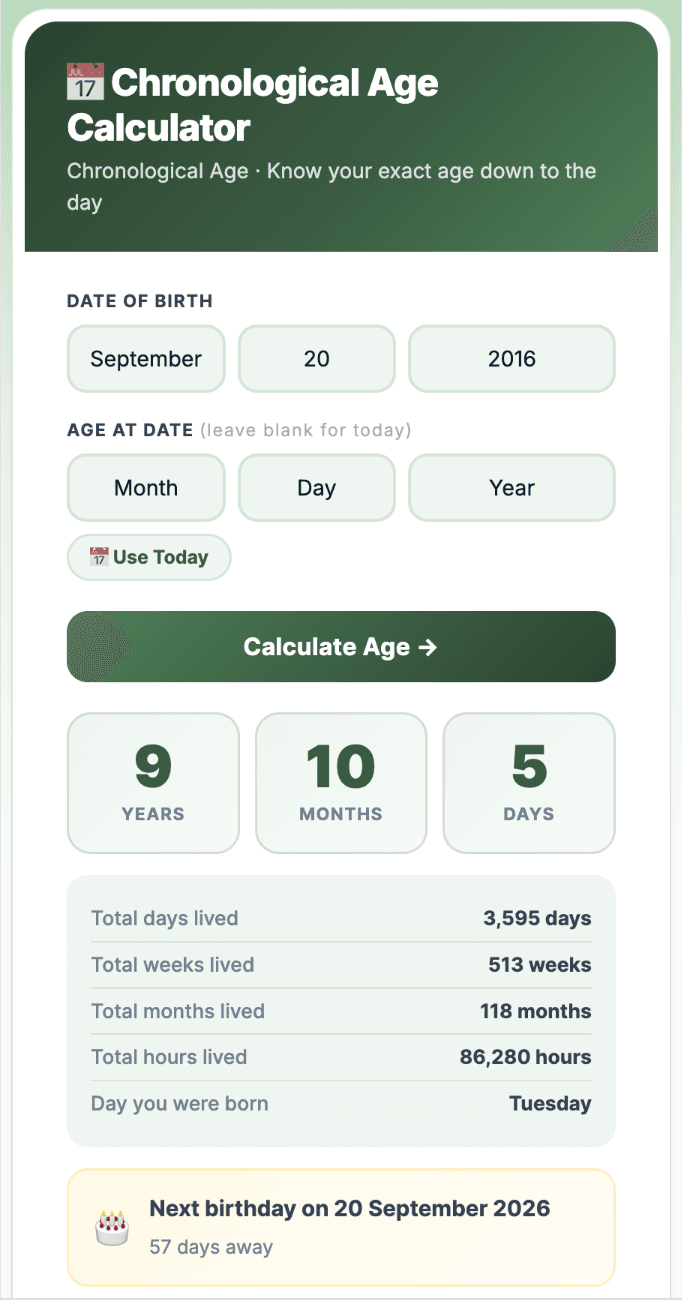
Notice what the manual method doesn't give you: the weekday, the running totals, the birthday countdown. That's the trade. By hand teaches you how the number is built; the calculator hands you the full picture in a second and never fumbles a leap year.
The Tricky Parts: Leap Years, End-of-Month, and February 29
Most disagreements between two age calculations come down to three edge cases.
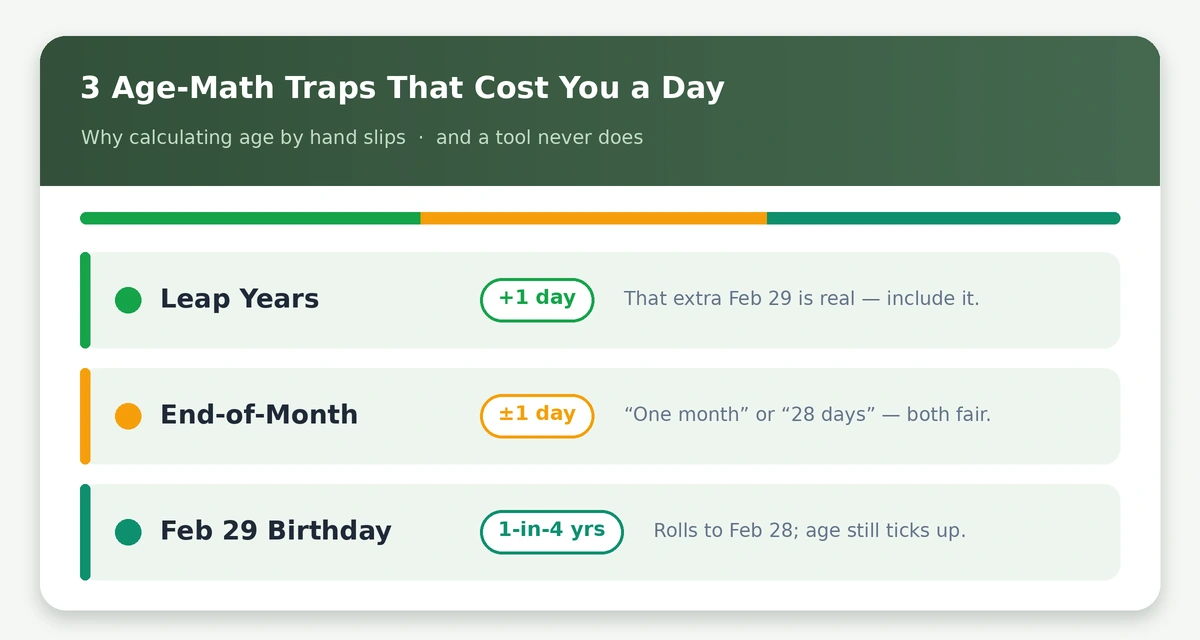
Leap years. Every four years February gets a 29th day. If your date span crosses one, that extra day is really there and your total-days count has to include it. This is exactly why doing it by hand is error-prone and why a tool that counts actual elapsed days wins on precision.
End-of-month borrowing. Going from, say, January 31 to a February date is genuinely ambiguous — you can count it as "one month" or as "28 days," and both are defensible. Different tools resolve it differently, which is why two calculators can disagree by a day without either being broken.
February 29 birthdays. If you were born on a leap day, your birthday only lands on the calendar once every four years. In common years, most systems roll the birthday to February 28. Your age still advances every year — the celebration just moves.
Chronological Age vs Corrected Age for Premature Babies
For a baby born early, plain chronological age can be misleading — and this is where a lot of parents get worried for no reason. A baby's chronological age counts from their birth date like anyone else's. But if they arrived weeks ahead of schedule, their development tracks closer to their corrected age (also called adjusted age): the age they'd be if they'd been born on their due date.
This matters at scale. About 1 in 10 U.S. infants is born preterm — before 37 completed weeks — and the CDC puts the 2022 rate at 10.4%. For all of those babies, milestone expectations should follow corrected age, not the calendar.
The formula is refreshingly simple. The American Academy of Pediatrics says to start with the baby's actual age in weeks, then take off however many weeks early they arrived — and you get that number by subtracting gestational age at birth from 40. So a baby born at 32 weeks was 8 weeks early. At 4 months old, or 16 weeks, her corrected age is just 2 months — which means a 2-month-old's skills are exactly on target. The AAP says to keep using corrected age through the first two years of life. After that, the head start the calendar took has effectively evened out.
Chronological Age in Speech Therapy, OT, and School Testing
Here's a use case where being off by a single day genuinely changes the result. Speech-language pathologists, occupational therapists, and school psychologists score standardized assessments against age-based norm tables — and those tables are keyed to age in years, months, and days.
The format is strict. On Pearson's assessments like the WISC-V and WIAT, chronological age is written as years;months;days — so a child who is nine years, two months, and ten days old is recorded as 9;2;10. There's an important quirk in how the subtraction is done: for test-date calculations, every month is treated as 30 days, and you generally do not round 29 days up to the next month unless the manual explicitly tells you to. That's different from the true-calendar method above, and it exists so every examiner lands on the same norm cell.
Get it wrong and the child can be compared against the wrong age group, which shifts their standard score. This is why testers almost always use a dedicated tool rather than mental math — our chronological age calculator returns the exact years, months, and days you need for the score sheet, with no rounding to second-guess.
Chronological Age vs Biological Age
Quick clarification, because people mix these up constantly. Chronological age counts calendar time and only moves forward. Biological age tries to estimate how worn your body actually is, using markers like blood proteins or DNA — and unlike your birthday, it can run faster or slower than the calendar.
The same Nature Medicine proteomic clock mentioned earlier linked accelerated biological aging to the later onset of 18 major diseases, from heart and kidney disease to diabetes and dementia. Encouragingly, biological age appears somewhat changeable through sleep, movement, and diet — while your chronological age just keeps counting. To be clear, this guide and our calculator measure chronological age only; biological age needs lab testing.
Common Mistakes to Avoid
A few errors show up again and again when people calculate age by hand. They borrow a flat 30 days for every month instead of the actual length of the month before the target date. They forget a leap day inside the span and undercount total days. And they subtract the columns left to right and "carry" like normal arithmetic instead of borrowing right to left. And with premature babies, they judge milestones against chronological age when corrected age is the fairer yardstick for the first two years.
None of these are disasters — but each one costs you a day or two of accuracy, and in a clinical or testing context, a day or two is enough to matter.
This article is for informational purposes only and does not constitute medical advice or diagnosis. Always consult a qualified healthcare professional.
Frequently Asked Questions
Write today's date and your birth date as year, month, and day, then subtract each column separately. If the days go negative, borrow one month and add that month's number of days; if the months go negative, borrow one year as 12 months. What remains is your age in whole years, months, and days. Our calculator does all of this instantly if you'd rather skip the arithmetic.
Subtract the child's date of birth from the test date to get years, months, and days. For Pearson tests like the WISC-V, record it in the format years;months;days (for example, 9;2;10) and treat each month as 30 days, without rounding 29 days up unless the manual says to. Precision matters because norm tables are age-specific.
Chronological age counts from a baby's actual birth date. Corrected age adjusts for prematurity by subtracting the weeks the baby was born early, reflecting the age they'd be at their original due date. The AAP recommends using corrected age to judge development through the first two years for babies born preterm.
Take the baby's actual age in weeks and subtract the number of weeks preterm. To find weeks preterm, subtract the gestational age at birth from 40. A baby born at 32 weeks was 8 weeks early, so at 16 weeks old their corrected age is 8 weeks — about 2 months.
Yes. It counts the actual number of days between the two dates, so every February 29 inside the span is included automatically and the totals stay exact. If you were born on a leap day, the birthday countdown lands on February 28 in common years and returns to the 29th in leap years.
Yes. The method works for any two dates — just put the date you're measuring to on top instead of today. In the calculator, leave the "age at date" field blank to use today, or enter any past or future date to answer questions like "how old will I be on September 1?"
Usually it's end-of-month and leap-year handling. Counting January 31 to February 28 as "one month" versus "28 days" is a judgment call, and tools resolve it differently. As long as a tool uses consistent date logic, your result stays the same every time you check it.
Enter your date of birth into a chronological age calculator. It applies the same subtract-and-borrow logic described here, handles leap years automatically, and returns your exact age plus total days, weeks, months, and hours — with no chance of a manual arithmetic slip.
Sources
Every figure on this page is drawn from government health statistics, professional medical guidance, or peer-reviewed research. Last verified August 2026.
- Centers for Disease Control and Prevention. Preterm Birth. CDC; 2024.
- American Academy of Pediatrics. Corrected Age for Preemies. HealthyChildren.org; 2018.
- Argentieri MA, et al. Proteomic aging clock predicts mortality and risk of common age-related diseases in diverse populations. Nature Medicine. 2024. doi:10.1038/s41591-024-03164-7.
- Pearson Assessment Support. Test date age calculation. Pearson; 2024.