Dr. Farah Taqueer is a pediatrician based in Karachi with more than 14 years of clinical experience. She qualified with an MBBS from Liaquat University of Medical and Health Sciences and holds an MD in Pediatrics, and is registered with...
Your sweat rate is how much fluid you lose per hour of exercise, and the only honest way to get it is to weigh yourself before and after. This sweat rate calculator does the math from four numbers you already have. Most people land between 0.5 and 2 liters an hour. Some football players hit triple that.
What Your Sweat Rate Actually Tells You
One number, two uses.
The first is how much to drink during exercise. If you lose 1.4 liters an hour and your session runs two hours, you are down 2.8 liters by the end unless you replace some of it. That is a real deficit on a 70 kg frame, and it is the difference between finishing strong and finishing flat.
The second is whether you are already drinking too much. Overdrinking is the rarer problem but the more dangerous one, and your sweat rate is the ceiling that tells you when you have crossed it.
Both ACSM and the National Athletic Trainers' Association say the same thing about how to find it: individual sweat rates are estimated by measuring body weight before and after exercise. Not from a chart. Not from your body weight. From a scale, on the day, in the conditions you actually train in.
How to Calculate Sweat Rate
The Formula
Sweat loss is your body mass change plus whatever you drank, minus anything you passed as urine. Divide by hours to get a rate.
Sweat loss (L) = body mass before (kg) − body mass after (kg) + fluid consumed (L) − urine volume (L)
The fluid you drank gets added, not subtracted, and that trips people up. If you drank a liter and still finished a kilogram lighter, you sweated two liters, not one. The scale only shows you the part you failed to replace.
Adult sweat rates during exercise run from 0.5 to 4.0 liters an hour, which is an eightfold spread. That range is exactly why a calculator beats a rule of thumb here.
Metric and Imperial, With a Worked Example
The equation is unit-agnostic as long as you stay consistent. One kilogram of body mass lost equals one liter of sweat, because water weighs what it weighs.
Imperial is where it gets slippery. Most guides tell you one pound lost equals 16 fluid ounces, which quietly swaps weight ounces for fluid ounces. A US fluid ounce of water weighs about 1.04 weight ounces, so one pound of sweat is closer to 15.3 fl oz. The shortcut runs about 4% high. Small, but it is a 4% error baked into a number you are using to decide what to drink.
Worked example, a 2.5-hour football practice:
Weight before: 120.0 kg
Weight after: 114.0 kg
Fluid consumed during breaks: 2.0 L
Urine: none
Sweat loss = 120.0 − 114.0 + 2.0 = 8.0 L Sweat rate = 8.0 ÷ 2.5 = 3.2 L/h
Same numbers in imperial: 264.6 lb down to 251.3 lb is 13.2 lb, which is 203 fl oz of sweat. Add the 68 fl oz he drank and the session total is 271 fl oz over 2.5 hours, or 108 fl oz per hour. Run it with the 16-ounce shortcut instead and you get 112 fl oz per hour, four ounces an hour of fluid that was never there.
That 3.2 L/h figure is not invented for illustration. It is one of four published examples in the NATA position statement, alongside a recreational tennis player at 1.4 L/h, a 10 km runner at 1.6 L/h, and a collegiate soccer player at 1.3 L/h. Four athletes, a 2.5-fold spread.
How to Run the Test Properly
The formula is easy. The measurement is where results go wrong.
Weigh nude, or in dry minimal clothing, both times. Sweat-soaked gear can hold a pound of water and it all reads as retained body mass.
Towel off before the second weigh-in.
Use the same scale, and one that reads to 0.1 kg.
Track every drink. Weigh your bottle before and after if you can, since a swig is not a measurement.
Note the conditions: temperature, humidity, what you wore, how hard you went. The number belongs to that session, not to you forever.
Repeat it three or four times across different weather before you trust an average.
What Counts As A Normal Sweat Rate
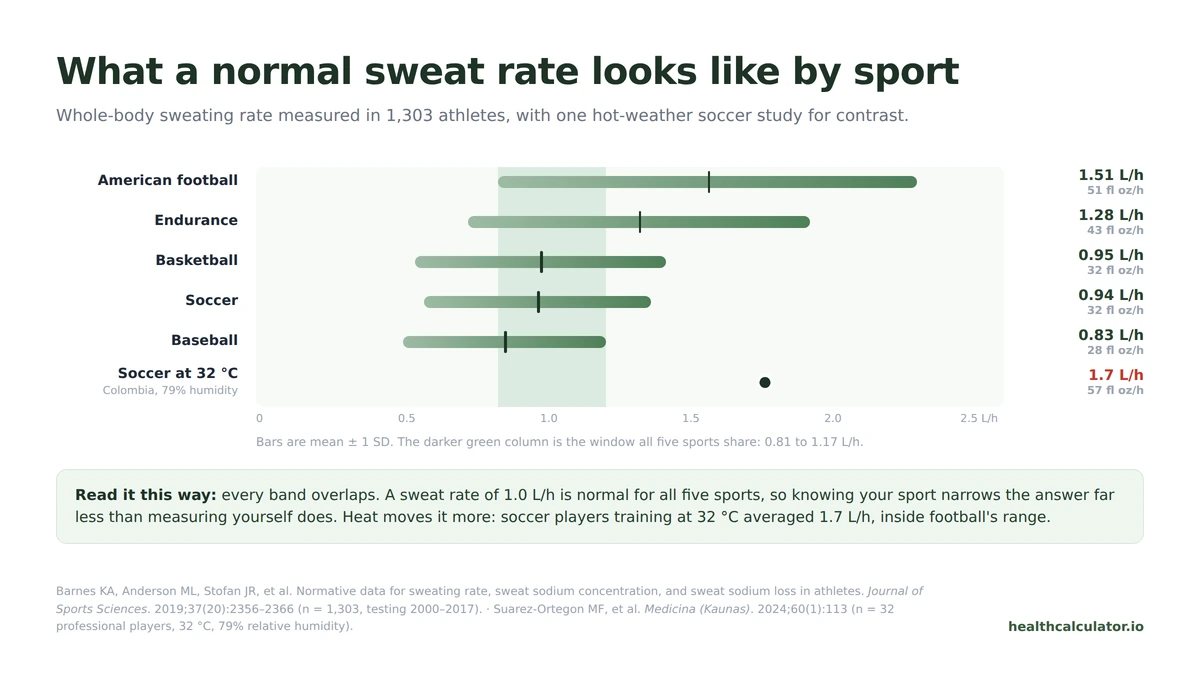
There is no single normal, but there are sport-specific norms. The largest dataset compiled 1,303 athletes tested between 2000 and 2017 and found real differences between sports:
Sport
Whole-body sweat rate (L/h)
In fl oz/h
Sweat sodium loss (mmol/h)
American football
1.51 ± 0.70
51
55.9 ± 36.8
Endurance
1.28 ± 0.57
43
51.7 ± 27.8
Basketball
0.95 ± 0.42
32
34.5 ± 21.2
Soccer
0.94 ± 0.38
32
34.6 ± 19.2
Baseball
0.83 ± 0.34
28
27.2 ± 14.7
Read the plus-or-minus, not just the mean. Football's 1.51 ± 0.70 means a normal range of roughly 0.8 to 2.2 L/h inside one sport.
And the environment moves it more than the sport does. Thirty-two professional soccer players training at 32 °C and 79% humidity in Colombia averaged 1.7 L/h, nearly double the 0.94 L/h soccer mean above. Same sport, different air.
Two things follow. A high sweat rate is not a fitness problem: heat-acclimatized athletes sweat more, earlier, and with less sodium, which is an adaptation rather than a fault. And a number outside the table is not automatically wrong. It is a reason to check your measurement, then believe it.
What To Drink Based On Your Number
Your sweat rate is a budget, not a target. The goal is to finish under 2% body mass loss without gaining weight.
For a 70 kg athlete, 2% is 1.4 kg. At a 1.4 L/h sweat rate, a one-hour session needs little or nothing. A three-hour session at that rate puts you 4.2 L down, so you need to replace roughly two-thirds of it to stay inside the limit.
A practical way to use the number:
Work out your total loss: sweat rate × hours.
Subtract your 2% allowance in liters, which is body mass in kg × 0.02.
What is left is what you need to drink, spread across the session rather than downed at the end.
Two cautions from the same guidelines. Drinking to thirst alone replaces only about two-thirds of sweat losses, so thirst is a floor and not a plan. And you should not finish heavier than you started. If your sweat rate is above 2.5 L/h and your sweat tastes salty, sodium is worth adding, not just water. For where the upper limit sits and why hourly pace matters more than daily totals, how much water is too much covers the rate your kidneys can actually clear.
Coffee before training does not need to be subtracted, either. The position statement is explicit that caffeine does not induce diuresis during exercise, and does coffee count as water has the dose data behind that.
Measured Versus Predicted: What The 2024 Calculators Changed
This is worth knowing before you decide which tool to use, and no page in the search results for this term mentions it.
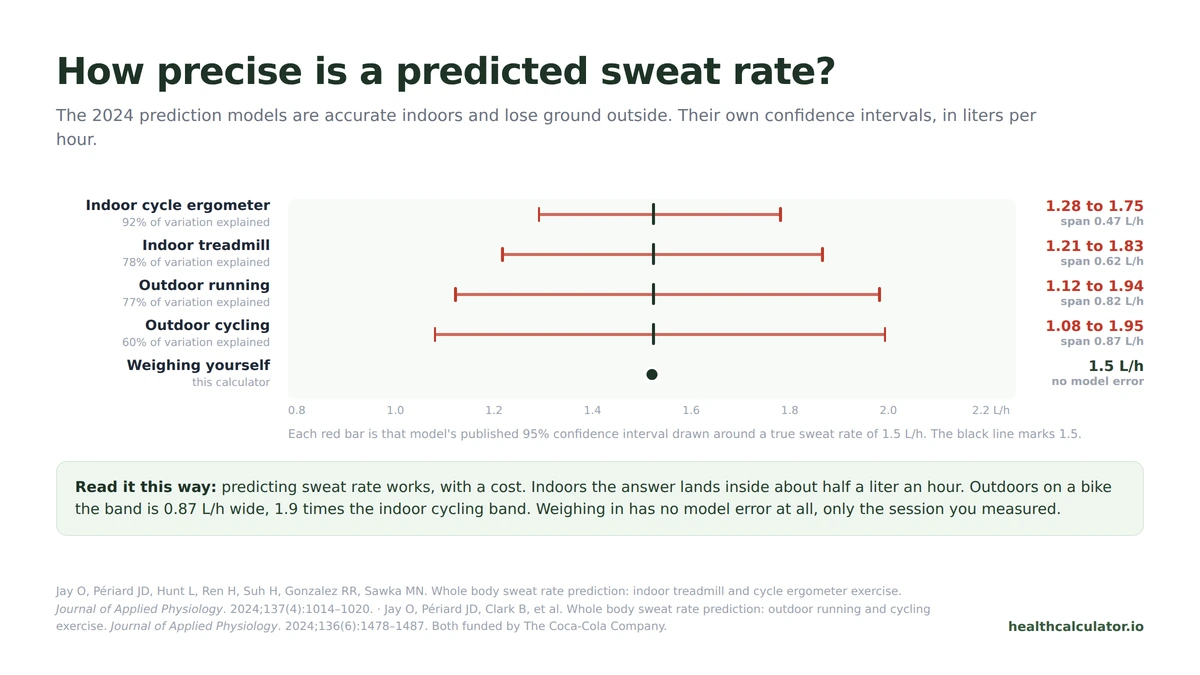
In 2024 a research group at the University of Sydney and the University of Canberra published two validation papers that predict whole-body sweat rate from activity and weather inputs, with no weigh-in at all. The models are free to use at sweatratecalculator.com. They are also genuinely accurate, within limits, and the limits are published:
Compared on
Prediction model, Jay et al. 2024
Weigh-in method, this calculator
What you need
Activity, intensity, temperature, humidity, wind
A scale, your bottle, a stopwatch
Activities covered
Four: indoor treadmill, indoor cycle, outdoor run, outdoor bike
So the honest answer: if you run or ride indoors and want a number before you train, the prediction calculator is the better tool and we would rather say so. If you play a team sport, lift, hike, swim, or want the number that actually happened to you, weigh in. The prediction models were never built for those, and substituting eyeballed weather for measured conditions cost their running model about a quarter of its accuracy.
When Your Own Number Will Be Wrong
Three ways the weigh-in method misleads, and the third is new.
You lose mass you did not sweat out. Burning fuel and breathing off water accounts for a modest amount of the change over a long session. For sessions under about two hours it is small enough to ignore. For an all-day event it is not, and your sweat rate will read slightly high.
One session is not your sweat rate. Intensity, heat, humidity, clothing and acclimatization all move it. The Colombian soccer data against the pooled soccer average is the size of that effect: same sport, 0.8 L/h apart.
Starting dehydrated makes your sweat rate read low. A 2026 trial split 30 active men by morning urine specific gravity and cycled both groups to 3% body mass loss. The well-hydrated group sweated 0.30 liters an hour more than the insufficiently hydrated group, and 10 of 16 reached 3% loss versus 1 of 14. Read that backwards and it is a measurement warning: test yourself on a day you started dehydrated and the number you get is an underestimate of what you lose when properly hydrated. Since more than half of athletes turn up to training already hypohydrated, this is not an edge case.
The fix for all three is the same. Measure more than once, note the conditions, and treat the average as a planning figure rather than a constant.
Why Use Our Sweat Rate Calculator
It runs the published NATA equation, nothing modified and nothing proprietary. It takes metric or imperial and converts both ways, so you can weigh in pounds and drink in ounces without doing conversions in your head. It shows the sweat loss and the hourly rate separately, because the first tells you what to replace today and the second is what you plan with. It compares your result against the sport-specific norms above instead of leaving you with a bare figure. No sign-up, nothing stored, works on a phone at the side of a field.
This Calculator Does Not Replace Medical Advice
This calculator is for informational and screening purposes only and does not constitute medical advice or diagnosis. Sweat rate estimates guide training hydration; they do not diagnose or rule out dehydration, heat illness, or exercise-associated hyponatremia. Anyone who has collapsed, become confused or disoriented, vomited repeatedly, or gained weight during exercise needs medical assessment, not a calculator. Always consult a qualified healthcare professional.
Check your everyday baseline too. Sweat rate covers the exercise window; the water intake calculator works out the daily total your size, activity and climate call for.
Frequently Asked Questions
There is no good or bad, only high or low. A sweat rate calculator gives you a planning number, not a grade. Adults typically fall between 0.5 and 4.0 liters an hour, and heat-acclimatized athletes sweat more, not less, because sweating earlier is an adaptation.
Add it. This is the single most common mistake. If you drank one liter and still finished a kilogram lighter, you lost two liters of sweat. The scale shows only the deficit you failed to replace, so the fluid you drank has to go back in.
On the high side, but well inside the measured adult range. It sits above the football average of 1.51 L/h and roughly double the soccer average. Above 2.5 L/h with salty sweat is the point where guidelines suggest adding sodium rather than water alone.
Three or four times, across different weather and intensities, before you trust an average. One session tells you what happened that day. Position statements recommend repeating the test under realistic conditions in the clothing and equipment you actually compete in, since both change the result.
Yes, but only for four activities. Validated 2024 prediction models estimate sweat rate from intensity and weather for indoor treadmill, indoor cycling, outdoor running and outdoor cycling. They explain 60% to 92% of the variation depending on mode. For team sports or lifting, you need the scale.
Not on its own. Volume and concentration are separate variables. Sweat sodium ranges from 10 to 100 mEq/L between people, so two athletes losing identical fluid can lose very different salt. Knowing your concentration needs a patch or lab test, not a weigh-in.
Sources
Every figure on this page is drawn from position statements of professional bodies or peer-reviewed research. Last verified September 2026.