
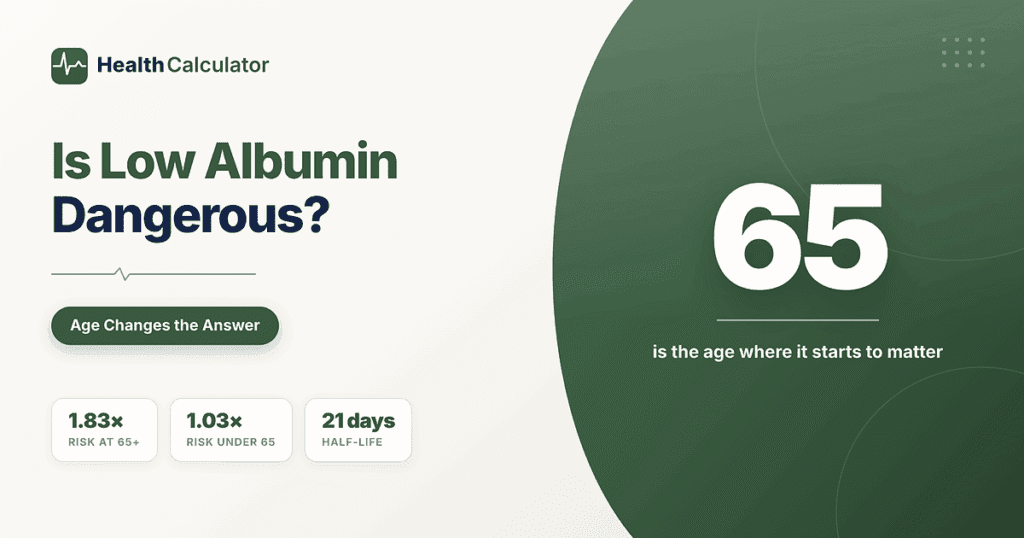
Is low albumin dangerous? Usually it is a signal rather than a disease. On its own it rarely causes harm, but it reliably points to something else that might, most often inflammation, liver disease, kidney disease or gut losses. How much it matters depends on what is causing it, and on your age.
That last part surprises people, so let us start there.
Is Low Albumin Dangerous? Age Changes the Answer
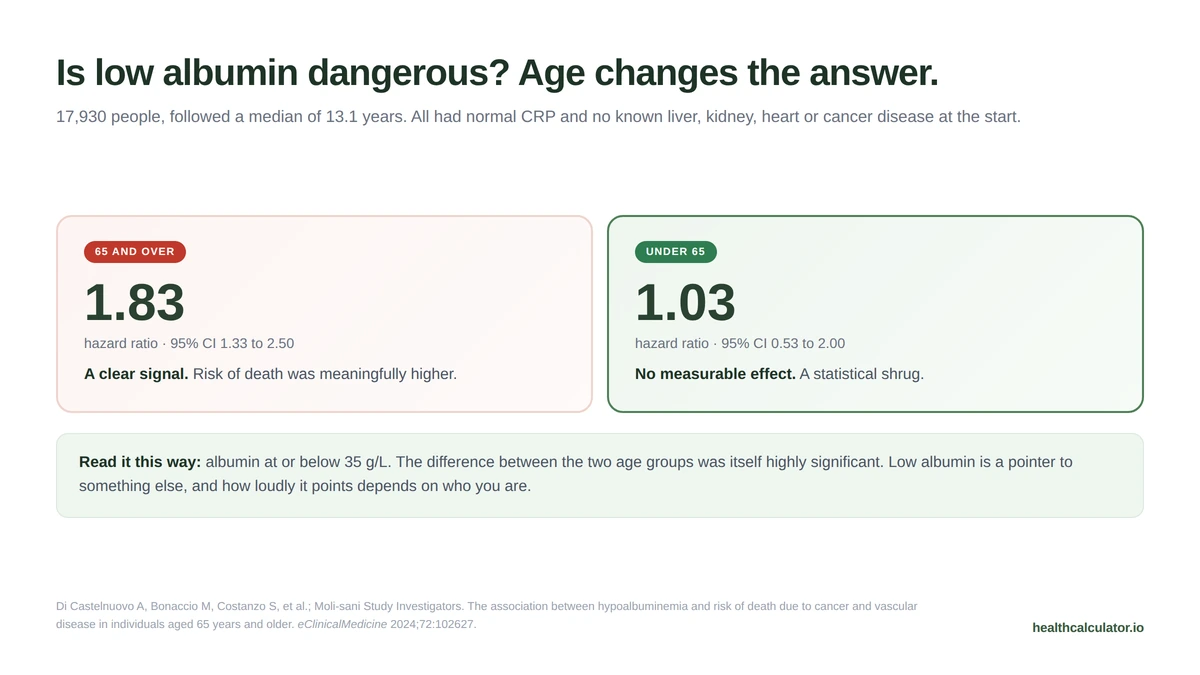
The largest recent look at this question followed 17,930 people for a median of 13.1 years in the Italian Moli-sani cohort. Everyone in it had a normal C-reactive protein and no known liver, kidney, heart or cancer disease at the start. In other words, people who looked well.
Albumin at or below 35 g/L was linked to a higher risk of death overall, with a hazard ratio of 1.61.
Then the researchers split the group by age, and the picture broke in two:
| Age group | Hazard ratio for death | Confidence interval | What it means |
|---|---|---|---|
| 65 and over | 1.83 | 1.33 to 2.50 | A clear, statistically solid signal |
| Under 65 | 1.03 | 0.53 to 2.00 | No measurable difference |
The difference between those two groups was itself highly significant. Under 65, in people with no known disease and normal inflammatory markers, a low albumin carried essentially no mortality signal in this cohort. A hazard ratio of 1.03 with a confidence interval running from 0.53 to 2.00 is a statistical shrug.
This is not permission to ignore the result. It is a reason to stop reading a single number as a verdict, and to find out what is behind it.
What Albumin Actually Does
Albumin is the most abundant protein in your blood, made in the liver. It does two jobs worth knowing about.
First, it holds fluid inside your blood vessels. Protein in the bloodstream creates oncotic pressure, a kind of inward pull. Drop the albumin far enough and fluid leaks into surrounding tissue. That is where the swelling comes from.
Second, it carries things. Calcium, hormones, bilirubin, and a long list of medications ride around bound to albumin. StatPearls notes that albumin binds at least 40% of the calcium circulating in your blood, which is why a low albumin quietly distorts other results on the same panel. More on that below, because it matters more than most people realize.
The normal range runs roughly 35 to 50 g/L, or 3.5 to 5.0 g/dL. Your own lab’s printed range wins over any figure on the internet, including this one.
One more number to hold onto: albumin has a half-life of 21 days. Nothing you do today shows up on a test tomorrow.
Low Albumin Symptoms
Here is the honest answer most pages skip: mild low albumin often produces no symptoms at all. It gets found on a routine panel, not because anyone felt unwell.
When symptoms do appear, they usually come from either the fluid shift or the underlying condition:
- Swelling, typically in the ankles, feet, legs or hands, and sometimes around the eyes in the morning
- Fluid in the abdomen, which is common when liver disease is the cause
- Fatigue that does not track with how much you slept
- Foamy urine, which points toward protein being lost through the kidneys
- Poor wound healing
Notice that almost none of these are specific to albumin. They are what the underlying problem is doing. That distinction runs through this whole page.
MedlinePlus is direct about what the test is for: it checks general health and nutrition, and how well your liver and kidneys are working. It is a pointer, not a diagnosis.
What Causes Low Albumin
StatPearls groups the causes into decreased production, increased loss, or increased breakdown, with losses running through the kidneys, gut, skin or into the tissues.
| Category | Typical causes | How common |
|---|---|---|
| Inflammation | Infection, surgery, injury, chronic inflammatory disease, cancer | The most frequent driver |
| Liver disease | Cirrhosis, hepatitis, alcohol-related liver disease | Common |
| Kidney loss | Nephrotic syndrome, chronic kidney disease | Common |
| Gut loss | Inflammatory bowel disease, celiac disease, protein-losing enteropathy | Less common |
| Skin loss | Extensive burns | Uncommon |
| Genuinely low intake | Severe, prolonged starvation | Rare |
That last row is the one to pay attention to, because StatPearls explicitly calls decreased production the rare category. Almost every page telling you to eat more protein is aimed at the least likely cause on the list.
Inflammation earns the top spot for a specific reason. Pro-inflammatory signals including interleukin-6, interleukin-1 and tumor necrosis factor suppress albumin production directly, and in critical illness the transcription of albumin mRNA falls. Your liver is not failing. It has been told to make something else.
Albumin is what the literature calls a negative acute-phase reactant. When your body is dealing with something, this number goes down. That is the signal working, not breaking.
Why “Eat More Protein” Is Usually the Wrong Advice
This is the part where most low albumin articles go wrong, and there is a clean piece of evidence that settles it.
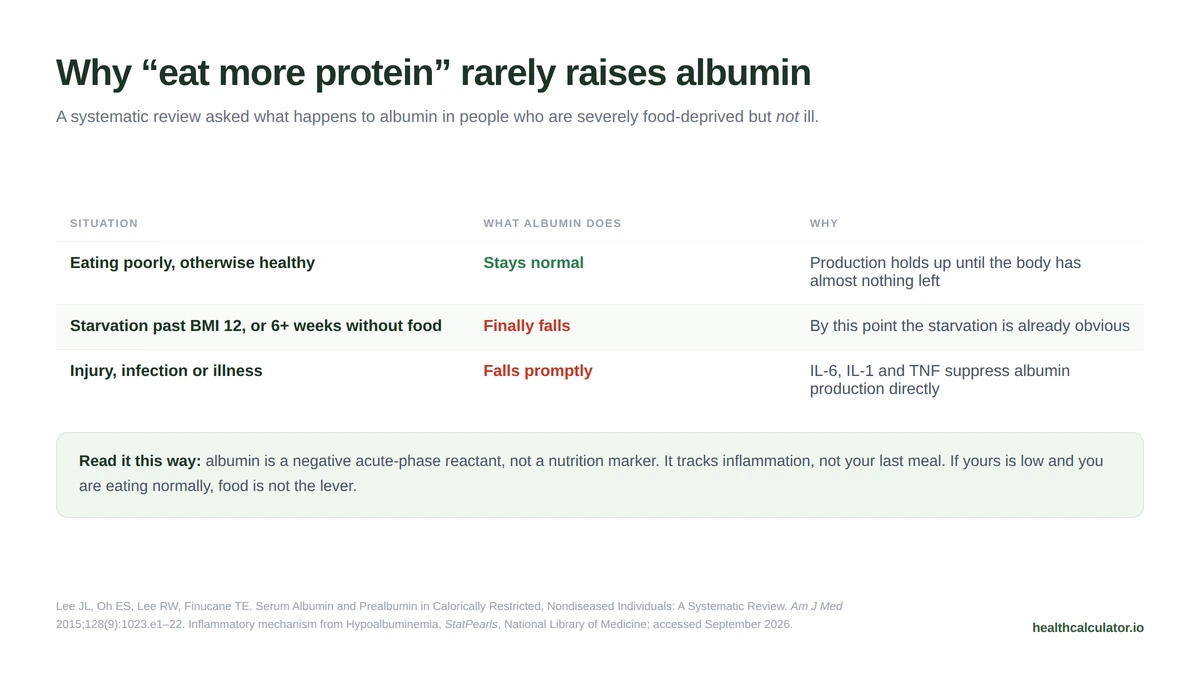
A systematic review in The American Journal of Medicine asked a simple question: in people who are genuinely starving but not sick, does albumin actually fall? The researchers gathered studies of otherwise healthy people who were severely deprived of food, either through poor access or unwillingness to eat.
The finding, in their words: serum albumin and prealbumin remained normal despite marked nutrient deprivation until the extremes of starvation, meaning a body mass index below 12 or more than six weeks without food.
A BMI of 12 is not “not eating enough protein.” That is a person in visible, life-threatening starvation.
Their conclusion was blunt. Albumin and prealbumin are not “markers of nutritional status”. They failed to identify people with severe protein-calorie malnutrition until the starvation was already obvious, while falling promptly with injury or illness regardless of what the person ate.
So when a page lists salmon, eggs and tofu as the fix for low albumin, it is answering a question almost nobody has. If your albumin is low and you are eating normally, food is not the lever.
Eating well still matters for recovery, healing and muscle. It is just not the thing that moves this number.
Doctors Tried Raising Albumin Directly. It Did Not Help.
If low albumin is dangerous, then pushing it back up should help. That sounds obvious enough that it was worth a large trial, and in 2021 the New England Journal of Medicine published one.
The ATTIRE trial enrolled 777 hospitalized patients with decompensated cirrhosis whose albumin was under 30 g/L. Half received repeated infusions of 20% human albumin, targeting a level of 30 g/L or higher. The other half got standard care.
The albumin group received a median of 200 g of albumin. The standard care group got 20 g. The gap was real and the target was hit.
The results:
| Outcome | Targeted albumin | Standard care |
|---|---|---|
| New infection, kidney dysfunction or death, days 3 to 15 | 29.7% (113 of 380) | 30.2% (120 of 397) |
Adjusted odds ratio 0.98, with a P value of 0.87. Nothing. And more severe or life-threatening serious adverse events occurred in the albumin group than in the standard care group.
Raising the number did not move the outcome. That is the strongest evidence there is that albumin is reporting on the illness rather than driving it.
To be clear about scope: this trial studied hospitalized cirrhosis patients, and albumin infusions do still have specific accepted uses in liver disease. The point is narrower and more useful. The number itself is not the target.
So What Actually Raises Albumin
Treating the cause. That is the whole answer, and it is less satisfying than a food list.
- Inflammation or infection: albumin recovers as the illness resolves. Given the 21-day half-life, expect weeks to months, not days
- Kidney loss: the treatment aims at the kidney disease and at protein leaking into urine, not at the albumin figure
- Liver disease: managing the liver condition is the work
- Gut loss: identifying and treating the bowel condition
- Genuine severe undernutrition: nutrition support helps here, and this is the situation where food genuinely is the answer
The recurring theme is that albumin follows. It is a downstream reading, and chasing it directly is what ATTIRE tested and found wanting.
Low Albumin Quietly Distorts Your Other Lab Results
This is the practical part nobody mentions, and it affects results you may already be holding.
Because albumin binds at least 40% of circulating calcium, a low albumin drags the measured total calcium down with it, even when the active calcium in your blood is perfectly normal. A calcium that looks low may not be. Our corrected calcium calculator applies the Payne formula that adjusts for this, and explains where that adjustment stops being reliable.
The same applies to the anion gap. Albumin carries most of the unmeasured negative charge that the gap is built from, so a low albumin makes the gap look falsely normal and can hide a real acidosis. Our anion gap calculator corrects for albumin and shows how much the correction changes the interpretation.
Sodium is the interesting exception. There is no albumin correction for it, and our corrected sodium calculator explains why arithmetic cannot fix a distorted sodium the way it can a distorted calcium.
If your panel came back with a low albumin and a low calcium together, run the corrected calcium before assuming you have two problems. Often you have one.
When to Get Help
Get prompt medical attention for new or rapidly worsening swelling, shortness of breath, a swollen abdomen, or signs of infection alongside a low albumin. Those point at the underlying condition, which is the thing that needs attention.
For a mildly low albumin found on a routine panel with no symptoms, the sensible next step is a conversation about why, not a protein shake. Reasonable questions for your doctor: is there inflammation, is protein leaking into my urine, how are my liver and kidneys, and should this be rechecked.
Ask for the recheck to be a few weeks out at least. With a 21-day half-life, testing again next week tells you very little.
The Bottom Line
This article is for informational purposes only and does not constitute medical advice or diagnosis. Always consult a qualified healthcare professional. Low albumin is a marker that requires interpretation in the context of your full clinical picture, and no article can do that for you.
Browse our health calculators for the lab tools referenced above.
Frequently Asked Questions
It depends on the cause and your age. In a cohort of 17,930 people followed 13 years, low albumin raised mortality risk in those 65 and over (hazard ratio 1.83) but showed no measurable effect under 65 (1.03). The danger sits in what caused it, not the number itself.
There is no life expectancy attached to an albumin level, because albumin is not the illness. People live for decades with chronic conditions that keep albumin slightly low. Prognosis follows the underlying cause, which is the question worth asking your doctor instead.
For most people, none of them meaningfully. A systematic review found albumin stays normal despite marked nutrient deprivation until a BMI below 12 or six weeks of starvation. Unless you are severely undernourished, food is not what is holding your albumin down.
Weeks to months. Albumin has a half-life of 21 days, so the level you see today reflects the past several weeks rather than the past few days. Rechecking within a week or two rarely tells you anything useful.
They raise the number without reliably improving outcomes. In the ATTIRE trial of 777 cirrhosis patients, targeted infusions hit the albumin target but produced 29.7% versus 30.2% event rates against standard care, with more serious adverse events. Infusions still have specific accepted uses, decided clinically.
Roughly 35 to 50 g/L, or 3.5 to 5.0 g/dL. Laboratories set their own reference intervals from their own analyzers and populations, so the range printed on your report is the one your result should be read against.
Yes, when it falls far enough. Albumin holds fluid inside blood vessels through oncotic pressure. Below a certain point that pull weakens and fluid moves into surrounding tissue, producing swelling in the ankles, legs or abdomen. Mild reductions usually cause no visible swelling at all.
Yes, and it is easy to miss. Albumin binds at least 40% of circulating calcium, so low albumin pulls measured total calcium down even when active calcium is normal. It also narrows the anion gap. Run the corrected calcium before assuming two separate problems.
Sources
Every figure on this page is drawn from government health statistics or peer-reviewed research. Last verified September 2026.
- Di Castelnuovo A, Bonaccio M, Costanzo S, et al.; Moli-sani Study Investigators. The association between hypoalbuminemia and risk of death due to cancer and vascular disease in individuals aged 65 years and older: findings from the prospective Moli-sani cohort study. eClinicalMedicine. 2024;72:102627. doi:10.1016/j.eclinm.2024.102627.
- Gounden V, Vashisht R, Jialal I. Hypoalbuminemia. In: StatPearls. StatPearls Publishing, National Library of Medicine; last updated 28 August 2023, accessed September 2026.
- MedlinePlus. Albumin Blood Test. National Library of Medicine; accessed September 2026.
- Lee JL, Oh ES, Lee RW, Finucane TE. Serum Albumin and Prealbumin in Calorically Restricted, Nondiseased Individuals: A Systematic Review. The American Journal of Medicine. 2015;128(9):1023.e1-22. doi:10.1016/j.amjmed.2015.03.032.
- China L, Freemantle N, Forrest E, et al.; ATTIRE Trial Investigators. A Randomized Trial of Albumin Infusions in Hospitalized Patients with Cirrhosis. The New England Journal of Medicine. 2021;384(9):808-817. doi:10.1056/NEJMoa2022166.