Most Omni Calculator review posts count the tools and stop. Fine. There are 3,800 of them, 430 in health, and the math inside is right. But nobody asks the obvious thing, which is whether the number it just handed you is actually yours. I opened one and checked it against the report Omni cites.
Quick disclosure before anything else. I build health calculators myself, so I’m hardly a neutral party here. Everything below is either something I read in a primary source or something I watched happen on my own screen, and I’ve linked all of it. Checking my work should take you about a minute.
Omni gave me the right number. It just might not be mine.
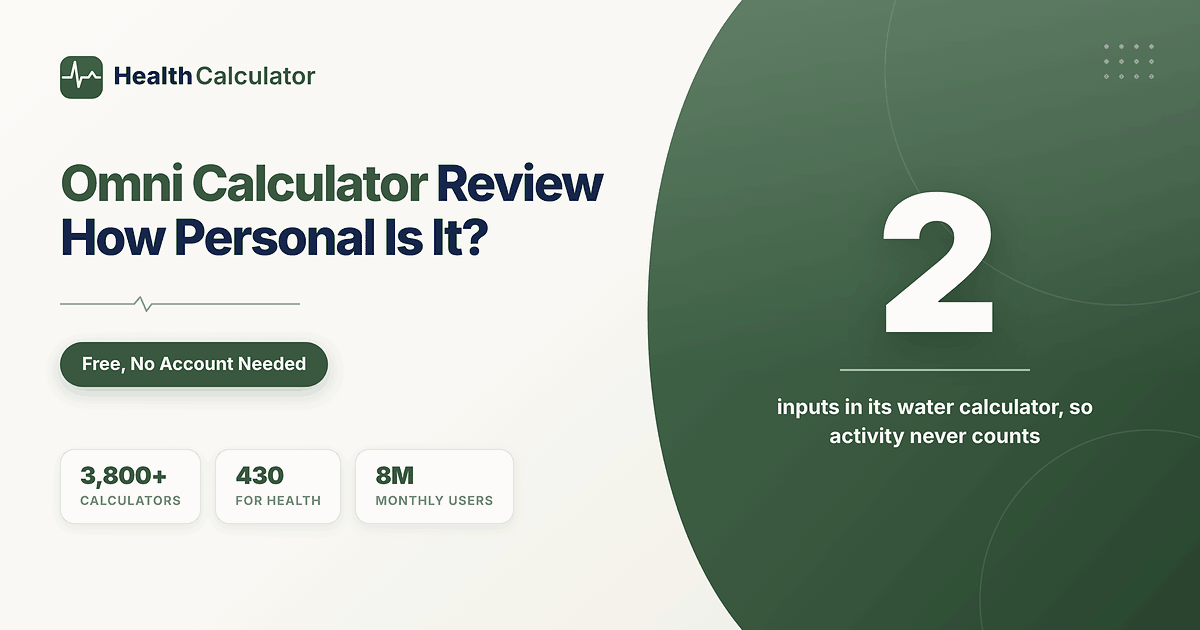
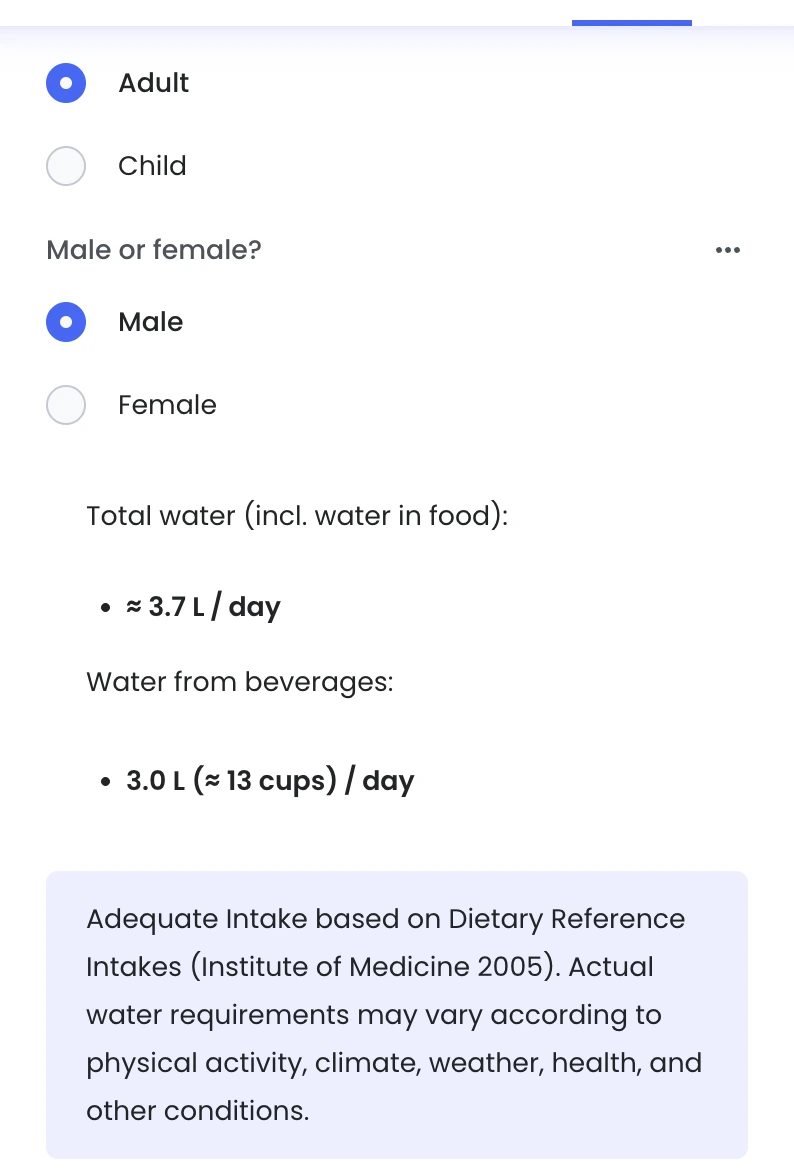
On October 7, 2026 I opened Omni’s water intake calculator and answered what it asked. It asked two things. Adult or child. Male or female.
That was the whole interview. It came back with 3.7 liters of total water a day, and 3.0 liters of that from beverages.
The number is correctly implemented. It comes from the Dietary Reference Intakes, and Omni says so on the result itself, which is more than most sites manage. But two questions can’t produce a personal answer, and the report those figures come from is specific about who they describe.
Where 3.7 liters actually comes from
The figure traces to a 2004 Institute of Medicine panel, and the National Academies’ own announcement of it contains a sentence that almost nobody quotes.
Total water intake at the reference level of 3.7 liters for adult men and 2.7 liters for adult women covers the expected needs of healthy, sedentary people in temperate climates.
Sedentary. Temperate. Those two words decide whether the number on your screen means anything at all, and Omni’s calculator has no way of knowing either, because it never asks.
The same release is blunt about the folk rule too. Lawrence Appel, the Johns Hopkins professor who chaired the panel, said they deliberately offered no rule of thumb about how many glasses to drink, because hydration comes from food and every other drink as well. The panel also declined to set an upper limit for water at all.
One more figure from that release, since it explains Omni’s second line: roughly 80 percent of total water comes from drinks and the remaining 20 percent from food. That’s why 3.7 liters of total water becomes about 3.0 liters of actual drinking.
So what if you are not sedentary?
The same report answers that, and the answer is a long way from 3.7 liters.
Very active people continually exposed to hot weather often have daily total water needs of six liters or more. That’s roughly 62 percent above the sedentary reference, from the same panel, in the same document. A calculator that only asks your sex can’t place you anywhere on that range.
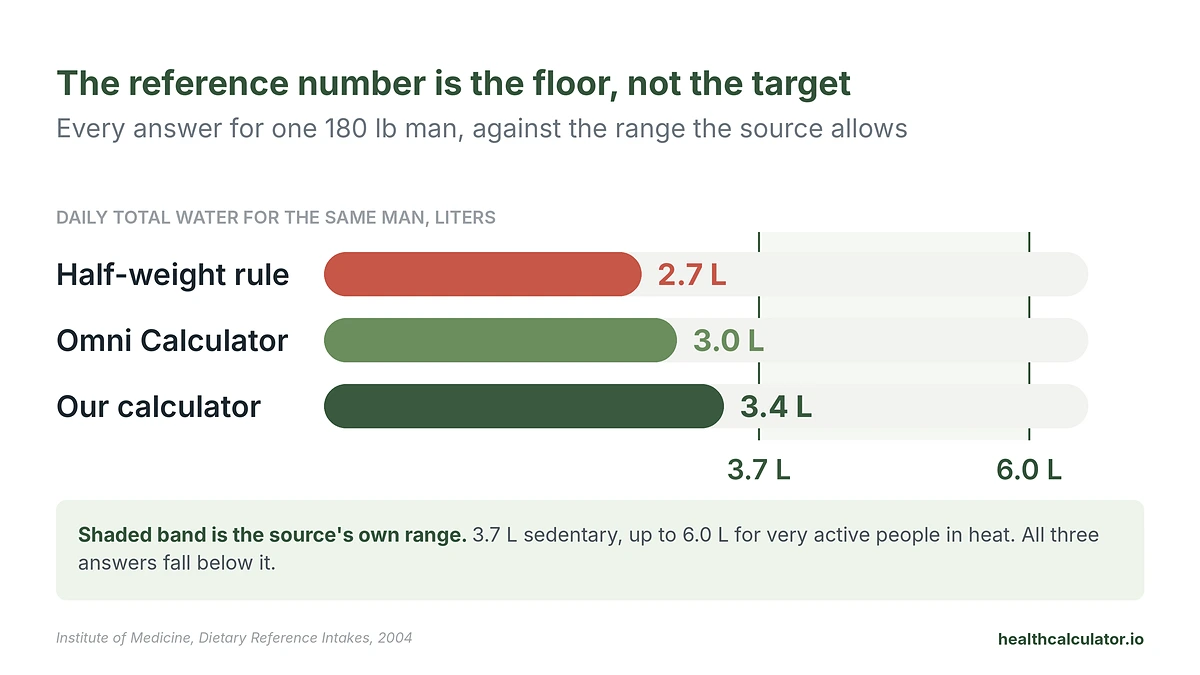
Three other things the panel settled that are worth carrying around.
There’s no official ceiling. The panel declined to set a tolerable upper intake level for water, because excessive drinking severe enough to cause harm is rare outside endurance sport and specific psychiatric conditions.
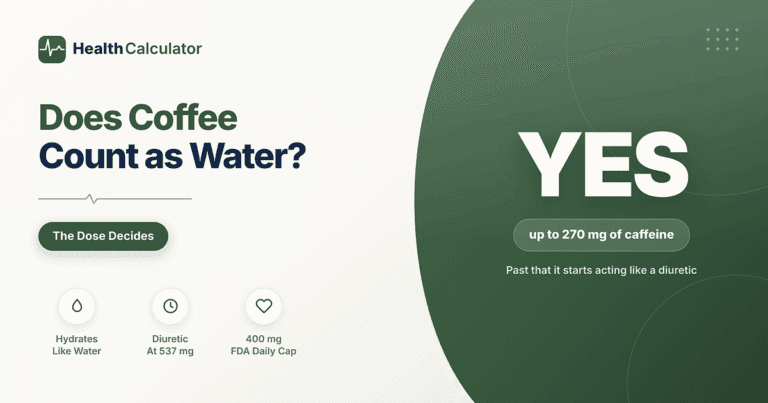
Coffee and tea count. The diuretic effect of caffeine appears transient, and the panel found no convincing evidence that caffeine produces a cumulative water deficit, so caffeinated drinks contribute about as much as plain water. We walk through what that means for your morning cups in does coffee count as water.
And thirst mostly works. For the average person, drinking to thirst plus the beverages that come with meals keeps hydration adequate, which is a finding that undercuts every rigid daily target including the ones calculators produce.
None of that reaches Omni’s result box. It’s all sitting in the document Omni correctly cites.
Three answers for one man, two of them from Omni
Here’s the part that made this worth writing.
Omni’s water page uses a 180 pound person as its own worked example for the half-your-bodyweight rule. So I used the same person: a 30 year old man, 180 pounds, moderately active, temperate climate. Then I collected every answer available for him.
| Source | Answer for the same man | What it accounts for |
|---|---|---|
| Omni’s calculator | 3.0 L from beverages | Age bracket and sex |
| The half-bodyweight rule, quoted on Omni’s own page | 2.7 L (90 fl oz) | Body weight only |
| Our water intake calculator | 3.4 L | Weight, age, sex, activity, climate |
Two of those three numbers come from the same Omni page, and they disagree by 300 milliliters. Neither one is an error. They are different methods answering slightly different questions, printed next to each other without anything telling the reader that.
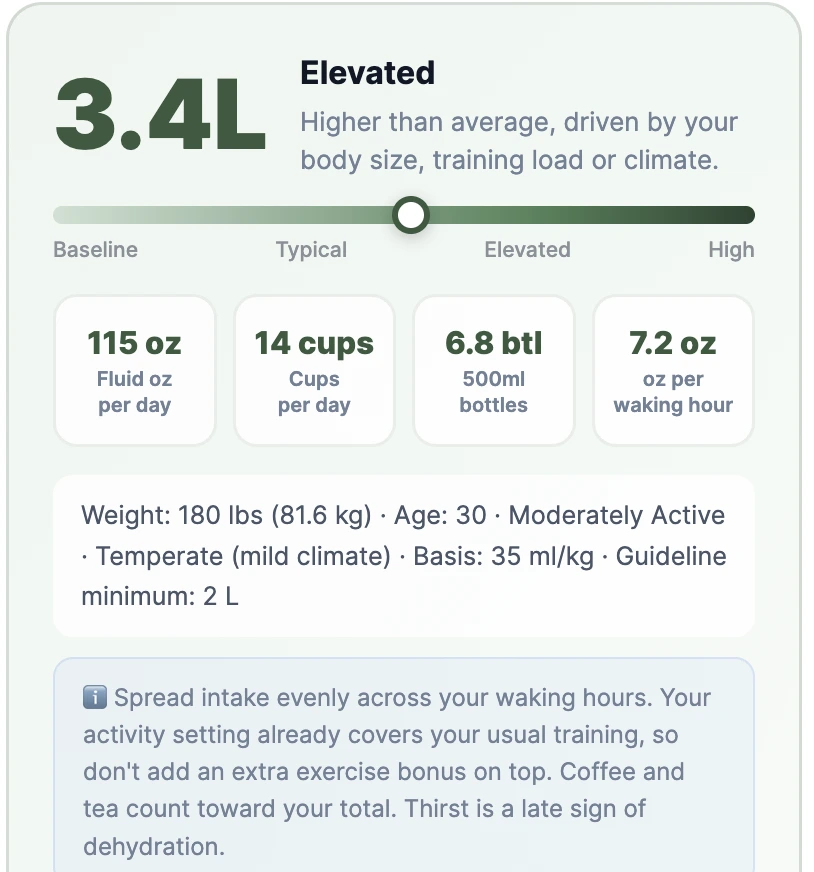
Our figure is higher because moderate training was in the inputs. Omni’s is the sedentary reference, correctly reported. Run the arithmetic yourself if you like: 180 pounds is 81.6 kg, times 35 ml is 2,858 ml, lifted by the activity multiplier to 3,429 ml.
I would not call any of this a flaw in Omni. I would call it the ceiling of a two question calculator, and the reason I built ours to ask five. You can try the same inputs on the water intake calculator.
What Omni does better than almost every health site
I went in looking for things to criticize and kept finding the opposite, so here it is.
Omni names its people. The water calculator credits Hanna Pamuła, PhD and Łucja Zaborowska, MD, PhD candidate as creators, with two named reviewers underneath. Most health content on the open web carries no byline at all, and a named MD on a free calculator is a real trust signal.
It states its source on the result. The output box names the Dietary Reference Intakes and the year. Very few tools do that.
It hedges where it should. The result carries a line saying actual requirements vary with physical activity, climate, weather and health. That warning is honest, even though the inputs it collects can’t act on it.
And it says the thing many health sites will not: it can never replace a professional assessment.
And there’s a documented process behind it. Omni publishes a four-step editorial policy: design the algorithm, write the article, have it reviewed by someone else who specializes in the topic, then proofread. Reviewers get named on the calculator page itself, which is where I found the two on the water tool.
One gap, and it’s a narrow one. Omni says reviewers are carefully recruited with expertise in specific scientific areas, but it doesn’t publish their qualifications, and health calculators go through the same four steps as every other category. For a site running 430 medical tools next to its mortgage and physics ones, a tighter standard for the health half would be worth having.
The arithmetic of 430 health calculators
Omni publishes more than 3,800 calculators across 14 categories, 430 of them in health, serving 8 million unique users a month. The company has grown from 5 people in 2018 to close to 40 core members, and it started in 2011 with a percentage calculator.
Forty people. Fourteen categories. Mathematics, finance, physics, chemistry, construction, ecology, sports, food, and 430 health tools among them.
That’s not an accusation. The pages I actually opened were better sourced than I expected. It’s just a structural fact worth knowing: a site covering everything can’t go as deep on your A1C as a site covering twelve things. Breadth and depth trade against each other, and Omni has chosen breadth, openly and successfully.
Is Omni Calculator free?
Yes, completely, with no account and no paywall. I used the water calculator logged out.
It runs on advertising instead. On the water page I counted display units above the tool and beside it, which is the trade for free access across 3,800 calculators and no subscription anywhere. Compare that to the clinical tools, where the calculators are free but continuing education credit costs hundreds of dollars a year.
There is a login and a sign-up option in the header. I didn’t test what an account changes, since nothing I actually wanted sat behind it, so treat that as unexamined rather than as a verdict. Each calculator also offers share and embed controls, which is how Omni pages end up quoted across other sites.
No free trial, no upgrade prompt, no email wall before a result. For a site this size, that’s worth saying plainly.
When to use Omni, and when to use something narrower
| Your situation | Omni is | Why |
|---|---|---|
| You want a quick reference figure | the right tool | Fast, correctly sourced, free, covers almost everything |
| You need math outside health | the right tool | 3,400+ non-health calculators, and this is where it is strongest. Calculator.net is the other big one |
| Your own activity, climate or body size matters | too blunt | A two input calculator cannot personalize what it never asked |
| You want the result explained | too thin | Good sourcing, but the interpretation is brief |
| You are reading a clinical lab value | the wrong shape | A tool built for one metric will carry more context |
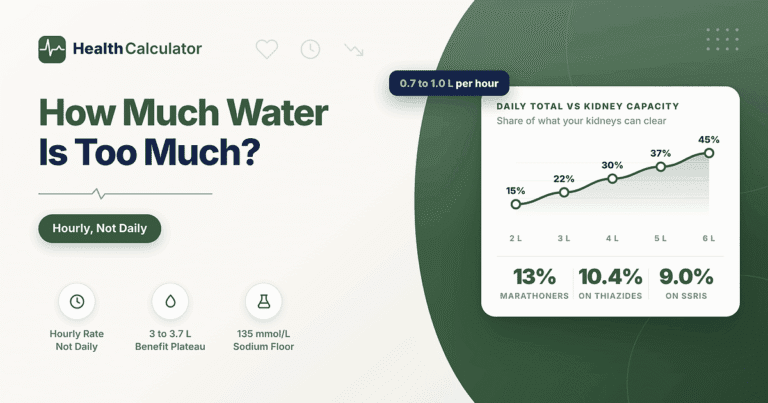
I’m not pretending six calculators beat 3,800. They don’t. What a small site can do is ask more questions about one number and then explain the answer, which is the trade you want when the number is about your body and not your mortgage. Ours do that for water intake, BMI and A1C, and the reasoning behind the hydration numbers sits in how much water is too much.
For most things you will type into a search box, Omni is a good answer. For the handful that are specifically about you, ask a tool that wants more than two facts.
This article is for informational purposes only and does not constitute medical advice or diagnosis. Always consult a qualified healthcare professional.
Frequently Asked Questions
Yes, the math is correct and the sources are named. The limitation is personalization. Its water calculator asks only age bracket and sex, then returns the reference figure for a sedentary person in a temperate climate, which may not describe you.
Yes. All 3,800+ calculators are free with no account required and no paywall on any tool I tested. The site is funded by display advertising, so expect ad units around the calculator. Signing up is optional and gives you nothing you need for the math.
Individual pages name them. The water intake calculator credits Hanna Pamuła, PhD and Łucja Zaborowska, MD, PhD candidate, plus two named reviewers. Omni publishes a four-step editorial policy that includes review by a topic specialist, though it doesn’t list reviewer credentials or set a separate standard for medical content.
Reliable as a reference, not as personal advice, which Omni states itself. Its tools report published figures correctly. They cannot account for factors they do not collect, and no free calculator of any kind substitutes for a clinician who knows your history.
Different inputs, usually. For a 30 year old 180 pound moderately active man on October 7, 2026, Omni returned 3.0 liters from beverages while our calculator returned 3.4 liters. Omni reports the sedentary reference value; ours adjusts for weight, activity and climate.
More than 3,800 across 14 categories, with 430 or more in health. Omni reports 8 million unique users monthly and traces its start to a percentage calculator built in 2011. Those are the company’s own published figures rather than audited numbers.
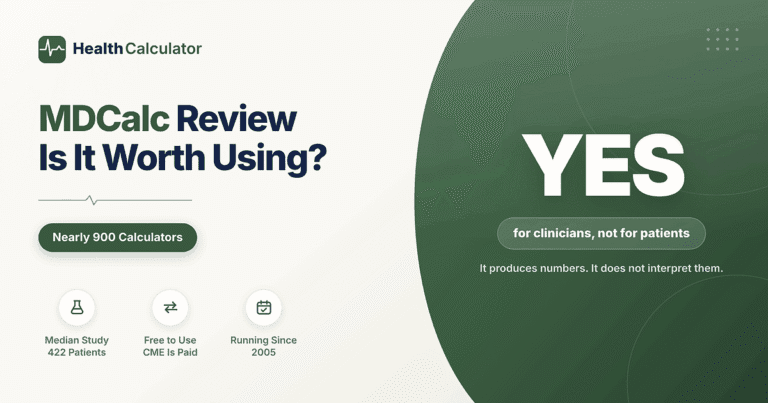
It depends what you need. Clinicians generally use MDCalc for scored clinical tools, and I put it through the same test in a separate review. For a personal health number explained in plain English, a focused calculator that collects more inputs will serve you better than any general-purpose site, including ours for hydration and body metrics.
No guideline body publishes that rule. The Institute of Medicine panel deliberately offered no rule of thumb for daily glasses, since water comes from food and all beverages. For a 180 pound person the rule gives 2.7 liters, close to the reference figure by coincidence rather than design.
Sources
Every figure on this page is drawn from primary sources or first-hand testing. Last verified October 2026.
- Omni Calculator. Water Intake Calculator. Omni Calculator sp. z o.o.; last updated September 22, 2026. Accessed October 7, 2026.
- Institute of Medicine, Food and Nutrition Board. Report Sets Dietary Intake Levels for Water, Salt, and Potassium To Maintain Health and Reduce Chronic Disease Risk. The National Academies; February 11, 2004.
- Omni Calculator. Editorial Policies. Omni Calculator sp. z o.o.; accessed October 7, 2026.
- Omni Calculator. Omni by the Numbers. Omni Calculator sp. z o.o.; accessed October 2026.