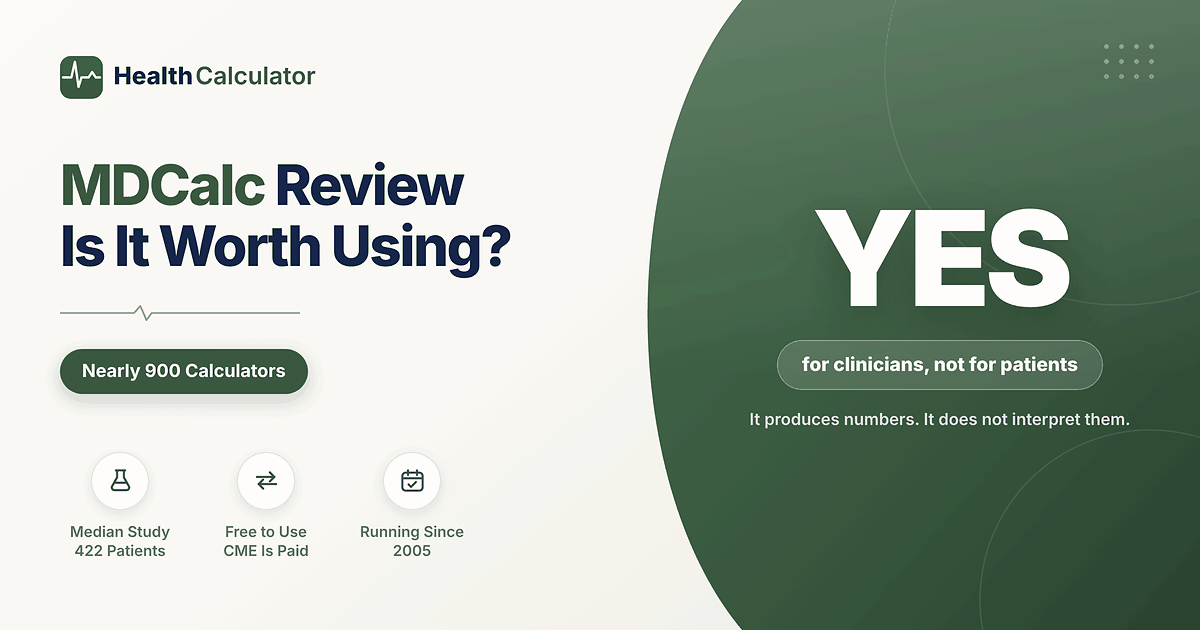
Every MDCalc review says roughly the same three things. It is free, clinicians love it, five stars. All three are true. None of them mention that a September 2026 analysis of 407 MDCalc calculators found the median validation study behind them enrolled just 422 patients, which is the number that actually decides how much your result is worth.
I run a calculator site myself, so read this with that in mind. I am not neutral about calculators in general. What I can do is show my work: every figure below links to the thing it came from, and the one comparison I make between MDCalc and my own MAP calculator is a dated run you can repeat in about forty seconds.
What MDCalc is, in one paragraph
MDCalc started in 2005 as a website one emergency medicine resident built so he would stop having to memorize risk scores. Today its founders, Graham Walker and Joe Habboushe, say it carries nearly 900 evidence-based calculators and that more than four out of five US clinicians use it. Those are the company’s own numbers, not an audited figure, and I could not find independent verification of the 80 percent claim. The scale is real either way. STAT News, covering the platform in July 2026, described it as the tool used by millions of doctors.
The important part for you is what kind of tool it is. MDCalc is built for a clinician standing next to a patient. Not for you, at home, holding a lab report.
Is MDCalc free?
Yes. The calculators are free, there is no paywall on them, and you do not need an account. I used the MAP calculator for this review without logging in. The 2019 peer-reviewed app review in the Journal of Digital Imaging also lists the app price as free, and it works offline.
What costs money is continuing medical education credit. Clinicians can earn CME from the clinical content sitting behind the calculators, but redeeming the certificate needs a subscription:
| Plan | Price per year | Credits |
|---|---|---|
| Plus 30 | $299 | 30 AMA PRA Category 1 credits |
| Plus 50 | $499 | 50 credits |
| Plus 100 | $999 | 100 credits |
| Unlimited | $1,499 | Unlimited |
Verified on MDCalc’s CME page in October 2026. CME is available across 275+ of their tools. If you are not a clinician chasing credit, none of this affects you. You will never hit a paywall.
Is MDCalc accurate? There are two questions hiding in that one
This is the question everyone types, and almost every review answers the easy half of it.
The arithmetic is fine. That was never the risk.
MDCalc runs the formula correctly. I checked the MAP calculator against the published equation and it matches. StatPearls gives the formula as MAP = DP + 1/3(SP – DP), and MDCalc returns exactly that. I found no credible report of a math error in a major MDCalc tool while researching this, and nothing wrong in the one I tested.
So if “accurate” means “does it add up,” the answer is yes, and you can stop reading.
The validation underneath is where it actually varies
Here is the part nobody puts in a review.
In September 2026, a team led by Shuhan He at Massachusetts General Hospital published a cross-sectional analysis of the MDCalc catalogue on medRxiv. They pulled 407 unique calculators out of the 847 then listed, and worked through 482 published evaluations of them. It is the only study I know of that asks what these results actually mean rather than whether the buttons work.
Three findings matter to you.
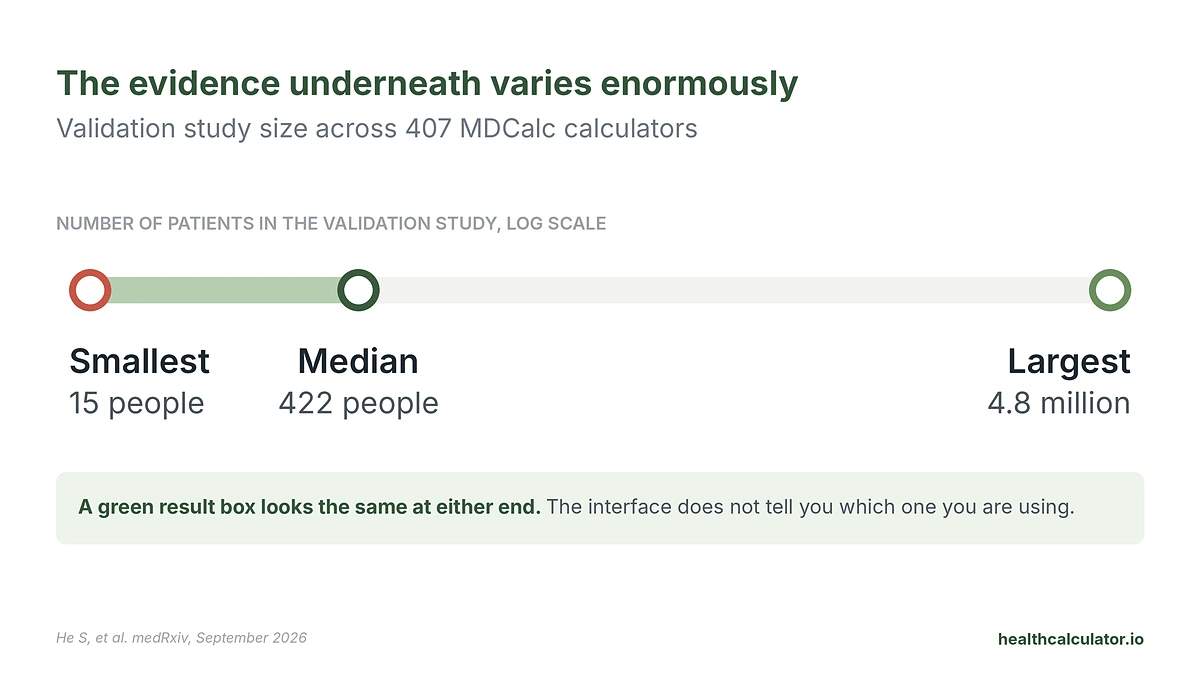
First, the evidence base is thinner than the interface suggests. The median evaluation enrolled 422 participants, across a range running from 15 people to more than 4.8 million. A clean green result box looks identical whether the score behind it was tested on five thousand patients or fifteen.
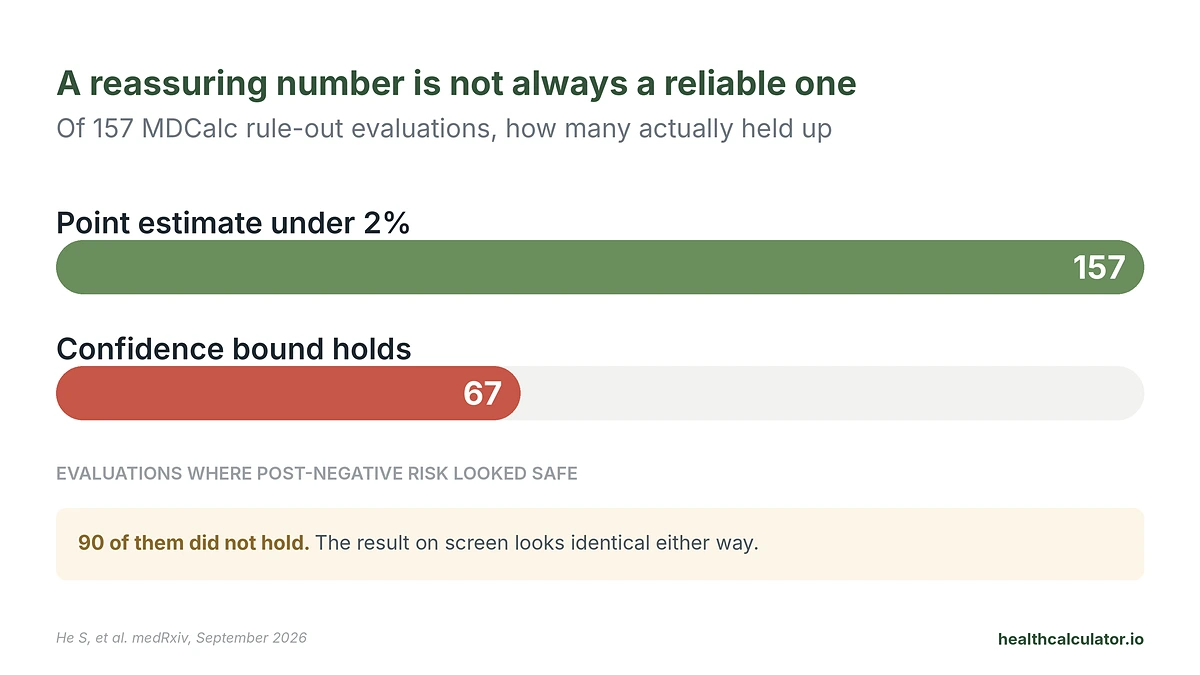
Second, and this is the finding I would tattoo on the inside of every “rule-out” calculator: of 157 evaluations where the point estimate suggested the post-negative risk was under 2 percent, only 67 had an upper 95 percent confidence bound that stayed under 2 percent. That is 67 out of 157. For the rest, the reassuring number on screen was not statistically solid enough to carry the reassurance it implies.
Third, most of the information a calculator gives you comes from one branch of it. In 329 of the 482 evaluations, 68.3 percent, a single classification supplied more than 60 percent of the information gain. The authors’ blunt summary is that clinical calculator results have no single quantitative meaning.
None of that is MDCalc’s fault. They did not run those original studies. But it does mean the honest answer to “is MDCalc accurate” is: the tool is accurate, and the underlying science is uneven, and the interface does not currently tell you which calculator you are looking at.
To their credit, they know
In July 2026 MDCalc announced a quality rating system covering more than 800 of their tools, built to flag how well validated each one is. Shazia Siddique, a gastroenterologist and health systems researcher working with them, put the problem plainly: with a lot of the tools clinicians use, we genuinely have no idea how limited it is in its validation.
That is a company naming its own biggest weakness in public. It is the single most reassuring thing in this review, and it is the reason my verdict lands where it does.
I ran the same reading through both calculators
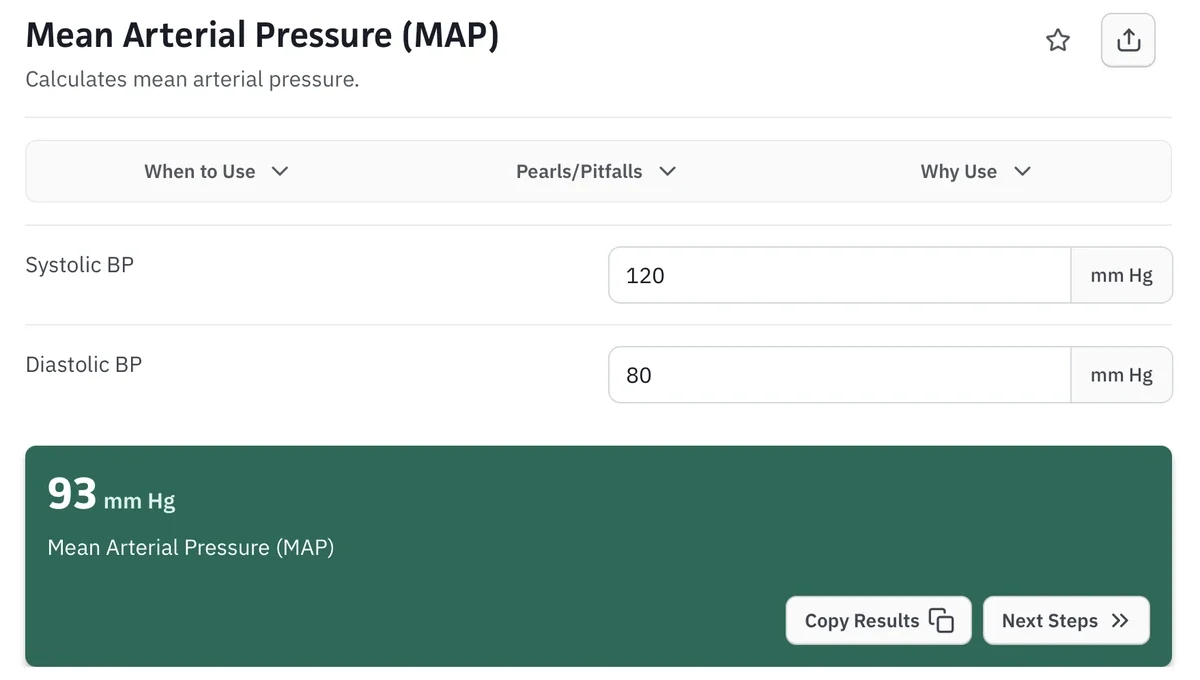
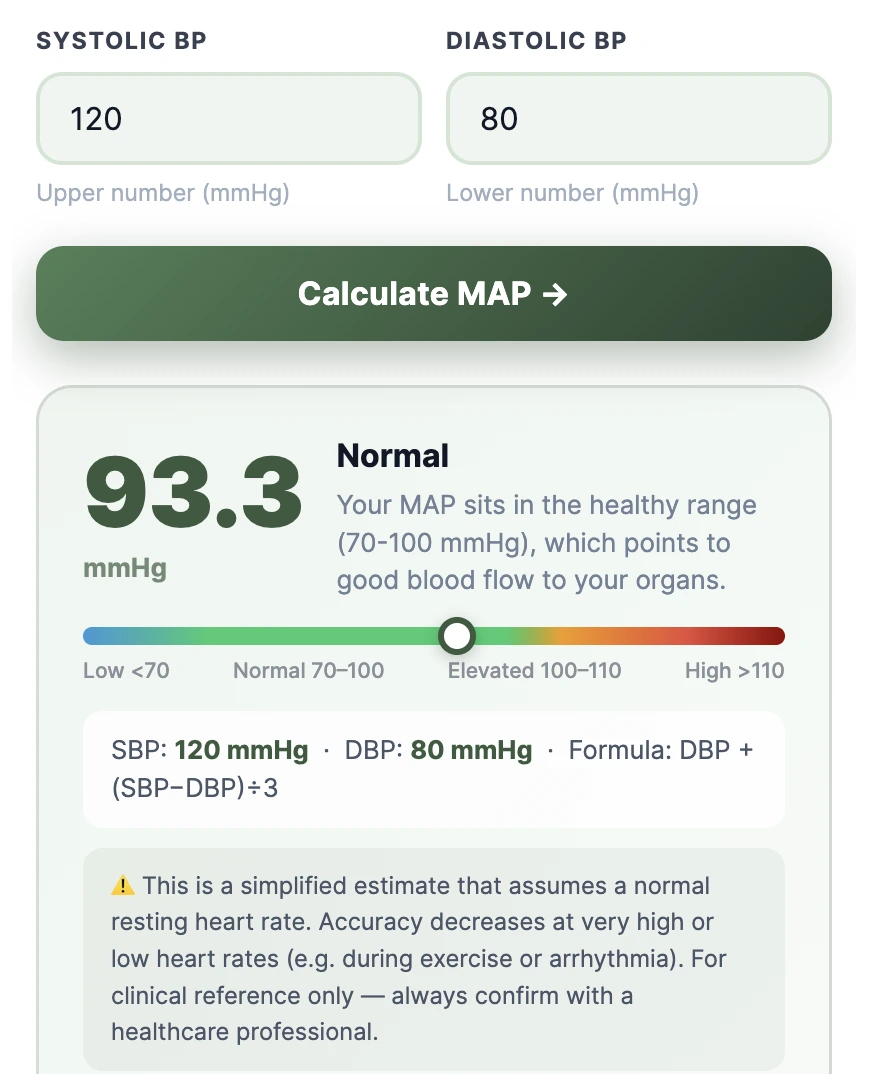
Enough theory. On October 6, 2026 I put the same reading into MDCalc’s MAP calculator and into mine, and screenshotted both.
Input: systolic 120, diastolic 80. A textbook normal reading.
| What you see | MDCalc | Health Calculator |
|---|---|---|
| Result | 93 mm Hg | 93.3 mmHg |
| Formula shown on screen | No | Yes, DBP + (SBP−DBP)÷3 |
| Interpretation given | “Patients with a MAP under or above set goal values should be treated with fluids, blood products, vasopressors, inotropes, or vasodilators” | “Normal. Your MAP sits in the healthy range (70-100 mmHg), which points to good blood flow to your organs” |
| Visual range band | No | Yes, Low / Normal / Elevated / High |
| Limitation flagged on the result | Behind a Pearls/Pitfalls tab | On the result itself, warns accuracy drops at very high or low heart rates |
Same formula. Same math. Completely different product.
My read on the rounding: a clinician titrating a vasopressor has no use for the decimal, so 93 is the useful number. The result then talks about inotropes, which tells you who the page expects to be reading it. MDCalc’s own page notes a MAP of at least 60 mmHg is believed necessary for tissue perfusion and at least 65 mmHg is recommended in severe sepsis by the Surviving Sepsis Campaign. StatPearls agrees on the 60 mmHg minimum.
If you are a nurse or a resident, MDCalc’s version is better. It is denser, faster, and it does not waste your time explaining what a normal range is.
If you googled your blood pressure at 11pm, MDCalc hands you a correct number and a sentence about vasodilators, and you are no better off than before. That is not a flaw. You are simply not the user it was built for.
Who should not be using MDCalc
Three groups, honestly:
Patients reading their own results. The tools I opened all assume clinical training, and the platform is built for clinicians by design. Nothing is dumbed down, and nothing is meant to be.
Anyone wanting a number explained rather than produced. The interpretation layer is written clinician-to-clinician. “Consider pressors” is not guidance you can act on.
Anyone who needs to know how solid a given score is. The ratings will score each tool on importance, scientific soundness and usability, with bias assessed through a published framework. Until they reach the whole catalogue, a well-validated score and a thin one look the same on screen. When I used the MAP calculator on October 6, 2026, no rating was shown on it. That is the gap the medRxiv work exposed, and it is the one real criticism I would make of the product as it stands today.
MDCalc alternatives, sorted by what you actually need
“MDCalc alternative” is a query with at least four different people behind it. Pick your row:
| If you want | Use | Why |
|---|---|---|
| The same clinical depth, different interface | Calculate by QxMD | The alternative clinicians name most often, and the one comparison sites line up against MDCalc directly |
| Your own lab or vital sign explained in plain English | A patient-facing calculator, including mine | Built to interpret, not just compute |
| Guideline text wrapped around the number | UpToDate (paid) or Medscape (free) | Calculators sit inside a full clinical reference rather than standing alone |
| General, non-clinical math | Omni Calculator or Calculator.net | Far broader catalogues, far shallower on medicine. I reviewed Omni and Calculator.net separately |
One caveat on that table. I verified MDCalc’s pricing and behavior myself for this review, but I have not audited the others to the same standard, so treat those rows as a starting point rather than a tested verdict.
I will not pretend my site replaces MDCalc. It does not. Six calculators against nearly 900 is not a competition. What I would say is that if you are not a clinician, “fewer tools, each one explained” is probably the trade you want. You can see how that reads on the MAP calculator, the GFR calculator, or the A1C calculator.
So is MDCalc reliable?
For its intended user, yes, and I would not hesitate to say so. Twenty years of clinician review, correct math, free access, and a company that just published a plan to grade its own tools on validation strength.
The reliability question is not really about MDCalc. It is about clinical calculators as a category, where a reassuring number can rest on 422 patients and a confidence interval nobody shows you. MDCalc is the platform doing the most to fix that. It just has not finished.
This article is for informational purposes only and does not constitute medical advice or diagnosis. Always consult a qualified healthcare professional.
Frequently Asked Questions
Yes. Every calculator on MDCalc is free and no account is required. The only paid product is CME credit for clinicians, which runs from $299 to $1,499 a year. If you are not claiming CME, you will never hit a paywall.
The calculations themselves are accurate and correctly implemented. The variable is the research behind each score. A 2026 analysis of 407 MDCalc calculators found the median validation study enrolled 422 people, so evidence strength differs sharply between tools.
It is reliable but not written for you. MDCalc assumes clinical training and returns management advice like “consider vasopressors” that a patient cannot act on. The number will be correct. The context needed to use it safely is missing unless you are a clinician.
MDCalc was built in 2005 by emergency physician Graham Walker and later co-founded with Joe Habboushe. It operates as MD Aware, LLC. The founders marked twenty years in December 2025, reporting nearly 900 calculators in the catalogue.
It depends who is asking. Clinicians wanting the same depth in a different interface usually choose Calculate by QxMD. Patients wanting their own result explained are better served by a plain-language calculator. There is no single best alternative because MDCalc serves one audience very specifically.
Yes. The mobile app works without a connection, which the 2019 review in the Journal of Digital Imaging confirmed and rated five out of five for content and usability. Offline access matters in hospital areas with poor signal, which is much of why clinicians rely on it.
Usually rounding, not disagreement. Running 120/80 through both on October 6, 2026, MDCalc returned 93 mm Hg and our MAP calculator returned 93.3 mmHg. Same formula, different display convention. A gap larger than a rounding step usually means the two tools use different equations.
No, and it does not need to be. Clinical reference calculators of this type are not regulated as medical devices, which the published app review records as FDA approval not applicable. The same is true of essentially every medical calculator you will find online, including ours.
Sources
Every figure on this page is drawn from primary sources or first-hand testing. Last verified October 2026.
- He S, et al. Meaning of clinical calculator results: a cross-sectional analysis of the MDCalc catalogue. medRxiv. 2026. Preprint, posted September 10, 2026.
- Walker G, Habboushe J. A Letter From the Founders: MDCalc Marks 20 Years. MDCalc; December 1, 2025.
- MDCalc is scoring the clinical calculators used by millions of doctors. STAT News; July 17, 2026.
- Elovic A, Pourmand A. MDCalc Medical Calculator App Review. Journal of Digital Imaging. 2019;32(5):682-684. doi:10.1007/s10278-019-00218-y.
- MDCalc. MDCalc CME subscription packages. MD Aware, LLC; accessed October 2026.
- MDCalc. Mean Arterial Pressure (MAP) Calculator. MD Aware, LLC; accessed October 6, 2026.
- DeMers D, Wachs D. Physiology, Mean Arterial Pressure. StatPearls Publishing; 2023. PMID: 30855814.