Dr. Farah Taqueer is a pediatrician based in Karachi with more than 14 years of clinical experience. She qualified with an MBBS from Liaquat University of Medical and Health Sciences and holds an MD in Pediatrics, and is registered with...
The anion gap is the quickest screen in the whole metabolic panel for a hidden acid in your blood. This anion gap calculator runs it with or without potassium, corrects it for low albumin, and gives you the delta ratio. It also covers something the other tools tend to skip: it shows you why your lab's normal range probably does not match the one you read online.
Enter your sodium, chloride and bicarbonate in the calculator. Everything else on this page explains what the number is telling you.
What the Anion Gap Actually Measures
Your blood carries the same number of positive and negative charges. Always. A lab panel only measures a few of them, so subtracting the anions it measures from the cations it measures leaves a gap. That gap is not real. It is the space where the ions nobody measured are hiding.
Most of that space belongs to albumin. At normal pH, albumin accounts for roughly 75% of the unmeasured anions. The rest is phosphate, sulfate, lactate and organic acids.
So when the gap widens, it usually means an acid has arrived that the panel cannot see. Lactate from poor perfusion. Ketones from uncontrolled diabetes. Toxins. Retained acids in kidney failure. The gap does not tell you which one. It tells you to go looking.
The Anion Gap Formula
Without potassium (the common version):
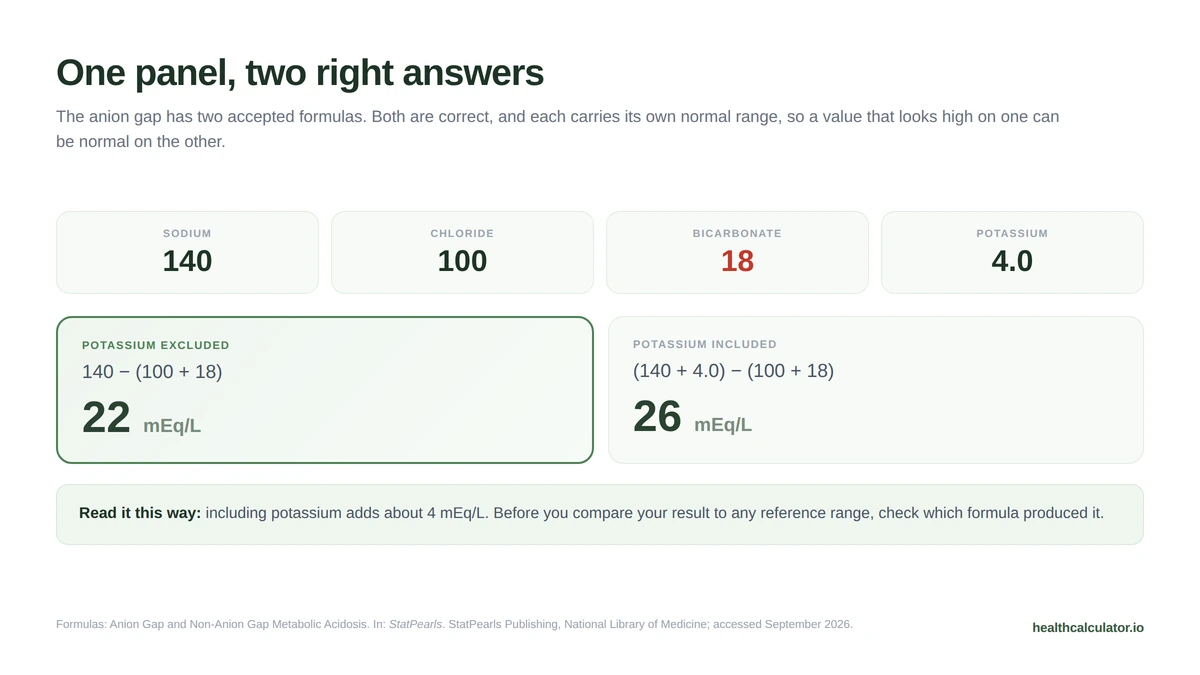
Anion gap = Sodium − (Chloride + Bicarbonate)
With potassium:
Anion gap = (Sodium + Potassium) − (Chloride + Bicarbonate)
Both are correct. They just answer with different numbers, and the normal range shifts with them. Including potassium adds roughly 4 mEq/L to the result, so a value that looks high on one version can be normal on the other. MDCalc leaves potassium out entirely, Omni and Medscape offer both. Check which one produced your number before you compare it to anything.
A note on units, because this trips people up
Enter sodium, chloride, bicarbonate and potassium in either mEq/L or mmol/L. For these four ions the two units are numerically identical, which is why MedlinePlus prints sodium as 136 to 144 mEq/L (136 to 144 mmol/L). No conversion, no thinking about it.
Albumin is the one that bites. It is reported as g/dL in the US and g/L almost everywhere else, and those differ by a factor of ten. Feed 24 g/L into a formula expecting 2.4 g/dL and your correction is nonsense. This calculator has a g/dL and g/L switch on the albumin field so you can paste straight off your report.
One more thing worth knowing: many US panels label bicarbonate as CO₂ or total CO₂. Same value, use it.
Worked example, with the numbers this tool returns
Say your panel reads sodium 140, chloride 100, bicarbonate 18, all in mEq/L.
Add the measured anions: 100 + 18 = 118
Subtract from sodium: 140 − 118 = 22 mEq/L
That is a clearly raised gap on any of the reference ranges in the next section. Add a potassium of 4.0 and the same patient reads 26. Same blood, two right answers.
What Counts as a Normal Anion Gap
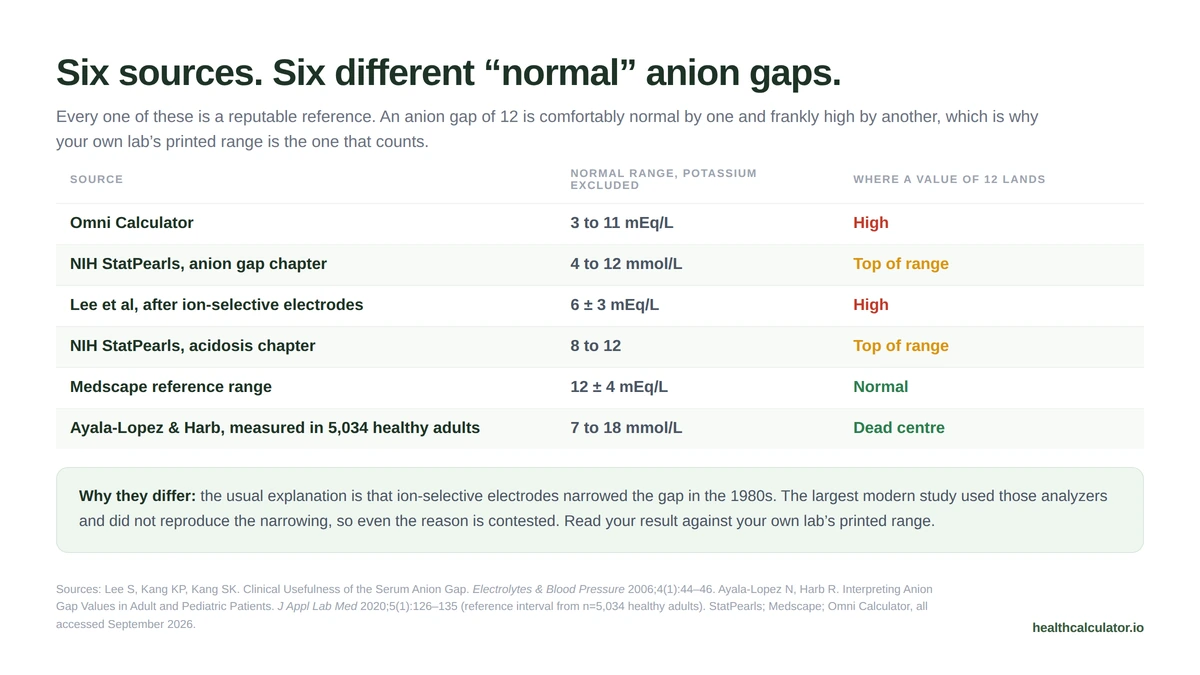
Here is the part most calculators leave out. Reputable sources do not agree on the normal range, and not by a little. Every source below is legitimate. The disagreement is real, and it has a cause.
Read that table again. A person with an anion gap of 12 is comfortably normal by Medscape, sitting at the top of StatPearls' range, frankly high by Omni's, and dead centre normal in the largest real-world dataset of the lot.
Why they disagree
Three things are going on, and the third is the one nobody expects.
The analyzers changed, or so the standard explanation goes. When labs measured sodium by flame photometry and chloride by colorimetry, 12 ± 4 was right. Ion-selective electrodes then arrived in the 1980s, chloride began reading higher, and the calculated gap fell. Lee and colleagues put the shift at 12 ± 4 down to 6 ± 3, and that account is widely repeated.
Except the largest modern study did not find it. Ayala-Lopez and Harb reviewed 17,137 patients at Yale-New Haven Hospital and derived an adult interval of 7 to 18 mmol/L from 5,034 healthy outpatients, using analyzers that measure sodium and chloride by ion-selective electrode. They address the narrowing argument directly and report that this has not been reflected in our data, pointing instead to how reference individuals are selected, differences between patient populations, and differences in method.
And real populations surprise the people who order the test. That 7 to 18 result was, in the authors' own words, surprising to clinicians who expected the upper limit to be closer to 12. Their hospital had been using 6 to 16, and against the new interval roughly 23% of emergency department patients and 18% of intensive care patients had been flagged as high when they were not.
So what should you actually do
Use the reference range printed on your own lab report, not the one on any calculator including this one. Your lab derived its range from its own analyzers and its own patients, and that is the only range your result was ever meant to be read against. If your report does not print one, treat this tool's result as a rough screen and take the raw sodium, chloride and bicarbonate to your doctor rather than the gap.
Correcting the Anion Gap for Low Albumin
Since albumin carries most of the unmeasured negative charge, low albumin shrinks the gap. A patient can have a serious acid load and a completely normal looking anion gap, purely because their albumin is low. That happens constantly in ICU patients, in liver disease, and in anyone malnourished. If your albumin came back low on the same panel, our guide to what a low albumin means explains what usually causes it and what actually raises it.
One warning that matters. Sources disagree on what "normal albumin" is in that formula. StatPearls' own chapter writes 4.0 in the equation and 4.5 in the sentence beside it. A 2025 MIMIC-IV analysis used 4.4. Our calculator uses 4.0 and shows you the constant on screen, so you always know which version produced your number.
This is the same problem albumin causes elsewhere in the panel. If your albumin is low, your calcium reading is distorted too, which is what our corrected calcium calculator is for.
Does the correction actually help?
For prognosis, the evidence is decent. In 2,826 critically ill cirrhosis patients, an albumin-corrected anion gap above 20 carried a 30-day mortality of 47.5% versus 28.9% below it, and it predicted death better than the uncorrected gap or albumin alone.
For diagnosis, be more careful. The correction still cannot tell you which acid is present, and a corrected gap is an estimate stacked on an estimate.
The Delta Ratio, and Why It Can Flip
Once the gap is high, the delta ratio asks whether a high anion gap acidosis is the only thing going on:
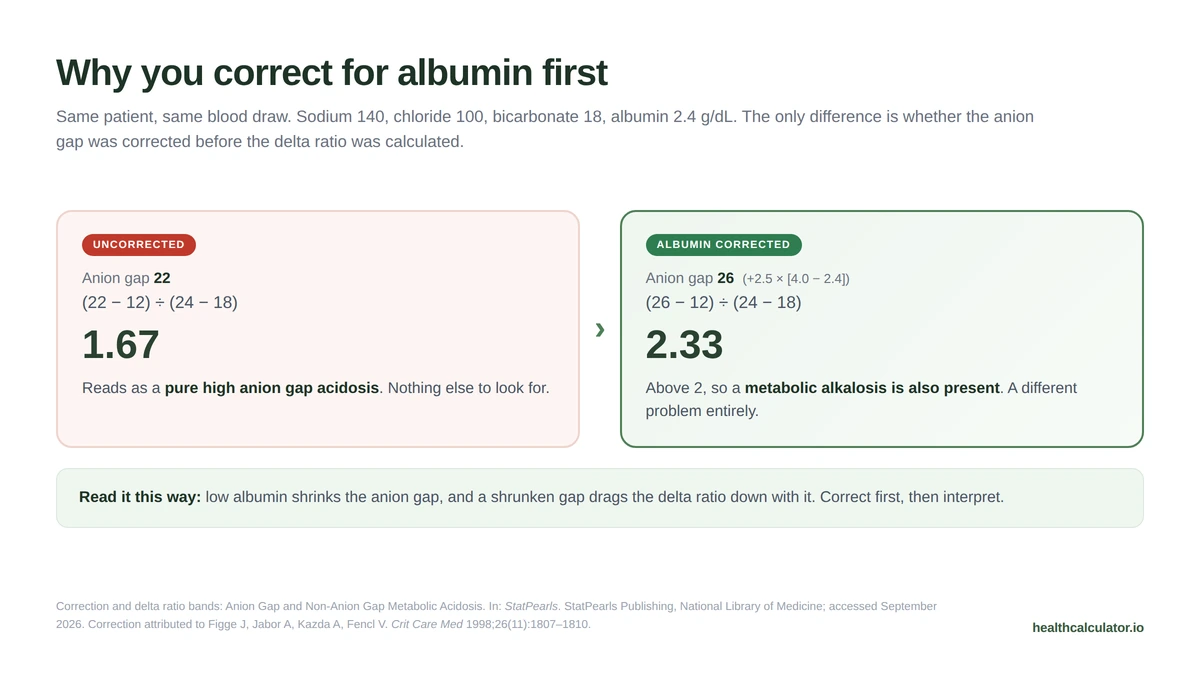
Delta ratio = (anion gap − 12) ÷ (24 − bicarbonate)
Delta ratio
Usual reading
Below 1
A normal anion gap acidosis is present as well
1 to 2
A pure high anion gap acidosis
Above 2
A metabolic alkalosis is present as well, or bicarbonate was high to begin with
Now watch what happens to our worked patient. Sodium 140, chloride 100, bicarbonate 18, and add an albumin of 2.4 g/dL.
Uncorrected gap 22, delta ratio 1.67, which reads as a pure high anion gap acidosis
Corrected gap 26, delta ratio 2.33, which says there is a metabolic alkalosis hiding underneath
Same patient. One albumin value. Two different clinical stories. That is the entire argument for correcting the gap before you calculate the ratio, and it is why this calculator does both in one pass.
What a High Anion Gap Points To
A raised gap means an unmeasured acid. MDCalc teaches the causes as MUDPILERS, and it is still the fastest way to hold them:
Methanol · Uremia · Diabetic or alcoholic ketoacidosis · Paraldehyde · Isoniazid · Lactic acidosis · Ethanol or ethylene glycol · Rhabdomyolysis and renal failure · Salicylates
Uremia links this straight back to kidney function, so if your gap is up and you have not checked filtration lately, our eGFR calculator takes thirty seconds. Diabetic ketoacidosis is the other common one, and if glucose control is the question, the A1C calculator gives you the three-month picture. If that ketoacidosis came with a high glucose and a low sodium on the same panel, the low sodium is usually dilution rather than a second problem, and our corrected sodium calculator shows what it corrects to.
A normal gap acidosis is a different list, usually bicarbonate lost through the gut or the kidney. MDCalc's mnemonic there is HARDUPS.
How This Calculator Compares to MDCalc and Others
We opened each of these and checked what it actually does.
Fair summary: MDCalc is the better tool if you are a clinician who already knows the ranges cold and wants the mnemonics at hand. Its creator is nephrologist Dr. Man S. Oh, and its MUDPILERS and HARDUPS lists are the ones most doctors learned from. It just does not offer the potassium variant or the delta ratio, and it does not print a normal range at all.
Omni is a solid consumer tool with a clean explanation, and it does offer potassium. It settles on one normal range, 3 to 11, which is a defensible choice. We went the other way and showed the spread.
We built this one for the person holding a lab report who wants to know whether their number is actually abnormal. That question has a more complicated answer than any single range can give, so we show the range spread instead of picking one and hoping.
Why Use Our Anion Gap Calculator
Both formulas, with and without potassium, and the reference band shifts with your choice
Albumin in g/dL or g/L, so a report from any country pastes straight in
Albumin correction with the constant visible, so you know which version made your number
Delta ratio calculated from the corrected gap, not the raw one
No sign-up, nothing stored, works on a phone at the pharmacy counter
When to Get Help Now
A high anion gap on its own is a lab finding, not an emergency. Combined with symptoms it can be. Get urgent care for deep rapid breathing, confusion or drowsiness, persistent vomiting, severe abdominal pain, or fruity-smelling breath, especially in anyone with diabetes.
If the number is mildly raised and you feel fine, the sensible next step is a repeat panel with albumin drawn at the same time, plus lactate, glucose and kidney function. Your doctor decides which.
The Anion Gap Is Not a Diagnosis
This calculator is for informational and screening purposes only and does not constitute medical advice or diagnosis. Always consult a qualified healthcare professional. The anion gap is a screening number that points toward a category of problem, never to a specific cause, and it must be read alongside your clinical picture, your blood pH and your own laboratory's reference range.
Anion gap = sodium − (chloride + bicarbonate), all in mEq/L or mmol/L. The potassium version is (sodium + potassium) − (chloride + bicarbonate), which runs about 4 mEq/L higher. Both are valid, but each has its own normal range, so check which one your result used.
There is no single answer, which is why calculators disagree. Published normal ranges run from 3 to 11 up to 7 to 18 mmol/L, depending on the population studied and how the interval was derived. Use the reference range printed on your own lab report.
The usual explanation is that ion-selective electrodes arrived in the 1980s, chloride began reading higher and the gap fell, shifting the anion gap from 12 ± 4 down to 6 ± 3. The largest modern study used those analyzers and did not reproduce the narrowing, so even the reason is contested.
Corrected anion gap = anion gap + 2.5 × (4.0 − albumin in g/dL). Albumin carries most of the unmeasured negative charge, so every 1 g/dL drop lowers the gap by about 2.5 mEq/L. Without the correction, a real acidosis can hide behind a normal-looking number.
Either way works as long as you match the range. Most US labs and MDCalc exclude potassium because it varies little and is easily altered by a difficult blood draw. Including it raises the result by roughly 4 mEq/L, so normal becomes about 12 to 16 rather than 8 to 12.
Either. For sodium, chloride, bicarbonate and potassium the two units are numerically identical, which is why MedlinePlus lists sodium as 136 to 144 mEq/L (136 to 144 mmol/L). Albumin is different: g/dL and g/L differ tenfold, so use the unit switch.
It means an acid your panel does not measure has built up. The common causes are lactic acidosis, diabetic or alcoholic ketoacidosis, kidney failure, and certain poisonings including methanol, ethylene glycol and salicylates. The gap flags the category, never the specific cause, so it always needs clinical follow-up.
Low albumin is by far the most common reason, since albumin supplies most of the unmeasured anions. Less often it points to a paraprotein disorder such as myeloma, or to lab error. A genuinely low gap is uncommon enough that it is usually worth repeating the panel.
Barely. In 145 healthy patients aged 18 and under, the measured interval was 8 to 19 mmol/L against 7 to 18 in adults, with the same median of 13. The authors caution that this pediatric figure rests on a small sample and should be viewed carefully. Read a child's result with their own doctor.
Sources
Every figure on this page is drawn from government health statistics or peer-reviewed research. Last verified September 2026.