Dr. Farah Taqueer is a pediatrician based in Karachi with more than 14 years of clinical experience. She qualified with an MBBS from Liaquat University of Medical and Health Sciences and holds an MD in Pediatrics, and is registered with...
Enter a birth date and a second date, and this chronological age calculator gives you the exact gap in years, months and days, plus the 9;6;21 style string that test forms ask for. If you're scoring an assessment, flip it to 30-day months. Pearson's WIAT-III scoring guidance treats every month as 30 days and never rounds up.
What Is Chronological Age?
Short version: it's how long you've been alive, in years, months and days. That's the whole idea. It's what every form means when it asks your age, what a school uses to decide which grade a kid starts in, and what your doctor plugs into a growth chart or a kidney function formula.
Funny thing is, that plain question is what most people type to find this page. Not "chronological age calculator", just "chronological age", a couple of hundred times a month in our Search Console. So, quickly: it doesn't care how healthy you are. Two kids born the same morning will share it for life, even if one ends up running marathons and the other lives on the couch. Everyone's clock runs at the same speed. That's the point of it.
Reading Your Result, Row by Row
The three big numbers are the age itself. Years, then months, then leftover days. Everything under them is the same age written the way different forms want it.
Report format is the one speech therapists and school psychologists copy straight onto a record form: years, months and days separated by semicolons. A child who is 7 years, 4 months and 12 days old reads 7;4;12. Some forms only want 7;4, so drop the days.
Decimal age is total days divided by 365.25, the average year length once leap years are counted. Growth formulas, such as the one behind the child height calculator on this site, take age this way, so 9 years and 6 months shows up as roughly 9.5.
Total months is years × 12 plus the leftover months. Toddler checklists are often organized by month, so a 2;4 child is simply 28 months.
Leave the second date blank and you get today. Change it and you get the age on any day you like: a test date, a school cutoff, a past appointment, a birthday five years out. Nothing you type leaves your browser.
Calendar Months or 30-Day Months?
Most age pages skip this part. There are two honest ways to count the leftover days, and they don't always agree.
The calendar method uses real month lengths. When the days come out negative, you borrow the month before your second date, at its true size: 31 days for January, 28 or 29 for February, 30 for April. That's the default, and it's right for birthdays, forms and medical records.
The 30-day method borrows a flat 30 every time, whatever the month really was. Pearson's WIAT-III article spells it out: subtract the birth date from the test date, treat all months as 30 days, don't round up to the next month or year, and if testing ran over two sessions, use the first date only. Tap "30-day months (testing)" and the calculator does exactly that, then tells you underneath what the calendar method would have said.
Which one should you use? Whatever your test manual says. If it's silent, write down which method you picked.
There's a twist worth knowing. Pearson, the publisher behind that rule, no longer runs an age calculator at all, and its old calculator page now points visitors to timeanddate.com's general date-duration tool. That tool counts real calendar months. So someone following Pearson's own link today can land on a different day count from the one in Pearson's older scoring guidance. Usually it's one day. Sometimes it's the whole month.
We Tested Seven Chronological Age Calculators With the Same Dates
On October 28, 2026, we took seven of the calculators on Google's first page for this search and fed every one of them the same three tricky date pairs. Then we ran the same pairs through our calculator and through the 30-day rule by hand.
Birth date → second date
Our calculator (calendar)
6 of the 7 tools
30-day rule
July 12, 2016 → February 3, 2026
9;6;22
9;6;22
9;6;21
March 31, 2016 → April 30, 2026
10;1;0
10;0;30
10;0;29
February 29, 2020 → February 28, 2025
5;0;0
4;11;30
4;11;29
Tested by healthcalculator.io on October 28, 2026. Ages are years;months;days. The 30-day column follows the borrow-30, no-rounding rule described above.
The first row is the everyday case, and every tool agreed with the calendar answer. Not one of the seven had a 30-day option, though, so anyone who needed 9;6;21 had to do it by hand.
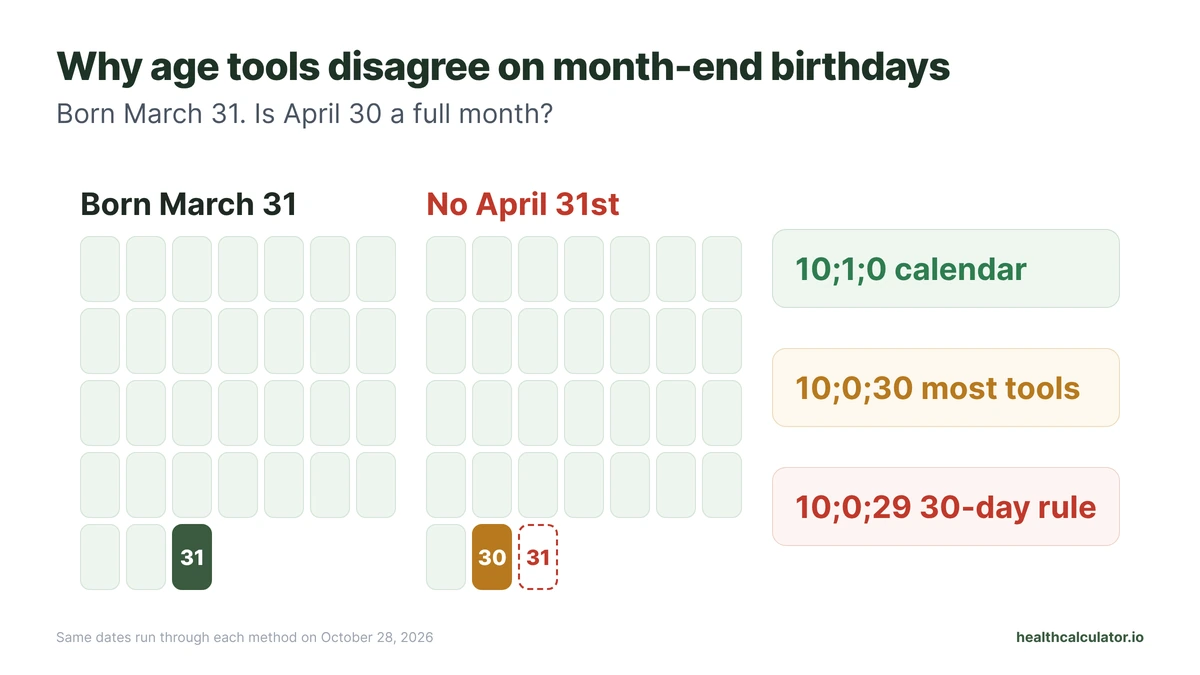
The second row is where things split. A child born on the 31st reaches April 30 and April simply has no 31st. We count that month as finished on April 30, the last day it could be. Most tools wait, and call it 30 days. Neither choice is a bug. It's a convention, and it's the most common reason two calculators "disagree."
The leap-day row works the same way. In a year without February 29, we land the birthday on February 28, so a leap-day baby turns 5 on February 28, 2025. Most tools hold off until March 1.
The seventh tool was a different story. It returned 9;6;24 for the first pair, which no counting method produces, and it called July 12, 2016 to January 12, 2026 "9 years, 6 months, 2 days" when that's exactly 9 years and 6 months. Another tool labeled its day total as approximate and came out 2 days short. If you've ever wondered why your hand calculation didn't match a website, now you know: sometimes it's the website.
A Real Test Date, Start to Finish
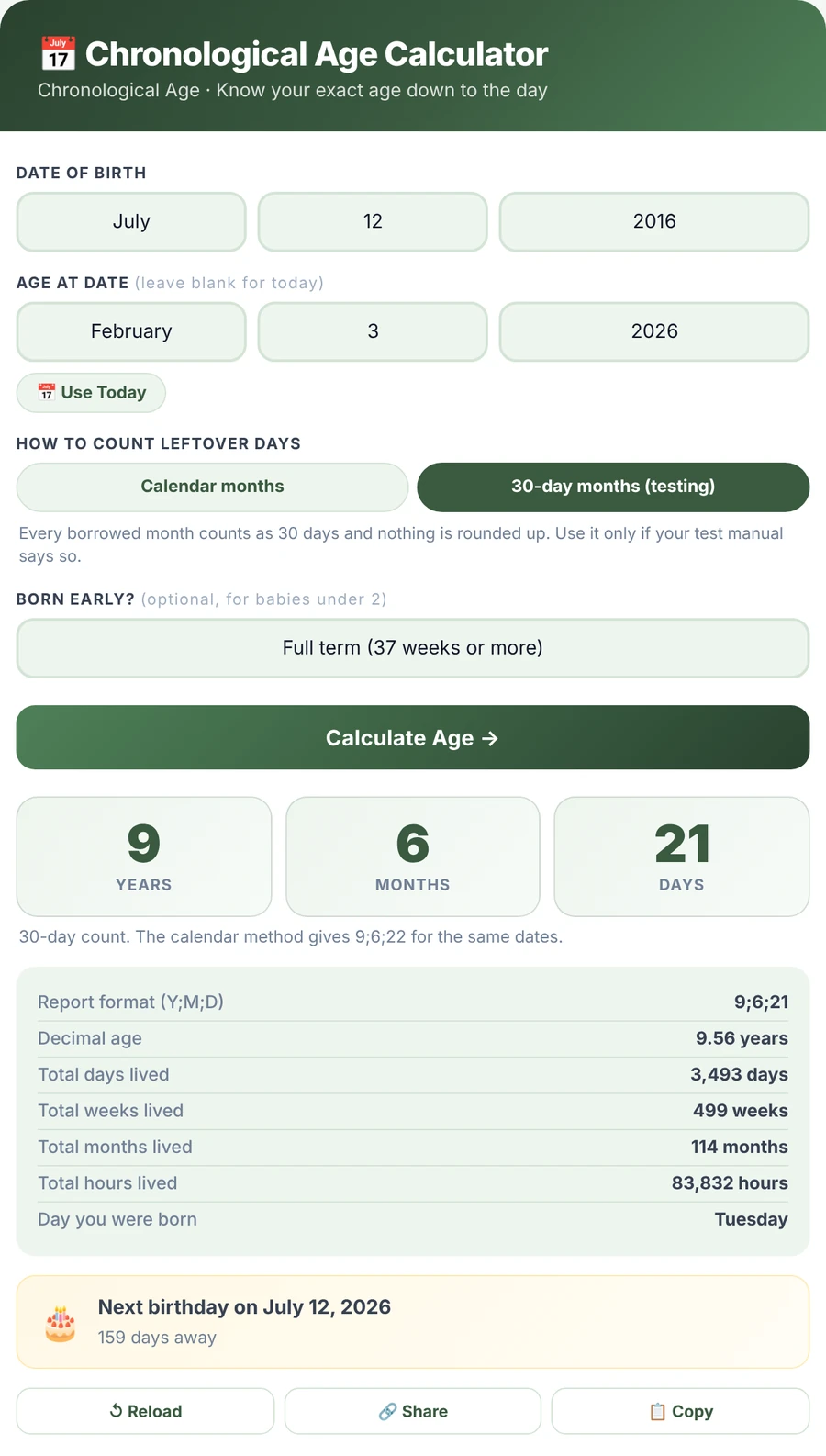
We ran this one through the calculator on this page on October 28, 2026. Birth date: July 12, 2016. Second date: February 3, 2026, the day of testing. Mode: 30-day months.
It returned 9 years, 6 months, 21 days, with the report string 9;6;21. The line underneath said the calendar method gives 9;6;22 for the same dates. Total days lived: 3,493. Born on a Tuesday.
So what do you write down? If the manual uses the 30-day rule, 9;6;21. Otherwise 9;6;22. For a norm table split by years and months, both land in the 9;6 band, so the score you look up doesn't change here. It only bites when the day count tips the month, like that March 31 row above.
Born Early? The Corrected Age Box
If your baby came before 37 weeks, their chronological age still starts on the real birthday. But babies don't read calendars. Their milestones tend to track the due date, and that due-date age is what doctors call corrected age (or adjusted age, depending on the clinic).
The American Academy of Pediatrics gives the corrected age rule: take the baby's age in weeks and subtract the weeks born early, which is 40 minus the weeks of pregnancy at birth. Its own example is a baby born at 32 weeks, 8 weeks early. At 16 weeks old she has a corrected age of 8 weeks, so she's expected to do what a 2-month-old does, not a 4-month-old. The AAP says to use corrected age for the first 2 years.
Pick the weeks at birth in the "Born early?" box and the calculator shows both ages. We ran the AAP example through it with a January 1, 2026 birth date and April 23, 2026 as the second date: chronological age 0;3;22, corrected age 1 month and 28 days, or 8 weeks. Past age 2, the box tells you to stop correcting.
How much does it matter? A lot, early on. In a study of 554 children born before 33 weeks, scoring by chronological age instead of corrected age dropped the average 18-month mental score from 96.8 to 79.5. By age 7 the gap had shrunk to 1.9 IQ points. A 2026 Italian study of 161 preterm toddlers reached the same practical conclusion: use corrected age at least until 24 months.
When One Day Changes the Score
Most of the time, a day either way changes nothing. Norm tables group children into age bands, and a small shift keeps the child in the same band.
The trouble starts at the edge of a band. A 2025 Spanish study re-scored the WISC-V for 153 very preterm school-age children using corrected age. The test's norm bands are 4 months wide, so correcting the age moved only 56.21% of the children into a different band, and the rest scored exactly the same. Across all 153 children, the share scoring below 90 fell from 42.1% to 34.2% once their ages were corrected.
That's the real lesson for anyone filling in a protocol. An exact age matters most when the child sits near a band boundary, and a borrowed day or a corrected month can be the thing that tips it. Check the age, check which band it falls in, and if it's close to the line, check again.
Your Calendar Age Isn't Your Body's Age
Chronological age counts days. Biological age tries to estimate how fast your body is actually wearing, from blood or DNA markers, and it can run ahead of the calendar or behind it.
The research is real. A 2024 UK Biobank study of 45,441 adults built an aging clock from 204 blood proteins that tracked chronological age closely, and people whose protein age ran ahead of their real age had higher rates of 18 chronic diseases.
No website can work that out from a birth date, though. A "biological age calculator" that only asks a few lifestyle questions is giving you an estimate of an estimate. This tool sticks to the calendar.
What This Tool Can't Tell You
This calculator is for informational and screening purposes only and does not constitute medical advice or diagnosis. It counts time exactly. It can't tell you whether a child's development is on track, and corrected age is a fairer yardstick, not a verdict. If you're worried about milestones, your pediatrician is the right next stop. Always consult a qualified healthcare professional.
Want to work an age out on paper, or in a spreadsheet for a whole caseload? Our guide to calculating chronological age by hand walks through the borrowing with real dates and gives you Excel formulas for both methods.
Common Questions
Enter your date of birth and leave the second date blank. A chronological age calculator then subtracts your birth date from today and shows your age in years, months and days, plus total days and your next birthday. To find your age on another day, such as a test date, enter that date instead.
A child born on July 12, 2016 and tested on February 3, 2026 has a chronological age of 9 years, 6 months and 22 days by the calendar method, written 9;6;22. Under the 30-day testing rule the same dates give 9;6;21. Either way, the child falls in the 9;6 band.
You don't need one. This calculator is free, needs no sign-up and works in any phone browser, including the 30-day testing mode and corrected age for preemies. Add the page to your home screen and it opens like an app. Your dates stay on your device and are never uploaded.
Follow the administration manual for the test you're scoring. Pearson's WIAT-III guidance counts every month as 30 days and never rounds up, while everyday forms use real month lengths. The two usually differ by a day or two. If the manual doesn't say, pick one method and note it on the report.
Usually it's the borrowing rule or a month-end birthday. A child born March 31 is 10;1;0 on April 30, 2026 on this calculator, 10;0;30 on most tools, and 10;0;29 under the 30-day rule. In an October 2026 test of page-one tools, one was also simply wrong by two days.
The American Academy of Pediatrics advises using corrected age for the first 2 years, and a 2026 study of preterm toddlers backs using it at least until 24 months. Some test manuals have their own rules, so check the one you're using. After age 2, most children are judged by chronological age.
Not accurately. Biological age is estimated from lab measurements such as blood proteins or DNA methylation, so a quiz built on a birth date and a few lifestyle questions can only guess. Chronological age is the part you can calculate exactly online, and that's what this tool does.
Have clinical or research experience with this calculator? If you spot an error in the formula, the thresholds or the sources, or you would like to contribute to this page, write to partnerships@healthcalculator.io.
Sources
Every figure on this page is drawn from publisher scoring guidance, professional medical guidance, government statistics, or peer-reviewed research. Last verified October 2026.