Navy PRT Calculator
Last updated:

Written by
Muhammad Hamza
, Founder & Content Researcher
Muhammad Hamza is the founder of Health Calculator, dedicated to building accurate and easy-to-use health tools for everyone.
Last updated:
Muhammad Hamza is the founder of Health Calculator, dedicated to building accurate and easy-to-use health tools for everyone.
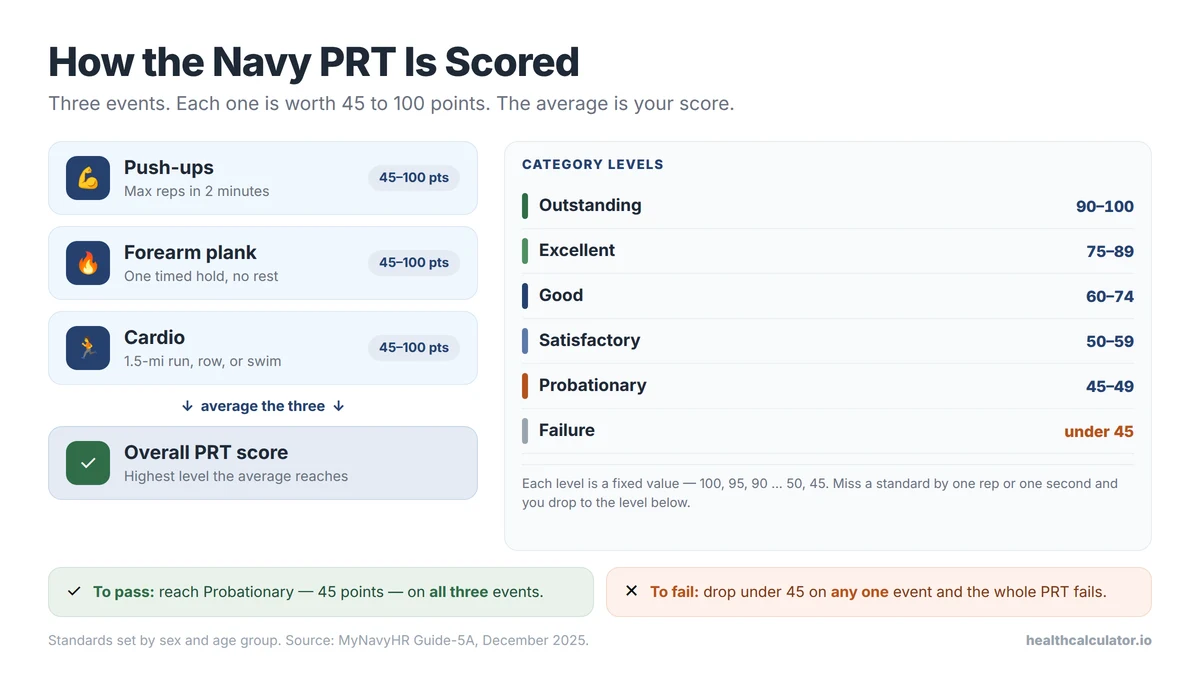
Put your age, cardio time, push-ups and plank hold in, and this Navy PRT calculator reads your score off the same Guide-5A tables your command fitness leader scores from. Each event is worth 45 to 100 points, your overall score is the average of the three, and you need 45 minimum on every one to pass.
Three events. That's the whole test.
There is no fourth event. If a calculator asks you for curl-ups, it is scoring you against a test the Navy retired: NAVADMIN 024/21 confirmed the forearm plank "has replaced curl-ups as the abdominal muscular endurance assessment," and the Navy's stated reason was blunt, the repeated spinal flexion of a curl-up is not operationally relevant to shipboard work.
Every event is scored against your sex and your age group on test day. The Navy uses eleven brackets, from 17–19 through 65 and older, and the standards ease at every step up.
The Navy does not score on a smooth curve. Each event has twelve published performance levels, each worth a fixed number of points:
| Points | Category level | Points | Category level |
|---|---|---|---|
| 100 | Outstanding High | 70 | Good High |
| 95 | Outstanding Medium | 65 | Good Medium |
| 90 | Outstanding Low | 60 | Good Low |
| 85 | Excellent High | 55 | Satisfactory High |
| 80 | Excellent Medium | 50 | Satisfactory Medium |
| 75 | Excellent Low | 45 | Probationary |
Hit the published standard for a level and you get that level's points. Fall one rep or one second short and you get the level below, there is nothing in between. Probationary, at 45 points, is the lowest passing score. Drop under it on any single event and the whole PRT is a failure, no matter how strong the other two are.
Your overall score is the average of your three event points, and your overall category is the highest level that average fully reaches.
This is worth knowing because it explains something that frustrates a lot of Sailors: two Navy PRT calculators giving two different answers for the same performance. Many tools store only the pass minimum and the max, then interpolate a straight line between them. That is fast to build and quietly wrong in the middle of the range, where most people actually land. This one carries all twenty-two published sub-tables instead.
Take a 27-year-old male Sailor at sea level. He runs 10:55, does 66 push-ups and holds a 2:34 plank. Solid numbers.
Average: 70.0 — Good High.
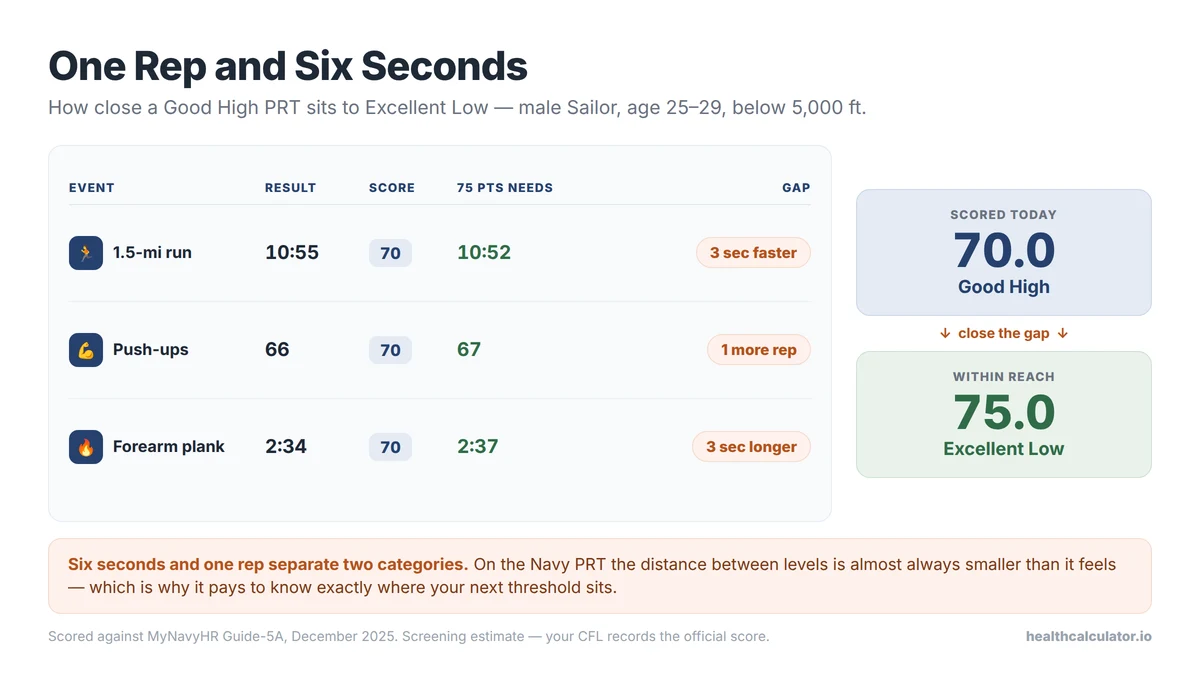
Now look at what he left on the table. One more push-up, three seconds off the run, three seconds more on the plank, and all three events move to 75. His overall jumps to Excellent Low, a full tier, for six seconds and one repetition spread across three events. That is the number the calculator's "next level up" panel is built to show you, because on the PRT the gap between categories is usually much smaller than it feels.
These are the Probationary standards, the least you can do on each event and still pass. They apply at elevations below 5,000 feet.
| Age group | Male push-ups | Male plank | Male 1.5-mile run | Female push-ups | Female plank | Female 1.5-mile run |
|---|---|---|---|---|---|---|
| 17–19 | 42 | 1:11 | 12:45 | 19 | 1:01 | 15:00 |
| 20–24 | 37 | 1:10 | 13:30 | 16 | 1:00 | 15:30 |
| 25–29 | 34 | 1:09 | 14:00 | 13 | 0:59 | 16:08 |
| 30–34 | 31 | 1:07 | 14:30 | 11 | 0:58 | 16:45 |
| 35–39 | 27 | 1:06 | 15:00 | 9 | 0:56 | 17:00 |
| 40–44 | 24 | 1:05 | 15:30 | 7 | 0:55 | 17:15 |
| 45–49 | 21 | 1:03 | 16:08 | 5 | 0:54 | 17:23 |
| 50–54 | 19 | 1:02 | 16:45 | 2 | 0:53 | 17:30 |
| 55–59 | 10 | 1:01 | 17:09 | 2 | 0:52 | 18:34 |
| 60–64 | 8 | 1:00 | 18:52 | 2 | 0:51 | 19:43 |
| 65+ | 4 | 0:58 | 20:35 | 1 | 0:50 | 20:52 |
Maxing out is a different world. A 25–29 male needs 84 push-ups, a 3:16 plank and an 8:55 run for 100 points on each; a 25–29 female needs 46 push-ups, a 3:06 plank and a 10:17 run.
Notice how much more room the plank gives you than the run. The pass standard for a 25–29 male is a 1:09 hold, but 100 points needs 3:16, nearly three times as long. Push-ups run from 34 to 84. The run only spans about five minutes. For most Sailors sitting in the Good range, the plank is the cheapest place to buy points, because holding position is a trainable skill in a way that shaving a minute off a mile and a half is not.
The 1.5-mile run is the default, but it is not the only scored option. Guide-5A prints full point columns for the 2,000-meter row on a Concept 2, the 500-yard swim and the 450-meter swim, right beside the run. These are not pass/fail alternates, they earn graduated points exactly like the run, and this calculator scores all four. A treadmill version of the 1.5-mile run and a 12-minute stationary bike test are also approved options.
For a 25–29 male at sea level, the minimums are a 9:30 row, a 13:08 500-yard swim or a 12:58 450-meter swim. To max, he needs 7:10, 6:38 and 6:28.
One condition matters: your CO or OIC decides whether you may use an alternate cardio event. It is a command call, not a personal preference, so clear it with your CFL before you plan a cycle around the rower.
If you test somewhere above 5,000 feet, switch the elevation selector. Push-ups and plank standards are identical at altitude, only the cardio times relax, by roughly nine percent.
Riding the bike instead? This calculator cannot score it, and neither can any other. The bike standard is worked out by the official PFA app from your bike model and your calorie burn, so it has no published table to calculate from.
The Physical Readiness Program changed shape for the 2026 assessment year, announced fleet-wide in NAVADMIN 264/25. The scoring tables themselves are unchanged since Guide-5A was published in December 2025, but the rules around them moved a lot:
Guide-5A remains the current PRT guide as of August 2026, sitting alongside the rest of the program guides covering the BCA, medical waivers, PRIMS and combat arms testing.
These three events are not arbitrary. Each one is a cheap proxy for something that predicts how long you stay healthy.
Cardiorespiratory fitness is the heavyweight. A 2025 meta-analysis pooling 3.8 million observations found that each one-MET increase in fitness was associated with a 14% lower risk of death from any cause and a 16% lower risk of cardiovascular death. The same analysis found that fitness estimated from a field test predicted mortality about as well as fitness measured in a lab, which is the entire justification for timing a run instead of wiring Sailors to a metabolic cart.
Push-up capacity carries its own signal. In a ten-year cohort of 1,104 male firefighters, men who could complete more than 40 push-ups had a markedly lower rate of cardiovascular events than men who managed fewer than ten. Read that one with care: it followed occupationally active men, recorded only 37 events, and the confidence interval was wide. It suggests push-up capacity is a useful marker of functional status, not that push-ups themselves are a treatment.
The plank earns its place on repeatability. A 2025 validity study found the front plank test reproduced with an ICC above 0.98 across sexes and age groups, the same person tested twice gets nearly the same time. For a test scored to the second across a fleet of hundreds of thousands, that consistency matters more than elegance. Isometric holds may also do something useful for blood pressure: a network meta-analysis of 270 randomized trials found isometric training produced the largest resting reductions of any exercise mode at −8.24/−4.00 mm Hg, though the wall squat, not the plank, topped the sub-mode ranking.
A high PRT score is good evidence of muscular endurance and aerobic capacity. It is not a health check-up, and a few honest caveats belong here.
It says nothing about strength. You can score Outstanding on push-ups and still struggle with a heavy awkward load, because two minutes of bodyweight reps measures endurance, not maximal force. If that is what you are training, a one-rep max estimate tracks a different quality entirely.
It does not measure body composition. That is the BCA's job, and the two are scored separately.
It cannot see injury risk, blood pressure, blood sugar or sleep. Plenty of Sailors pass a PRT while carrying something a physical would catch. Passing is not clearance to ignore symptoms.
And a single test is a snapshot on one morning. Heat, altitude, illness, a bad night and a rushed breakfast all move your number without moving your fitness.
Passing the PRT does not pass your Physical Fitness Assessment. The PFA has two parts, and the Body Composition Assessment comes first.
Since January 2026 the BCA runs as a two-step process: a sex-neutral waist-to-height screening, then the Navy's body fat equations only if you miss it. If you want to run your own numbers before your CFL does, the Navy body fat calculator applies the current rounding rules and tells you the maximum waist allowed for your height.
Miss the BCA and a decent PRT will not carry you. The High-Performance BCA Exception is the one narrow way back, and as of 2026 it demands an Outstanding-Low overall with Excellent-Medium or better in every event. Plan on passing both.
If you are actively training between cycles, recovery does more work than most people credit. Getting enough protein is the least glamorous and most reliable lever, a daily protein target is a reasonable place to start.
Most of the tools ranking for this search are behind. Some still score against the January 2023 tables. At least one still asks for curl-ups, an event the Navy dropped in 2021.
This one is different in four ways:
No sign-up, no email, nothing stored. It runs in your browser and the numbers never leave your device.
This calculator is for informational and screening purposes only and does not constitute medical advice, a medical diagnosis, or an official Navy record. Your official PRT score is the one your command fitness leader records in PRIMS. Standards change, verify against current Navy guidance before making any decision that affects your career. If you have a medical condition, an injury, or a medical waiver on file, speak with your medical department and your CFL before testing. Always consult a qualified healthcare professional about your health.
You pass the Navy PRT by scoring Probationary or higher, at least 45 points on all three events: push-ups, the forearm plank, and one cardio event. Falling below the Probationary standard on any single event fails the entire PRT, regardless of how strong your other two scores are.
Each event earns a fixed point value from 45 to 100, read off the Guide-5A table for your sex and age group. Your overall PRT score is the average of those three point values, and your overall category is the highest performance level that average fully reaches. For example, an average of 70.0 is Good High.
No. The forearm plank replaced curl-ups as the Navy's abdominal endurance event, confirmed in NAVADMIN 024/21 in January 2021. The Navy's reasoning was that the repeated spinal flexion of a curl-up is not operationally relevant. Any calculator still asking for curl-ups is using retired standards.
Only if your commanding officer or OIC approves it. The 2,000-meter row on a Concept 2, the 500-yard swim and the 450-meter swim all have their own full scoring columns in Guide-5A, so they earn graduated points just like the run. Alternate cardio is a command decision, not a personal choice, clear it with your CFL first.
Since 1 January 2026, PFA failures carry administrative consequences, and three failures within a four-year period trigger administrative separation processing. Failures recorded before that date were reset to zero for advancement, reenlistment, promotion and continuation decisions. Your CFL and chain of command handle the specifics.
Usually one of two reasons. The other tool may be running older standards, several still score against 2023 tables or the retired curl-up test. Or it stores only the pass minimum and the maximum and draws a straight line between them, which misreads mid-range performances by several points. This calculator reads every published level directly.
Yes, but only for cardio. Guide-5A publishes a separate standards table for test sites above 5,000 feet, where run, row and swim times are relaxed by roughly nine percent. Push-up and forearm plank standards are identical at any elevation. Use the elevation selector in the calculator to switch between the two tables.
Yes. The bike is an approved alternate cardio event and Guide-5A gives it two full sets of procedures, one for Life Fitness machines and one for everything else. What it does not give the bike is a scoring column. Tables 4-1 and 4-2 score six things and only six: push-ups, the forearm plank, the 1.5-mile run, the 2 km row, the 500-yard swim and the 450-metre swim.
The bike sits outside the tables because its standard depends on the machine. The note printed above both tables says the official PFA mobile application calculates the bike standard from the bike model and your calorie burn. That is why no website can give you a bike score, this one included. You ride a manual program for exactly 12 minutes, your command fitness leader reads the calories off the console at the 12-minute mark, and the app turns that into points. Calories burned during the cool-down do not count.
The treadmill is a different case again. It has no column because it is not a separate event: you run the same 1.5 miles at a 1.0 percent incline against a stopwatch, and you are scored on the 1.5-mile run column like everyone else.
One thing has not changed. Any alternate cardio needs your CO or OIC to authorise it, and your command fitness leader tells you which options your command is actually running.
Every standard and figure on this page is drawn from official U.S. Navy guidance or peer-reviewed research. Last verified August 2026.