Army Height and Weight Calculator
Published:

Written by
Muhammad Hamza
, Founder & Content Researcher
Muhammad Hamza is the founder of Health Calculator, dedicated to building accurate and easy-to-use health tools for everyone.
Published:
Muhammad Hamza is the founder of Health Calculator, dedicated to building accurate and easy-to-use health tools for everyone.
The Army checks recruits and serving Soldiers in two different ways now, and this Army height and weight calculator does both. If you're already in, there's been no weight table for you since July 7, 2026, and your waist only needs to measure under 0.55 of your height. If you're joining, you still have to fit the Army's weight table for your height, age and sex.
Choose the tab that fits you and type in your numbers. The Joining tab shows the lowest and highest weight the Army accepts for your height, age and sex, plus how many pounds you have to spare. The Current Soldier tab takes one waist reading or three, then gives you your official ratio and the largest waist that still passes at your height.
A lot of people think the weight tables are gone for good, but that's only true once you're in uniform. Army Directive 2026-13 dropped them for serving Soldiers, while Army Regulation 40-501, which covers getting in, still uses them for most new recruits.
| You are | What you're checked against | Tab to use |
|---|---|---|
| Enlisting with no prior service | A minimum and maximum weight for your height, age and sex. Over the maximum, body fat decides | Joining the Army |
| A Soldier in the Regular Army, Guard or Reserve | Waist divided by height, under 0.55. No weight limit | Current Soldier |
| A West Point or senior ROTC cadet | The same 0.55 rule as Soldiers | Current Soldier |
| Prior service, not qualified in an Army job (MOS) | The entry weight table | Joining the Army |
| Prior service and MOS qualified, or applying to be an officer | AR 600-9, the Soldier regulation, not the entry table | Ask your recruiter first |
If you're in that last row, check with your recruiter before you rely on any number here. Those applicants are sent to AR 600-9, and that regulation's weight table has been retired, so ask which check you'll actually get. In the meantime, the Current Soldier tab shows you where you stand on the Soldier standard.
The Joining tab works as an Army weight calculator. It looks you up in the two tables in AR 40-501, one for men and one for women, that first-time recruits have to fit. Every height from 58 to 80 inches has one minimum weight and four maximums, one for each age group.
The minimum is the same for men and women, and the table header explains where it comes from, since it's the weight that gives a body mass index (BMI) of 19. The maximum usually goes up a little with each age group.
| Height | Minimum | 17 to 20 | 21 to 27 | 28 to 39 | 40 and over |
|---|---|---|---|---|---|
| 5 ft 0 in (60 in) | 97 | 139 | 141 | 143 | 146 |
| 5 ft 2 in (62 in) | 104 | 148 | 150 | 153 | 156 |
| 5 ft 4 in (64 in) | 110 | 158 | 160 | 163 | 166 |
| 5 ft 6 in (66 in) | 117 | 168 | 170 | 173 | 177 |
| 5 ft 8 in (68 in) | 125 | 179 | 181 | 184 | 187 |
| 5 ft 10 in (70 in) | 132 | 189 | 192 | 195 | 199 |
| 6 ft 0 in (72 in) | 140 | 200 | 203 | 206 | 210 |
| 6 ft 2 in (74 in) | 148 | 211 | 214 | 218 | 222 |
| 6 ft 4 in (76 in) | 156 | 223 | 226 | 230 | 234 |
| Height | Minimum | 17 to 20 | 21 to 27 | 28 to 39 | 40 and over |
|---|---|---|---|---|---|
| 5 ft 0 in (60 in) | 97 | 132 | 134 | 135 | 136 |
| 5 ft 2 in (62 in) | 104 | 140 | 141 | 144 | 145 |
| 5 ft 4 in (64 in) | 110 | 149 | 151 | 153 | 154 |
| 5 ft 6 in (66 in) | 117 | 160 | 160 | 162 | 165 |
| 5 ft 8 in (68 in) | 125 | 168 | 171 | 173 | 174 |
| 5 ft 10 in (70 in) | 132 | 178 | 181 | 183 | 185 |
| 6 ft 0 in (72 in) | 140 | 189 | 191 | 194 | 196 |
| 6 ft 2 in (74 in) | 148 | 199 | 203 | 204 | 206 |
| 6 ft 4 in (76 in) | 156 | 210 | 213 | 215 | 216 |
Height is counted to the nearest whole inch, and a half inch rounds up. At 5 ft 9.5 in you're scored as 5 ft 10 in, for example, while weight is counted to the nearest pound. Men and women both have to stand between 58 and 80 inches (4 ft 10 in to 6 ft 8 in). And since the enlistment regulation that took effect on April 20, 2026 raised the top enlistment age to 42, recruits aged 40 to 42 use the 40-and-over column.
You may notice two places where the tables look wrong, but that's how they're printed in the regulation. At 58 and 59 inches, the men's limit for ages 21 to 27 is lower than the limit for ages 17 to 20 (128 against 129 pounds, and 132 against 134), and at 5 ft 6 in the women's limit is 160 pounds for both of those age groups. The calculator follows the tables exactly as printed.
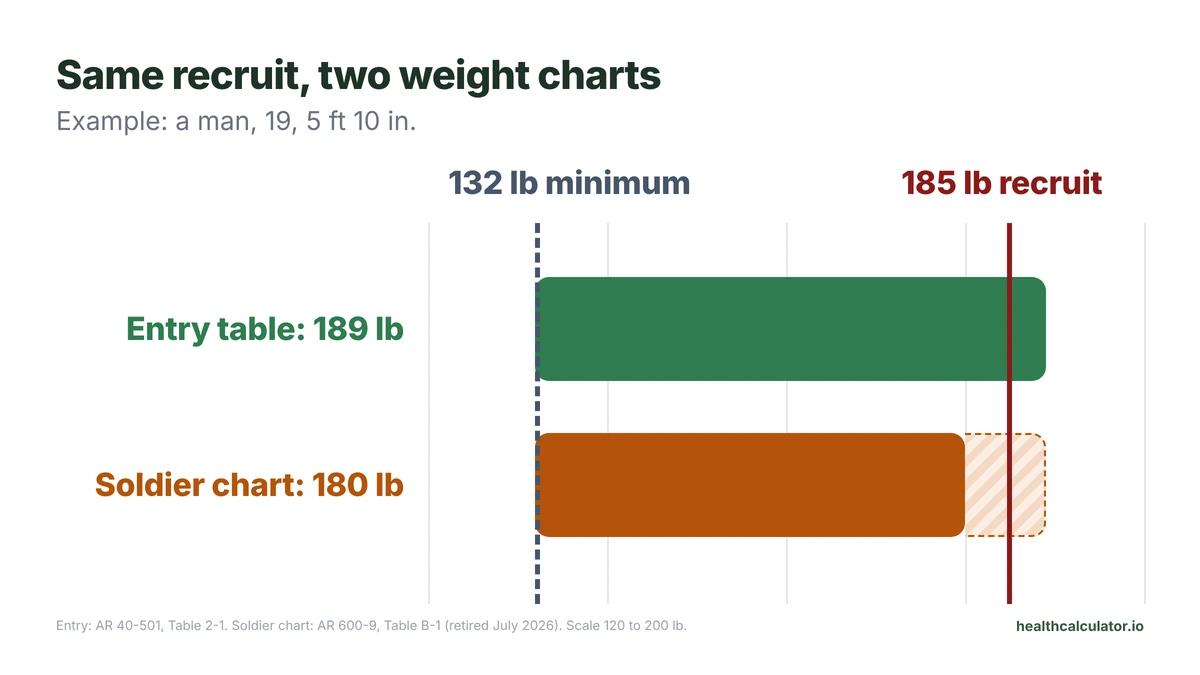
Before you worry about your weight, make sure you're reading the right chart. Two well-known enlistment weight charts we opened on November 15, 2026 still print the Army's old Soldier screening table from AR 600-9. That table was meant for Soldiers rather than recruits, and it was retired in July 2026. It runs 4 to 13 pounds lower than the entry table for men and 3 to 7 pounds lower for women, and it has no row at all for men under 5 feet.
Going over the weight table doesn't end your chances. The table's own footnote sends you to a body fat measurement, and you're only turned away if you're over that limit too.
| Age | Men | Women |
|---|---|---|
| 17 to 20 | 24% | 30% |
| 21 to 27 | 26% | 32% |
| 28 to 39 | 28% | 34% |
| 40 and over | 30% | 36% |
It all happens at MEPS (the Military Entrance Processing Station). The staff there weigh you in your underwear and measure your height with no shoes or socks, so measure yourself the same way at home if you want your numbers to line up with theirs. If you're over the table, trained MEPS staff tape you for body fat, and their numbers are the official ones.
If you're over on both weight and body fat, MEPS gives you a date to come back rather than a final answer. The date is set at 4 days for every pound you're over the table, or 16 days for every point of body fat, whichever is shorter. Seven pounds over is 28 days on the weight side, for example.
You can't count on a waiver to get around the weight table, because the enlistment regulation simply says "Weight waivers will not be considered." Height works differently. A height waiver request does exist, and it has to list your waist, shoe and hat size.
Some recruits who are over on body fat get in through the Future Soldier Preparatory Course instead. Its fitness track takes people who are over the body fat limit by up to 8 percentage points. You enlist first, train there for up to 90 days, and move on to basic training once you're within 2 points of the limit. That cutoff has changed before (it was 6 points until February 2024), so ask your recruiter what it is today.
Being under the minimum is handled through your BMI, which MEPS works out from your height and weight. You can check yours ahead of time with the BMI calculator. Below 17.5 you're temporarily disqualified, and the come-back date allows 4 days for every pound you need to gain. Between 17.5 and 19, the MEPS provider decides whether to send you to your own doctor first.
Once you're serving, the scale doesn't matter for this check anymore. Since July 7, 2026 the Army has looked at one number, your waist at the navel divided by your height, and it has to come out under 0.55. That line is the same for every Soldier, whatever your age or sex. You'll see it searched as the new Army height and weight calculator or the Army height and waist calculator, and for Soldiers the second name describes it better.
The Current Soldier tab is an Army waist-to-height ratio calculator, and it does the math the same way as the Army's worksheet, DA Form 5500:
You're measured at least twice a year. If a reading comes out at 0.550 or higher, a different team measures you again the same day before anything else happens. If you miss again, you're flagged and enrolled in the Army Body Composition Program (ABCP).
The Army height and weight standards guide has the largest passing waist for every height if you'd like the whole chart. And if a form still asks for the old tape test percentage, the Army body fat calculator runs both retired equations and explains what the ABCP involves.
These are example inputs, not real people. We ran both through the calculator on November 15, 2026.
| Example A: Joining the Army | Example B: Current Soldier | |
|---|---|---|
| Result | Over the Army weight table | ✓ Meets the Army standard |
| Main number | 196 lb | 0.547, waist-to-height ratio |
| Cards | Minimum weight 132 lb, maximum weight 189 lb, over by 7 lb | Recorded height 66 in, average waist 36.17 in, largest passing average 36.17 in |
| Also shown | This is not an automatic no. MEPS measures body fat next, and your limit is 24%. | Right at the limit for your height |
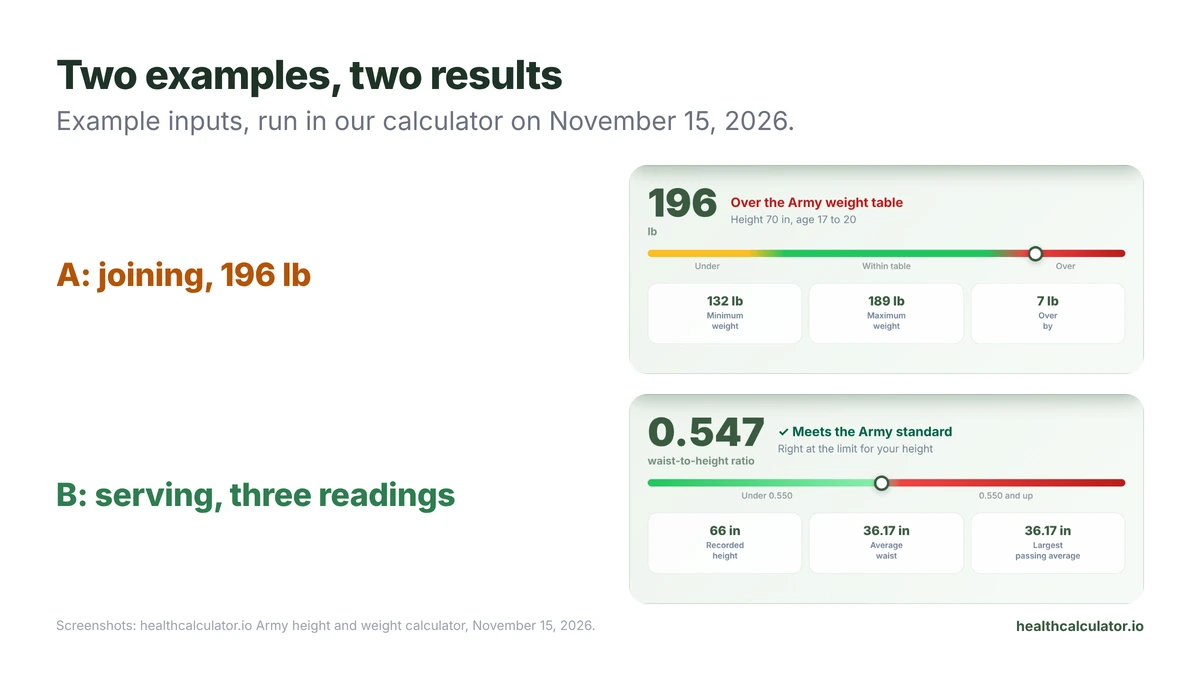
Example A is 7 pounds over, so his result points to the next step, which is a tape at MEPS against a 24% body fat limit. If he's over that too, the weight side of the come-back rule is 28 days. On the old Soldier chart he'd look 16 pounds over, even though that chart was never his standard. At 185 pounds it would still call him 5 pounds over, while the calculator shows 4 pounds of room.
Example B passes, but only just. If one reading changes from 36 to 36.5, the average becomes 36.333 inches, the ratio lands on 0.550, and the result flips to a fail. Half an inch on a single reading is enough to change the answer, so take all three readings before you trust a pass.
Passing the entry table doesn't mean you'll pass as a Soldier, because the first check is about your weight and the second is about your waist. A 19-year-old man at 5 ft 10 in can weigh 189 pounds and still get in, but as a Soldier he'd need a waist reading of 38 inches or less.
You do get some time to adjust. AR 600-9 gives initial entry Soldiers six months from the day they enter active service before they can be flagged and enrolled in the ABCP, and the 2026 directive says enrollment still follows that regulation. Your drill sergeants and first unit will tell you how they apply it. It's a good idea to run both tabs before you ship, because if Joining says yes and Current Soldier says no, you'll know what to work on.
Rounding is where a lot of home checks go wrong, so both tabs use the Army's own rounding rules.
| Joining the Army | Current Soldier | |
|---|---|---|
| Height | Nearest whole inch, half rounds up | Nearest half inch |
| Weight or waist | Weight to the nearest pound | Each waist reading down to the half inch |
| Readings | One weight | One reading, or three averaged to 3 decimals |
| Result | Your weight against the minimum and maximum for your age group | Ratio cut off at 3 decimals. Under 0.550 passes |
| Source | AR 40-501, paragraph 2-3 and Tables 2-1 and 2-2 | EXORD 182-26 Annex A and DA Form 5500 |
We checked all 230 values in the two entry tables against the regulation's PDF and ran the calculator through 29,218 automated checks against a separate scorer built from the same documents. Every one matched. It takes one waist reading or three, never two, because the Army doesn't average two readings. You can also switch to centimeters and kilograms, and the calculator converts to inches and pounds before it scores you, because that's how the Army's tables and worksheet are written.
Usually it comes down to rounding. On November 15, 2026 we typed 5 ft 10.7 in and a 38.9-inch waist into the simple calculator on the Army's own ABCP page. It divided the numbers as typed and showed 0.550 in red. On DA Form 5500 that same Soldier is recorded at 70.5 and 38.5 inches, which is 0.546 and a pass, and that's what this calculator returns. The other common reason is an out-of-date tool. One of the top search results for this topic still runs the tape test from June 2023, which the Army retired for Soldiers in July 2026.
Use this as a self-check rather than a final answer. If you're joining, MEPS takes the official height and weight. It measures a little differently from how you might at home, with no shoes or socks and height rounded up to the nearest half inch. If you're serving, your unit's tape and DA Form 5500 are the record. The Army is also running a 180-day assessment of the new standard, so the 0.55 line could still change.
Each service sets its own rules. If you're also looking at the Navy, the Navy body fat calculator covers its body composition check and the Navy PRT standards guide covers its fitness test. You'll find every other tool on the calculators page.
This calculator is for informational and screening purposes only. It is not an official Army determination and does not constitute medical advice. MEPS and your chain of command make the official call. Talk to a qualified healthcare professional before you start a weight loss plan.
It depends on whether you're in yet. Soldiers haven't had a weight table since July 7, 2026, and their waist divided by height must be under 0.55, which is why the new Army height and weight calculator asks for your waist. People enlisting still have to fit a minimum and maximum weight for their height, age and sex.
It's possible. Going over the entry table sends you to a body fat measurement at MEPS, where the limits run from 24% to 30% for men and 30% to 36% for women, depending on age. The table tops out at 259 pounds, so at 300 pounds body fat decides it, and weight waivers aren't considered.
Your waist has to stay under 0.55 of your height after the Army's half-inch rounding. The largest single reading that passes is 36.5 inches at 5 ft 7 in, 37.5 inches at 5 ft 9 in and 39.5 inches at 6 ft, and going half an inch over any of those makes the ratio fail.
They are for joining. Women have their own weight table with lower maximums and higher body fat limits, 30% to 36% by age compared with 24% to 30% for men, while the height range of 58 to 80 inches is the same. Serving Soldiers all have the same standard, since everyone has to be under 0.55.
The entry table's minimum weight is set at a BMI of 19, and MEPS uses BMI for applicants under it. Run the maximums through the BMI formula (pounds times 703, divided by inches squared) and they come to about 27 to 29 for men and 25.5 to 26.6 for women. Soldiers aren't checked on BMI at all.
Soldiers don't take it anymore. Army Directive 2026-13 withdrew the tape test in July 2026, and no other body fat method can be used to challenge a waist-to-height result. Applicants are different, because if you're over the entry weight table, MEPS staff still tape you for body fat before a decision is made.
Men and women need to be between 58 and 80 inches, which is 4 ft 10 in to 6 ft 8 in. Height is rounded to the nearest inch, so 57.5 inches counts as 58. If you're outside that range you don't meet the standard, though the enlistment regulation does describe a height waiver request, so ask a recruiter.
Have clinical or research experience with this calculator? If you spot an error in the formula, the thresholds or the sources, or you would like to contribute to this page, write to partnerships@healthcalculator.io.
Every rule and table value on this page comes from official Army and Defense Department documents. Last verified November 2026.