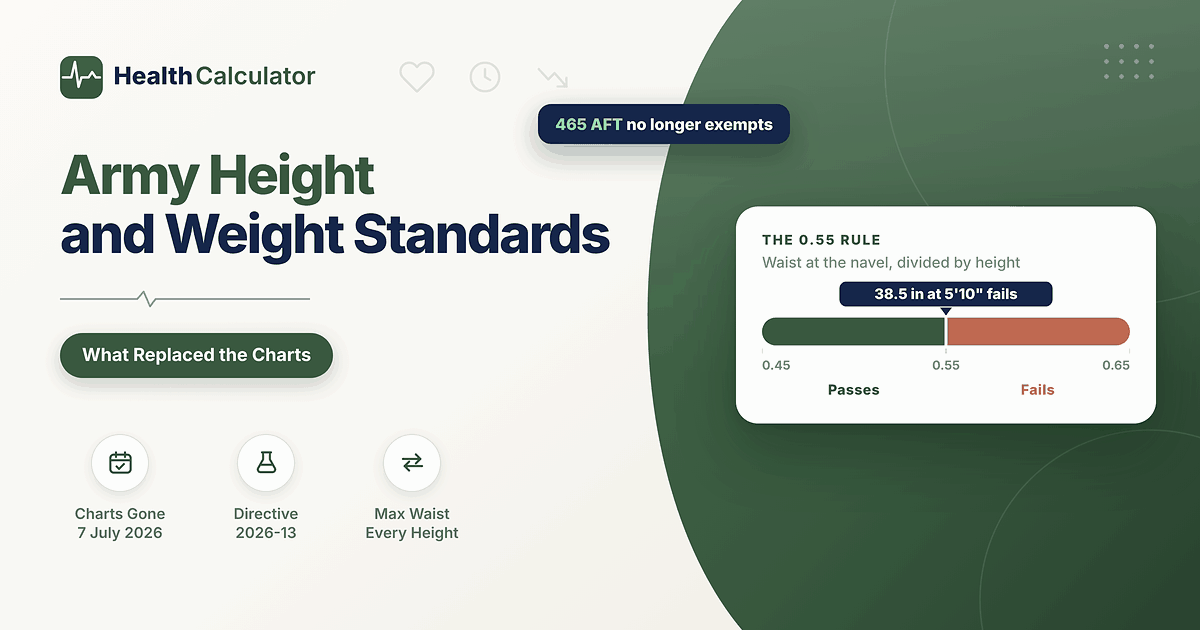
The Army height and weight standards you’re looking for no longer exist. Army Directive 2026-13 rescinded the height and weight tables on 7 July 2026 and replaced them with one number: your waist at the navel divided by your height, which must come in under 0.55. There is no weight column any more, and no chart to look yourself up in. Your scale is irrelevant to the standard.
Check your waist-to-height ratio now: enter your height and waist in our Army WHtR calculator and see if you’re under 0.55 →
That’s a bigger change than it sounds, and a lot of what’s currently published about it is wrong.
The Charts Are Gone. Here’s What Replaced Them.
For decades the process ran in two stages. You were weighed against a table for your height, age and sex, and if you exceeded it, out came the tape.
Both stages are gone. So is the tape test, so are the DXA and Bod Pod appeals, and so is the body fat percentage table that ran from 20% to 36% depending on who you were. One measurement now decides it, and it is the same threshold for a 19-year-old private and a 45-year-old sergeant major.
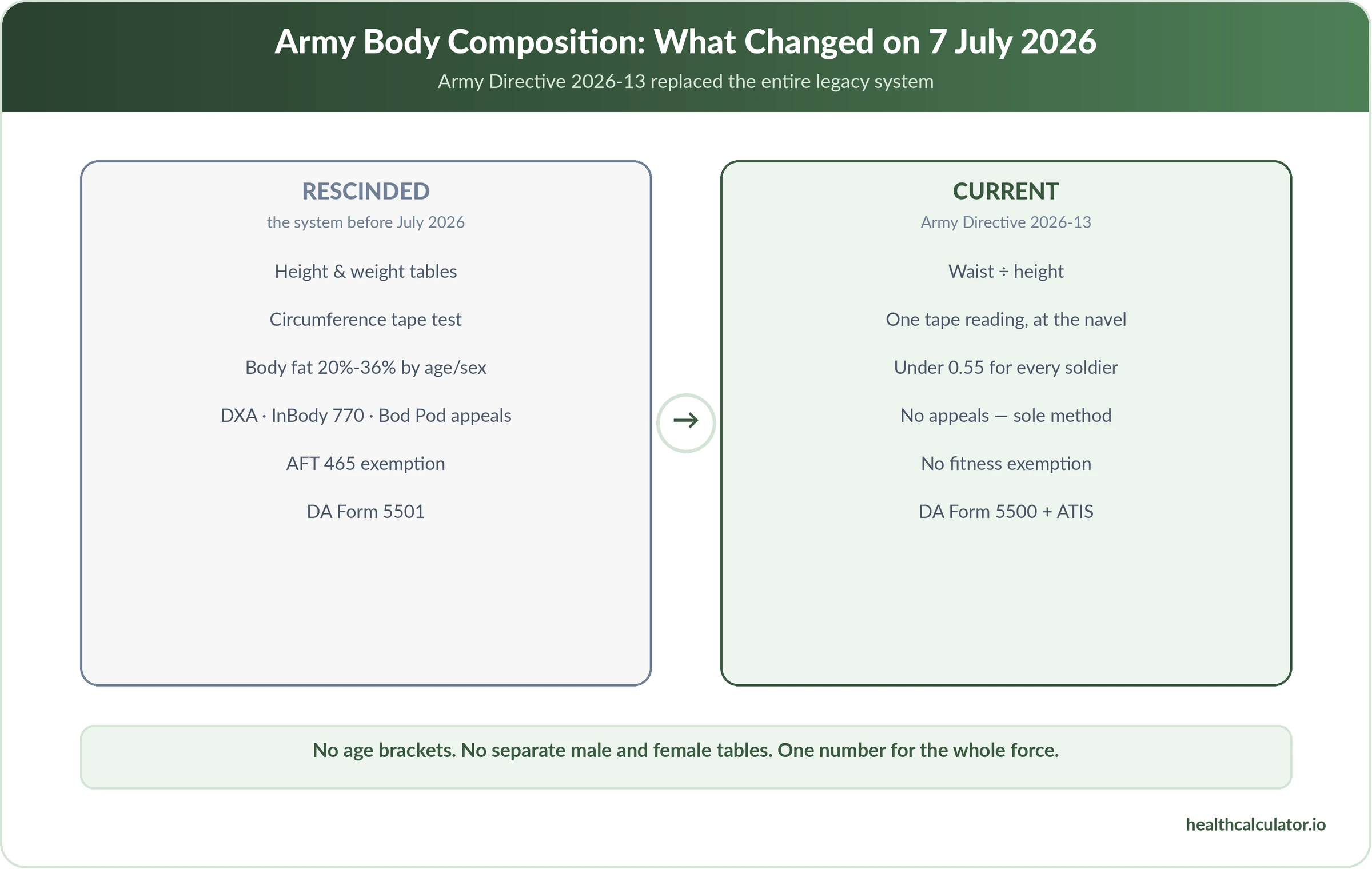
Our Army body fat calculator runs the official math, including the truncation rule that decides borderline cases. What follows is the context that calculator can’t give you, where the charts went, who this applies to, and what several currently-ranking pages are still getting wrong.
Your Maximum Waist, by Height
This is the closest thing to an Army height and weight chart that still exists, except the second column is inches of waist, not pounds. Multiply your height in inches by 0.55 and stay below the result.
| Height | Max waist (stay below) | Largest passing ½-inch reading |
|---|---|---|
| 5’0″ (60 in) | 33.00 in | 32.5 in |
| 5’2″ (62 in) | 34.10 in | 34.0 in |
| 5’4″ (64 in) | 35.20 in | 35.0 in |
| 5’6″ (66 in) | 36.30 in | 36.0 in |
| 5’8″ (68 in) | 37.40 in | 37.0 in |
| 5’9″ (69 in) | 37.95 in | 37.5 in |
| 5’10” (70 in) | 38.50 in | 38.0 in |
| 5’11” (71 in) | 39.05 in | 39.0 in |
| 6’0″ (72 in) | 39.60 in | 39.5 in |
| 6’2″ (74 in) | 40.70 in | 40.5 in |
| 6’4″ (76 in) | 41.80 in | 41.5 in |
| 6’6″ (78 in) | 42.90 in | 42.5 in |
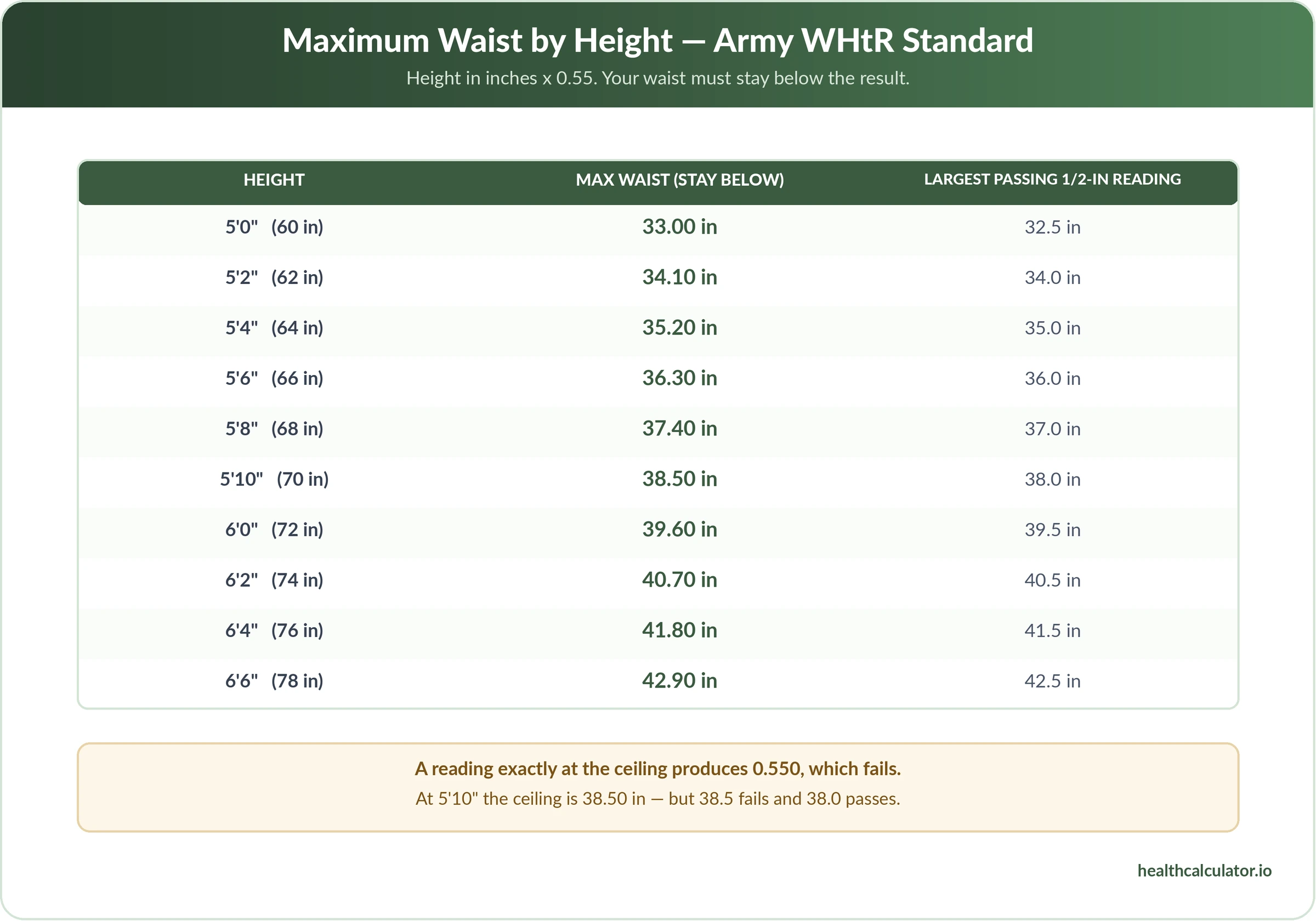
The third column matters more than it looks. Department of War guidance directs that measurements be recorded in inches and rounded down to the nearest half inch, which means the practical thresholds land on half-inch steps rather than exact decimals.
Watch what that does at 5’10”. The arithmetic ceiling is 38.50 inches, but a recorded 38.5 gives exactly 0.550, and 0.550 fails. The largest reading that actually passes is 38.0. Half an inch of tape decides it.
Why the Army Height and Weight Standards Changed
This didn’t start at Army headquarters. On 30 September 2025 the Secretary of War ordered changes to military fitness standards, and a follow-up memorandum from the Under Secretary of War, signed 18 December 2025, set the implementation date for waist-to-height ratio at 1 January 2026 across the Joint Force.
That memo is blunt about the tables: they “will no longer be utilized to evaluate body composition.” It set the ceiling at less than 0.55 and required each Military Department to evaluate members twice per year. The Army’s directive in July was its implementation of a decision made at the Pentagon six months earlier.
The reasoning the Army gives is that WHtR is a superior predictor of long-term cardiovascular and metabolic risk than the legacy methods, along with fairness across body types and less administrative friction. Whether it genuinely outperforms the alternatives is a more nuanced question, we cover the evidence on the calculator page, and the short version is that it’s a solid risk marker rather than a dramatic upgrade.
Three Things Currently-Ranking Pages Get Wrong
Search this topic and you’ll find confidently-worded pages carrying rescinded information. These three come up repeatedly.
“Score 465 on the AFT and you’re exempt.” You aren’t. That exemption came from Army Directive 2025-17, and the Army’s own FAQ states that it has been rescinded and that AD 2025-17 is inactive. Every soldier meets the WHtR standard regardless of fitness test performance. Several pages ranking on page one still tell you otherwise.
“Fail the tape and request a DXA scan.” There is no tape to fail and no appeal to request. The FAQ is unambiguous: all previous body fat assessment methods including the tape test have been rescinded, and WHtR is the sole authorized method. You cannot challenge a WHtR result with a different measurement type.
The directive number is genuinely confusing. The Army’s published FAQ refers to “Army Directive 2026-06.” The directive itself, hosted on armypubs and cited in the Army’s press release, is 2026-13, signed 1 July 2026 by the Secretary of the Army. If someone quotes 2026-06 at you, they’re reading the FAQ’s typo, not a different policy.
There’s a fourth wrinkle worth knowing, and it isn’t an error so much as an open question. The Department of War memo provides that members at 0.55 or above “will be further evaluated by a body fat calculation,” with standards no more stringent than 18 percent for men and 26 percent for women. The Army’s implementation contains no such backstop, its FAQ rules out every secondary assessment. Those two documents sit awkwardly together, and the Army’s 180-day review is the likely place it gets resolved.
Does This Apply to You?
Serving soldiers: yes, all of them. Regular Army, National Guard and Reserve, plus USMA and Senior ROTC cadets. Every soldier needed a WHtR screening recorded in the Army Training Information System within 90 days of the directive’s publication, a window that closes around the end of September 2026. Some commands set their own cutoff: Army Sustainment Command required entries before October 1. If you haven’t been measured yet, ask your unit now.
Applicants and recruits: this is the distinction most articles blur. Army Directive 2026-13 governs the Army Body Composition Program, which is a retention program for people already in uniform. Accession screening at a Military Entrance Processing Station runs under separate medical standards. Treat the under-0.55 figure as the standard you’ll be held to once you’re in, and confirm entrance requirements with your recruiter rather than assuming they match.
Soldiers already flagged under the old system: you’re reassessed under WHtR like everyone else, and you stay enrolled until you meet it. Critically, no separation actions for a WHtR failure will occur until the Army completes its 180-day assessment and issues further guidance.
Pregnant and postpartum soldiers: existing medical exemptions to body composition standards remain in effect, unchanged.
What the Old Army Height and Weight Standards Measured
Worth understanding, because it explains the switch.
The height and weight tables were a screening gate, not a body composition measure. They asked whether your total mass was plausible for your height, which is the same question BMI asks and carries the same flaw: it cannot distinguish muscle from fat. A powerlifter and a sedentary soldier of identical height and weight screened identically.
The tape test existed to correct that, estimating body fat from circumference. But it added a second measurement, a second opportunity for technique error, and a second set of tables varying by age and sex. Soldiers routinely passed one stage and failed the other.
WHtR collapses all of it into a single ratio that needs no table lookup, no age adjustment and no sex adjustment. It also targets abdominal fat specifically, which is the fat most strongly linked to cardiovascular risk. The same reasoning behind using waist-to-height ratio as a general health screen rather than BMI alone.
The trade-off is real, though. A ratio built on one tape reading is exquisitely sensitive to how that tape is placed. Half an inch of tape drift at 5’10” is the entire margin between a 0.548 and a 0.550. Under the old system a borderline soldier had a second method to fall back on. Now there is one number, and the only recourse is a confirmation measurement by a different team on the same duty day.
There’s a second trade-off nobody mentions. The tables, for all their faults, gave you a target you could weigh yourself against at home every morning. A waist measurement is harder to self-check accurately and moves more from day to day, with meals, with hydration, with training. Soldiers used to tracking a scale number will need a different habit.
Army Body Fat Standards in 2026
There is no body fat percentage standard any more. Since 7 July 2026 the Army measures one thing, the ratio of your waist to your height, and the pass mark is under 0.55. No percentage is calculated, recorded or appealed.
The limits below ran the program for years and are the numbers most sites still print. Army Directive 2026-13 retired all of them along with the tape test and the supplemental body fat assessment:
| Age | Men | Women |
|---|---|---|
| 17 to 20 | 20% | 30% |
| 21 to 27 | 22% | 32% |
| 28 to 39 | 24% | 34% |
| 40 and over | 26% | 36% |
If a recruiter, an NCO or another website quotes you one of those percentages today, they are quoting a rescinded rule. The only number that counts on your record now is the ratio. If you still need the old percentage for a civilian form or an archived record, the army tape test calculator on the same page runs both retired equations.
Two details that catch people out. The ratio is truncated, not rounded, so 0.549 passes and 0.550 fails. And a high Army Fitness Test score no longer buys you an exemption: the 465-point exemption went when the tape test did.
Height and Weight to Join the Army in 2026
The waist-to-height rule that replaced the tape test applies to soldiers, not to applicants. Army Directive 2026-13 says so in its own applicability paragraph: it covers the Regular Army, the Army National Guard and the Army Reserve, and its policy section reaches soldiers, West Point and ROTC cadets, retention actions and Army schools. Nobody at a recruiting station or a MEPS is measuring your waist against 0.55. Joining is screened under a different regulation, and that one did not change.
Minimum and maximum height to join the Army
Army Regulation 40-501, paragraph 2-3, sets it in one sentence: for both men and women, a height below 58 inches or over 80 inches does not meet the standard. That is 4 ft 10 in at the bottom and 6 ft 8 in at the top, and it has been the same figure for men and women since the 2019 edition.
The rounding works in your favor, and in the opposite direction to the waist measurement. Your height is measured and then rounded to the nearest whole inch: under half an inch rounds down, half an inch or more rounds up. So 57.5 inches rounds to 58 and meets the standard, while 57.4 rounds to 57 and does not. If the figure still falls outside the range after rounding, the regulation says the applicant will be rejected for service.
Candidates for West Point, ROTC and the Uniformed Services University are treated differently. If they are over the maximum or under the minimum, the DoD Medical Examination Review Board automatically recommends them for an administrative waiver, which Headquarters Department of the Army decides during processing.
Where the 58 to 80 inch rule actually comes from
Almost every site that prints these numbers credits DoD Instruction 6130.03, Volume 1, the medical standards for joining. That citation is out of date. The current volume, dated 30 March 2018 and incorporating Change 6 of 3 February 2026, has no height standard in it at all. Its list of disqualifying conditions runs from the head to miscellaneous conditions across twenty-nine paragraphs, and height is not one of them. The rule you are looking for is the Army’s own, in AR 40-501, paragraph 2-3.
What about weight?
Weight for applicants is still handled by the tables in AR 40-501, Chapter 2, not by the waist-to-height ratio. They set a minimum weight at every height, equal to a body mass index of 19, and a maximum weight that rises with your age bracket. Go over the maximum weight and you are not rejected on the spot: body fat is measured under AR 600-9, and only an applicant who exceeds the body fat limit as well is turned down. Officer and warrant officer applicants are held to the AR 600-9 standards directly.
Once you are in, none of that applies to you any more. From 7 July 2026 your body composition is one number, your waist divided by your height, and you can run it in the army body fat calculator.
The Standard Is Not Finished Yet
Worth holding in mind before you treat 0.55 as permanent. The Army committed to a 180-day assessment of the new standard, to evaluate its accuracy, fairness and impact on readiness, and to determine whether refinements are needed. That review runs to early January 2027, 180 days from the July 7, 2026 start date, and no separations occur until it closes.
Three things could plausibly move. The threshold itself, if the review finds 0.55 catches too many or too few. The measurement site, given that Department of War guidance describes the waist as the midpoint between the last palpable rib and the top of the iliac crest, “typically at or just above the belly button,” while the Army simply says at the navel, on some body types those are not the same spot. And the missing backstop, since the Pentagon memo contemplates a body fat evaluation for members at or above the ratio and the Army’s implementation has none.
None of that changes what you’re measured against today. It does mean anything you read about the Army height and weight standards now has a shelf life, this article included. Check the date on whatever you’re reading.
What to Do Now
Measure yourself before someone else does. Waist at the navel, tape parallel to the floor, arms down, reading taken at the end of a normal exhale, then divide by your height in inches. If you’re close to your ceiling, you now know exactly how many inches you’re working with, which is a far more actionable target than a weight on a chart ever was.
If you need to bring the number down, remember what’s being taped. Losing weight and losing waist aren’t the same project, and protecting lean mass while you cut is what keeps the ratio moving in the right direction.
This article is for informational purposes only and does not constitute an official military body composition determination or medical advice. Standards are new and under review. Always confirm anything career-related with your chain of command.
Frequently Asked Questions
No. Army Directive 2026-13 rescinded the height and weight tables on 7 July 2026. There is no weight standard at all now. Your bodyweight does not factor into the assessment. The only chart that matters is maximum waist by height, which you get by multiplying your height in inches by 0.55.
The same ceiling, yes. The December 2025 Department of War memorandum set an upper limit of less than 0.55 for all Military Service body composition policies and required every Military Department to evaluate members twice per year. Each service writes its own implementing policy, though, so measurement details and what happens after a failure can differ. The Army’s version is Army Directive 2026-13.
The decision came from the Department of War, not the Army. A December 2025 memorandum from the Under Secretary of War directed the Joint Force to adopt waist-to-height ratio from 1 January 2026 and stated that height and weight tables would no longer be used. The Army’s July directive implemented that across the force. The stated reasons were better prediction of cardiovascular risk, fairer treatment of different body types, and less administrative work.
No, and this is the single most common error in currently-published guidance. The exemption for scoring 465 or higher on the Army Fitness Test came from Army Directive 2025-17, which the Army’s own FAQ confirms is now inactive. Every soldier meets the WHtR standard regardless of fitness test score. Pages still telling you otherwise are out of date.
Not directly. Army Directive 2026-13 governs the Army Body Composition Program, which applies to soldiers already serving. Accession screening at a Military Entrance Processing Station runs under separate medical standards administered by MEPS staff. Treat the under-0.55 ratio as the standard you will be held to once you are in, and confirm current entrance requirements with your recruiter.
2026-13. The directive published on armypubs and cited in the Army’s own press release is Army Directive 2026-13, signed 1 July 2026 by the Secretary of the Army and effective 7 July. The Army’s FAQ document refers to “2026-06”, which appears to be an error in that document rather than a separate policy. Both describe the same waist-to-height standard.
They are reassessed under waist-to-height ratio like everyone else and remain enrolled in the Army Body Composition Program until they meet it. No separation actions for a WHtR failure will occur until the Army completes its 180-day assessment of the new standard and issues further guidance, so a failing ratio during this period does not put anyone out.
Meals, hydration, digestion and recent training all shift abdominal circumference, and tape placement adds more variation on top. That matters more than it used to, because the old system let a borderline soldier fall back on a second assessment method and this one does not. Measure yourself at a consistent time of day, under consistent conditions, so you are tracking a real trend rather than yesterday’s dinner.
Sources
Every figure on this page is drawn from government health statistics or peer-reviewed research. Last verified September 2026.
- Secretary of the Army. Army Directive 2026-13 (Army Body Composition Program and Standards). Headquarters, Department of the Army; signed 1 July 2026, effective 7 July 2026.
- Office of the Under Secretary of War (Personnel and Readiness). Additional Guidance on Military Fitness Standards. Department of War; memorandum dated 18 December 2025.
- U.S. Army. Army Body Composition Program and Standards: Frequently Asked Questions. Department of the Army; effective 7 July 2026.
- Army Public Affairs. Army Modifies Body Composition Program, Adopts Waist-to-Height Ratio. U.S. Army; published 7 July 2026.