Air Force PT Calculator
Published:

Written by
Muhammad Hamza
, Founder & Content Researcher
Muhammad Hamza is the founder of Health Calculator, dedicated to building accurate and easy-to-use health tools for everyone.
Published:
Muhammad Hamza is the founder of Health Calculator, dedicated to building accurate and easy-to-use health tools for everyone.
Put your age, height, waist and event results into the Air Force PT calculator and your composite PFRA score comes back instantly. It's read off the official scoring charts, not estimated. The 2026 assessment splits 100 points four ways: 50 points for cardiorespiratory fitness, 20 for body composition, 15 for muscular strength and 15 for core endurance. You need 75 to stay physically ready.
The test changed more this year than it has in a decade. The 1.5-mile run is gone, body composition is scored again, and everybody tests twice a year. Here's the whole thing on one screen.
| Component | Events you can pick from | Max points | Minimum required? |
|---|---|---|---|
| Cardiorespiratory | 2-mile run or 20-meter HAMR | 50 | Yes |
| Body composition | Waist-to-height ratio | 20 | No |
| Muscular strength | Push-ups (1 min) or hand-release push-ups (2 min) | 15 | Yes |
| Core endurance | Sit-ups (1 min), cross-leg reverse crunches (2 min) or forearm plank | 15 | Yes |
You choose one event per component, and the Air Force confirmed those options when it announced the new format. The calculator scores all seven events, so you can run the same performance through a plank and a set of crunches and see which one pays you better before test day.
The diagnostic window ran from 1 March to 30 June. Official scored testing resumed on 1 July 2026. If you're testing now, it counts.
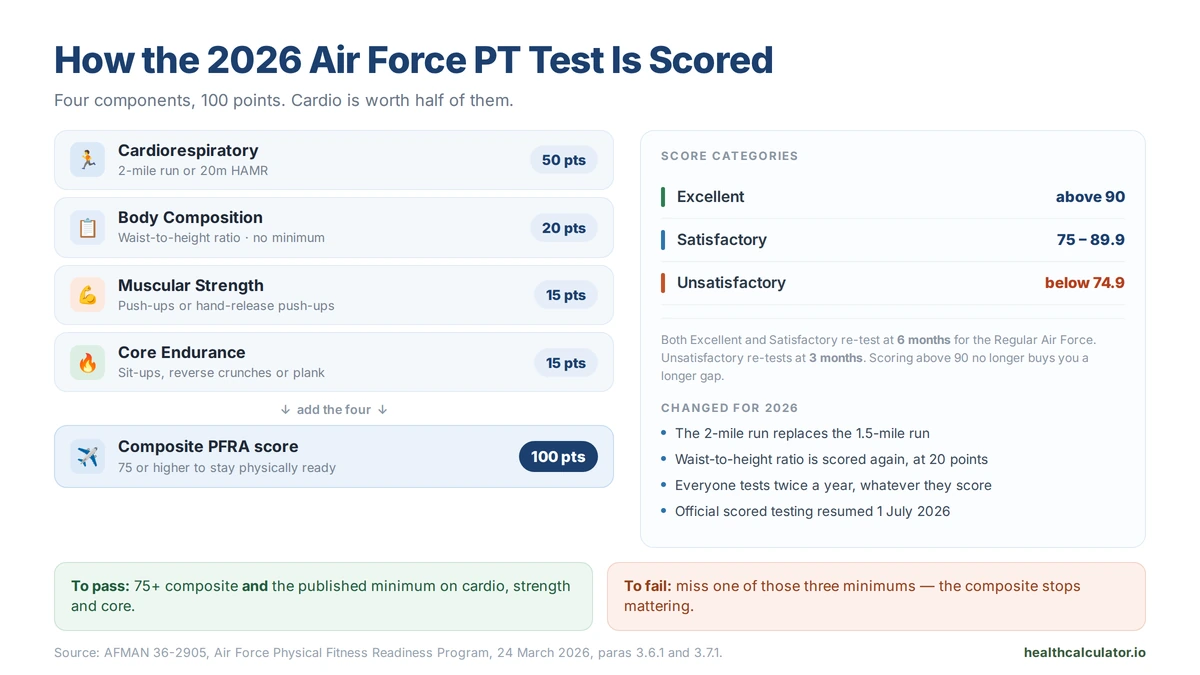
There's no formula in the mathematical sense. Every event has a published table, your result buys a fixed number of points off it, and the four numbers are added.
Composite score = cardio + body composition + muscular strength + core endurance
Cardio runs on a 21-rung scale from 50 down to 35. The other three step in half points, 15.0 down to 2.5. Nothing in between. Reach a rung and you get its points; miss it by one rep or one second and you're paid at the rung below.
Take a 27-year-old male Airman. He runs the 2-mile in 15:29, knocks out 47 push-ups, holds a 2:35 plank, and measures 34 inches at the waist against 70 inches of height.
Composite: 83.0 — Satisfactory. Type those numbers in above and you'll get 83 back. Notice the push-ups: one more rep would have moved him from 9.0 to 9.5. That's the whole game: knowing where the next rung sits.
Every number here comes from the PFRA scoring charts current as of 17 March 2026, the same tables the calculator above runs on. The test is scored out of 100: 50 points for cardio, 15 for strength, 15 for core and 20 for body composition. Cardio, strength and core each carry a minimum you have to hit. Body composition does not, so a poor waist-to-height ratio costs you points but cannot fail you by itself.
Find your age group, then read across. The first figure earns the full points for that component and the second is the lowest result that still counts.
| Age group | Men: 50 points | Men: minimum | Women: 50 points | Women: minimum |
|---|---|---|---|---|
| Under 25 | 13:25 | 19:45 | 15:30 | 25:23 |
| 25-29 | 13:35 | 19:55 | 15:55 | 25:40 |
| 30-34 | 13:42 | 20:44 | 16:10 | 26:15 |
| 35-39 | 13:56 | 21:16 | 16:12 | 26:30 |
| 40-44 | 14:05 | 22:04 | 16:45 | 26:52 |
| 45-49 | 14:30 | 22:27 | 16:55 | 27:15 |
| 50-54 | 15:09 | 22:50 | 17:10 | 28:05 |
| 55-59 | 15:28 | 23:36 | 17:43 | 28:40 |
| 60 and over | 16:58 | 24:00 | 18:20 | 29:40 |
| Age group | Men: 50 points | Men: minimum | Women: 50 points | Women: minimum |
|---|---|---|---|---|
| Under 25 | 87 | 42 | 68 | 21 |
| 25-29 | 85 | 42 | 65 | 20 |
| 30-34 | 84 | 38 | 63 | 19 |
| 35-39 | 82 | 36 | 63 | 18 |
| 40-44 | 81 | 32 | 59 | 17 |
| 45-49 | 77 | 31 | 58 | 16 |
| 50-54 | 71 | 30 | 57 | 14 |
| 55-59 | 69 | 27 | 53 | 13 |
| 60 and over | 65 | 26 | 50 | 11 |
| Age group | Push-ups men | Push-ups women | HR push-ups men | HR push-ups women |
|---|---|---|---|---|
| Under 25 | 67 / 30 | 50 / 15 | 52 / 27 | 42 / 17 |
| 25-29 | 63 / 28 | 47 / 14 | 50 / 25 | 40 / 15 |
| 30-34 | 60 / 26 | 44 / 12 | 48 / 23 | 38 / 13 |
| 35-39 | 56 / 23 | 42 / 11 | 46 / 21 | 36 / 11 |
| 40-44 | 52 / 21 | 39 / 10 | 44 / 19 | 34 / 9 |
| 45-49 | 49 / 19 | 36 / 8 | 42 / 17 | 32 / 7 |
| 50-54 | 45 / 17 | 34 / 7 | 40 / 15 | 30 / 5 |
| 55-59 | 42 / 14 | 31 / 5 | 38 / 13 | 28 / 3 |
| 60 and over | 38 / 12 | 28 / 3 | 36 / 11 | 26 / 1 |
| Age group | Sit-ups men | Sit-ups women | Crunches men | Crunches women | Plank men | Plank women |
|---|---|---|---|---|---|---|
| Under 25 | 58 / 33 | 54 / 29 | 60 / 35 | 58 / 33 | 3:40 / 1:35 | 3:35 / 1:30 |
| 25-29 | 56 / 31 | 50 / 25 | 58 / 33 | 56 / 31 | 3:35 / 1:30 | 3:30 / 1:25 |
| 30-34 | 54 / 29 | 45 / 20 | 56 / 31 | 54 / 29 | 3:30 / 1:25 | 3:25 / 1:20 |
| 35-39 | 52 / 27 | 43 / 18 | 54 / 29 | 52 / 27 | 3:25 / 1:20 | 3:20 / 1:15 |
| 40-44 | 50 / 25 | 41 / 16 | 52 / 27 | 50 / 25 | 3:20 / 1:15 | 3:15 / 1:10 |
| 45-49 | 48 / 23 | 35 / 10 | 50 / 25 | 48 / 23 | 3:15 / 1:10 | 3:10 / 1:05 |
| 50-54 | 46 / 21 | 34 / 9 | 48 / 23 | 46 / 21 | 3:10 / 1:05 | 3:05 / 1:00 |
| 55-59 | 44 / 19 | 32 / 7 | 46 / 21 | 44 / 19 | 3:05 / 1:00 | 3:00 / 0:55 |
| 60 and over | 42 / 17 | 31 / 6 | 44 / 19 | 42 / 17 | 3:00 / 0:55 | 2:55 / 0:50 |
| Waist-to-height ratio | Points |
|---|---|
| 0.49 or lower | 20 |
| 0.50 | 19 |
| 0.51 | 18 |
| 0.52 | 17 |
| 0.53 | 16 |
| 0.54 | 15 |
| 0.55 | 12.5 |
| 0.56 | 10 |
| 0.57 | 7.5 |
| 0.58 | 5 |
| 0.59 | 2.5 |
| 0.60 or higher | 0 |
A composite of 75 passes. Hitting every minimum does not get you there: a man aged 25 to 29 who scores the bare minimum in cardio, strength and core, and takes nothing for body composition, lands at 42.5 points. The minimums are a floor, not a plan.
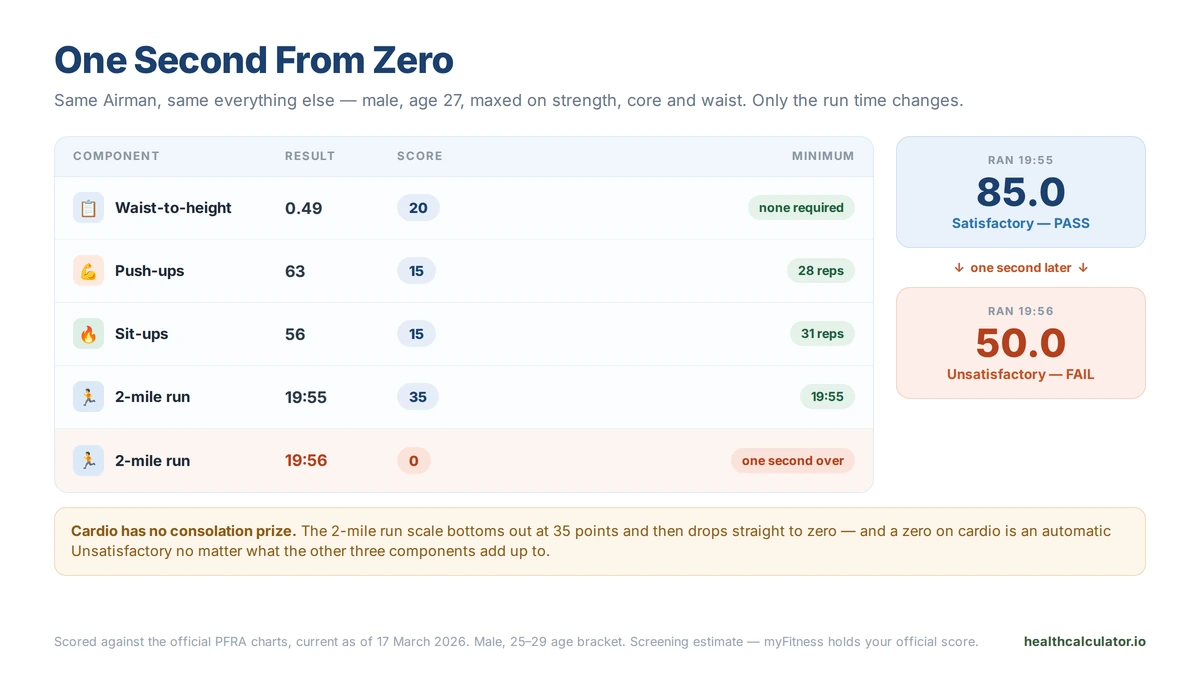
The cardio scale doesn't fade out gently. It bottoms out at 35 points and then falls straight to zero. A zero on cardio is an automatic Unsatisfactory, no matter how good the rest of your card looks.
Picture that same 27-year-old, but maxed everywhere else: 63 push-ups, 56 sit-ups, a 0.49 waist ratio. That's 50 points banked before he starts running. Run the 2-mile in 19:55 and he scores 85.0 and passes. Run it in 19:56, one second later, and cardio pays nothing: the composite falls to 50.0, and he's Unsatisfactory with a three-month retest.
That asymmetry is deliberate, and there's evidence behind it. In a prospective cohort of 781 cadets, injured trainees had weaker hand-release push-ups, weaker planks and slower two-mile runs — but once every risk factor was modeled together, aerobic fitness was the only one that independently predicted injury. Cardio is worth half the test because it's the half that keeps you in the fight.
If you test at Peterson, Schriever, Buckley, the Academy, F.E. Warren, Kirtland or Malmstrom, thin air is costing you seconds you're entitled to have back.
Attachment 3 of the manual publishes an altitude correction, and almost nobody applies it. Four bands, and the credit scales with how long you're out there:
| Test site elevation | 2-mile run credit | 20m HAMR credit |
|---|---|---|
| 5,250 – 5,499 ft | 2 – 8 sec | +1 shuttle |
| 5,500 – 5,999 ft | 6 – 22 sec | +2 shuttles |
| 6,000 – 6,599 ft | 11 – 37 sec | +3 shuttles |
| 6,600 ft and above | 18 sec – 1:02 | +4 shuttles |
That's not cosmetic. Take the Airman from the section above who missed the cut by one second with a 19:56. Run that same 19:56 at 6,000 feet and the chart hands him 19 seconds back — a scored time of 19:37, 35 points, and a pass instead of a three-month retest. Set your test site elevation in the calculator above and it applies the correction for you.
Body composition is back, it's worth 20 points, and it's the component people misread most often.
Your ratio is your waist in inches divided by your height in inches. Age-agnostic, same table for everyone. Then comes the part that matters: the result is truncated, not rounded, to two decimal places. The Air Force's own example is a 39.5-inch waist against 72 inches of height: 39.5 ÷ 72 = 0.5486, and the recorded ratio is 0.54, not 0.55. That single truncation is the difference between 15 points and 12.5.
The scale isn't linear either. From 0.50 through 0.54 you lose one point per hundredth. At 0.55 the step doubles to 2.5 points and stays there until you hit zero at 0.60. That break isn't arbitrary, the Department of War set the allowable ceiling below 0.55 for every service, and the research points to the same place. Following 94,000 US adults for two decades, a 2025 analysis found a ratio of 0.55 or above carried higher all-cause mortality than one under 0.50, even after adjusting for BMI. Our BMI calculator shows how differently the two measures read the same body.
How it's actually measured on test day: at the midpoint between your lowest rib and the top of your hip bone, on bare skin, from your right side, recorded at the end of a normal exhale. No breath-holding, no sucking in. Three measurements, each rounded down to the nearest half inch, then averaged and rounded down again. Height comes off a stadiometer with your shoes off, also to the nearest half inch. Every rounding step in that chain goes in your favor.
And here's the part almost nobody knows: body composition is the one component with no minimum. Score a 0.62 ratio and you take a zero. But you don't automatically fail. Max your other three (50 + 15 + 15 = 80) and you still pass with an 80. It's a narrow road, but it exists. If you're near the line, the body fat calculator is worth a look, because a secondary body fat assessment, pass/fail at under 26% for men and under 36% for women is what you'll face if your ratio runs above 0.55 and you miss PFRA standards.
The Air Force says this outright: hitting the minimum on every single event "does not generate enough points to earn a composite score of 75 or greater." Here's what that looks like in numbers for a male Airman in the 25–29 bracket.
| Component | Bare minimum | Points |
|---|---|---|
| 2-mile run | 19:55 | 35 |
| Push-ups | 28 reps | 2.5 |
| Sit-ups | 31 reps | 2.5 |
| Waist-to-height | 0.59 | 2.5 |
| Composite | 42.5 |
Swap that 0.59 waist for a perfect 0.49 and you reach 60. Still 15 points short. There is no combination of minimums that passes. You have to be genuinely good at something.
Two conditions, both required: a composite of 75 or higher, and the published minimum on cardio, muscular strength and core.
| Category | Score | Next test — Regular AF | Next test — Reserve & Guard |
|---|---|---|---|
| Excellent | above 90 | 6 months | 12 months |
| Satisfactory | 75 – 89.9 | 6 months | 12 months |
| Unsatisfactory | below 74.9 | 3 months | 3 months |
Read that top row again if you're used to the old system. Scoring above 90 no longer buys you a longer gap. Excellent and Satisfactory both come back in six months for the Regular Air Force. The only thing your score changes now is the penalty for missing.
And one line most Airmen have never read: once the administrator hands you your composite, you may elect to take it as a diagnostic instead of a scored PFRA. You see the number first, then decide whether it counts.
Honest limits, because a tool that pretends to cover everything is worse than one that tells you where it stops.
Testing for a different service? The Navy PRT calculator runs the full Guide-5A tables the same way, and the Army body fat calculator covers the tape method.
It's free, there's no sign-up, nothing is stored, and it works on a phone in a parking lot. But the real reason is narrower than that: every number in it was checked against the source.
We machine-read the official PFRA scoring charts published by AFPC and compared every published cell of the push-up, 2-mile run and HAMR tables — 1,224 of them, plus every anchor and step size on hand-release push-ups, sit-ups, reverse crunches and the plank, against what this tool returns. Zero mismatches. It also applies the Attachment 3 altitude correction, which no other Air Force PT calculator we can find implements at all.
That matters more than it should. If you've run your numbers somewhere else and the answer looked strange, check what the tool asked you for. As of August 2026, several widely used general-purpose calculators — Omni Calculator and Inch Calculator among them — still score the Air Force PT test on the retired 1.5-mile run with no body composition component at all. A calculator that never asks for your waist measurement cannot be scoring the 2026 PFRA. You can see the rest of our tools on the calculators page.
This calculator is for informational and screening purposes only and does not constitute medical advice, an official fitness assessment, or a diagnosis. Your official PFRA score is the one recorded in myFitness by a certified administrator. Always consult a qualified healthcare professional before starting a new training program, and your unit fitness program manager for anything about your record.
You need a composite score of 75 or higher and the published minimum on cardiorespiratory, muscular strength and core endurance. Falling below any of those three minimums scores that component zero and makes the whole assessment Unsatisfactory, whatever the composite says. Body composition is the exception, it carries no minimum.
Out of 100 points: 50 for cardiorespiratory fitness, 20 for body composition, 15 for muscular strength and 15 for core endurance. Each event has its own published table by age bracket and sex. Your performance buys a fixed number of points, and the four component scores are added to produce the composite.
It depends on age and sex. For males it runs from 19:45 under 25 out to 24:00 at 60 and over; for females, from 25:23 under 25 out to 29:40 at 60 and over. Hitting the minimum scores 35 points. One second slower scores zero and fails the component outright.
No. Body composition is the only component with no minimum requirement. A ratio of 0.60 or above scores zero points, but you can still pass by earning 75 from the remaining 80 available. If your ratio is above 0.55 and you miss PFRA standards, you face a secondary body fat assessment.
Not any more. Under the 2026 program, Excellent and Satisfactory both re-test at six months for the Regular Air Force and twelve months for the Reserve and Guard. Only an Unsatisfactory changes the clock, pulling your next assessment forward to three months across the Total Force.
0.49 or lower earns all 20 points, at any age and for both sexes. From 0.50 to 0.54 you lose a point per hundredth. At 0.55 the penalty doubles to 2.5 points per step, reaching zero at 0.60. Remember the ratio is truncated to two decimals, never rounded up.
No. Active-duty Airmen had to be measured by 31 July 2026 and Guard and Reserve members by 31 August 2026, but that was a one-time baseline collection — it did not affect fitness scores, test currency or any personnel action. Your waist-to-height ratio only earns or costs points when it is taken as part of a scored PFRA, where it is worth 20 of the 100 points.
Yes. The 20-meter High Aerobic Multi-shuttle Run remains a full alternative to the 2-mile run and is scored on the same 50-to-35-point scale. A male Airman under 25 needs 87 shuttles for the full 50 points and 42 to avoid a zero. Switch the event above to compare both.
Yes. At test sites of 5,250 feet and above, Attachment 3 of AFMAN 36-2905 credits you time on the 2-mile run, from 2 seconds in the lowest band up to 1:02 for a slow run above 6,600 feet, and adds 1 to 4 shuttles to a HAMR score. Set your elevation in the calculator and it applies automatically.
Yes. Fitness scores began appearing in performance briefs in February 2026 for officers and May 2026 for enlisted Airmen, starting with colonels and rolling down through lieutenant colonels, majors and chief master sergeants. Your composite is no longer a standalone pass or fail, it sits where raters and promotion boards see it.
Every figure on this page is drawn from official Department of the Air Force publications or peer-reviewed research. Last verified August 2026.