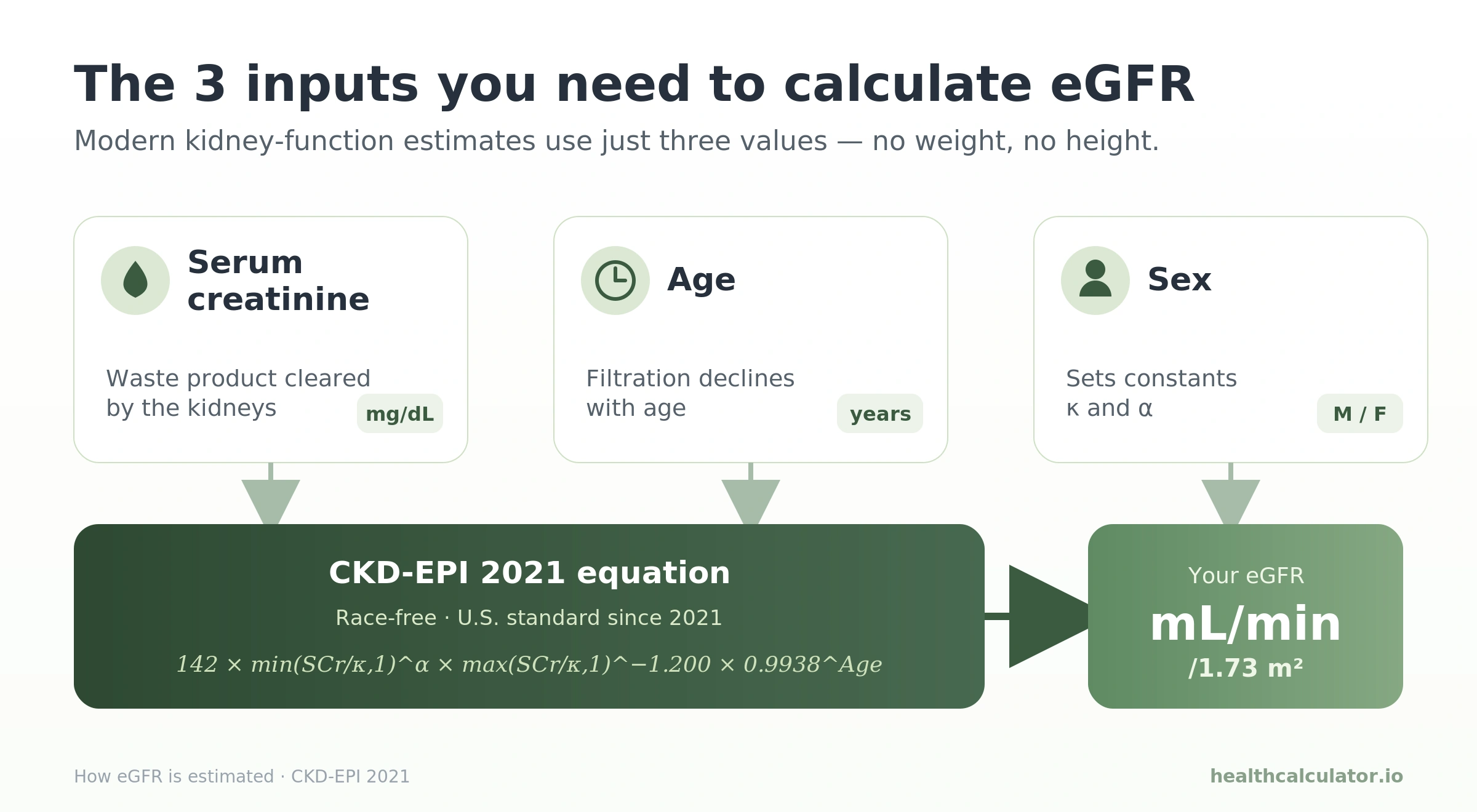
To calculate eGFR, you apply the CKD-EPI 2021 equation to three values: your serum creatinine (mg/dL), your age, and your sex. It returns your estimated glomerular filtration rate in mL/min/1.73 m² — no weight or height required. An eGFR of 90 or above is generally considered normal kidney function.
Try it yourself — enter your creatinine, age, and sex:
Enter your creatinine, age and sex — the full method is explained below.
That’s the fast way — three numbers, one equation, no weight or height. But the formula looks scarier than it is (a kappa, an alpha, a couple of exponents), and it’s worth knowing where your number actually comes from. So below, we work the CKD-EPI 2021 formula by hand, step by step, until it stops being a black box.
One quick clarification, because it trips almost everyone up. When people ask how to calculate GFR, they nearly always mean eGFR — the “e” is for estimated. True GFR is measured directly, with a tracer injected into your blood, in a lab. Slow, expensive, and rare. So “how is GFR calculated” in day-to-day medicine really means “how is eGFR estimated,” and the equation below is that estimate.
The three inputs you need (and nothing else)
Here’s what surprises people: the modern eGFR equation barely asks for anything. Three values. That’s it.
- Serum creatinine — a waste product your muscles make and your kidneys clear. Labs report it in mg/dL (the US) or µmol/L (the UK, Europe, much of Asia). Normal runs roughly 0.6–1.2 mg/dL for men and 0.5–1.1 mg/dL for women.
- Age — in years. Filtration slips as you get older, and the formula bakes that in.
- Sex — male or female. It sets two constants in the equation.
No weight. No height. No 24-hour urine collection. The CKD-EPI equation U.S. labs have used since 2021 already scales the result to a standard body size of 1.73 m², which is why weight falls out entirely. That’s the big break from the old creatinine clearance method (Cockcroft-Gault), which does demand your weight — more on that mix-up later.
The eGFR calculation formula: CKD-EPI 2021
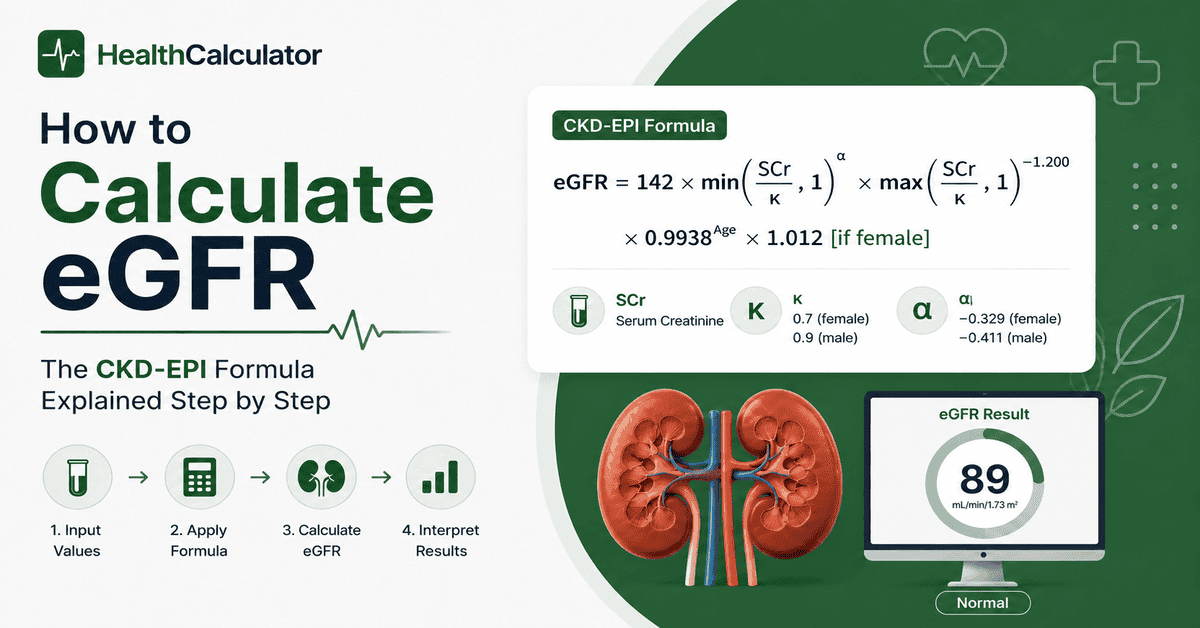
Since 2021, the standard eGFR calculation formula in the US has been the race-free CKD-EPI creatinine equation. It replaced an older version that adjusted for race — a variable the National Kidney Foundation and American Society of Nephrology task force threw out after it was shown to overestimate kidney function in Black patients. Here’s the equation exactly as labs run it:
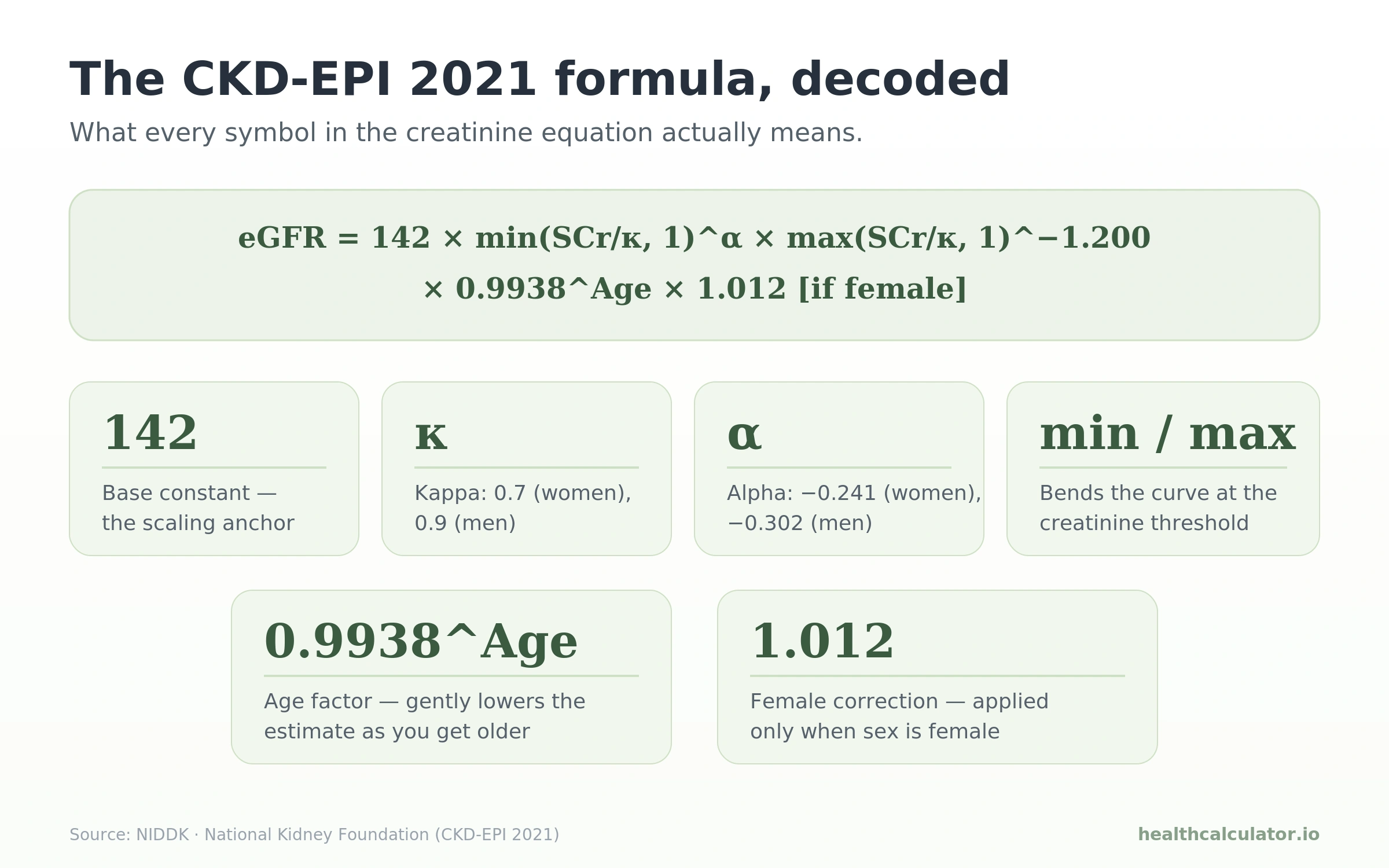
eGFR = 142 × min(SCr/κ, 1)^α × max(SCr/κ, 1)^−1.200 × 0.9938^Age × 1.012 [if female]
Don’t let the Greek scare you. Decoded, it’s just multiplication:
- SCr — your serum creatinine in mg/dL.
- κ (kappa) — a sex constant: 0.7 for women, 0.9 for men.
- α (alpha) — a sex exponent: −0.241 for women, −0.302 for men.
- min(SCr/κ, 1) — take SCr/κ, but cap it at 1 if it’s higher.
- max(SCr/κ, 1) — take SCr/κ, but floor it at 1 if it’s lower.
- 0.9938^Age — nudges the result down as you age.
- 1.012 — a small bump applied only for women.
The min/max pair is the clever bit. One formula bends at the exact point where creatinine crosses its sex-specific threshold, so the estimate stays accurate whether your creatinine reads low or high. No need for two separate equations.
How to calculate eGFR step by step (worked example)
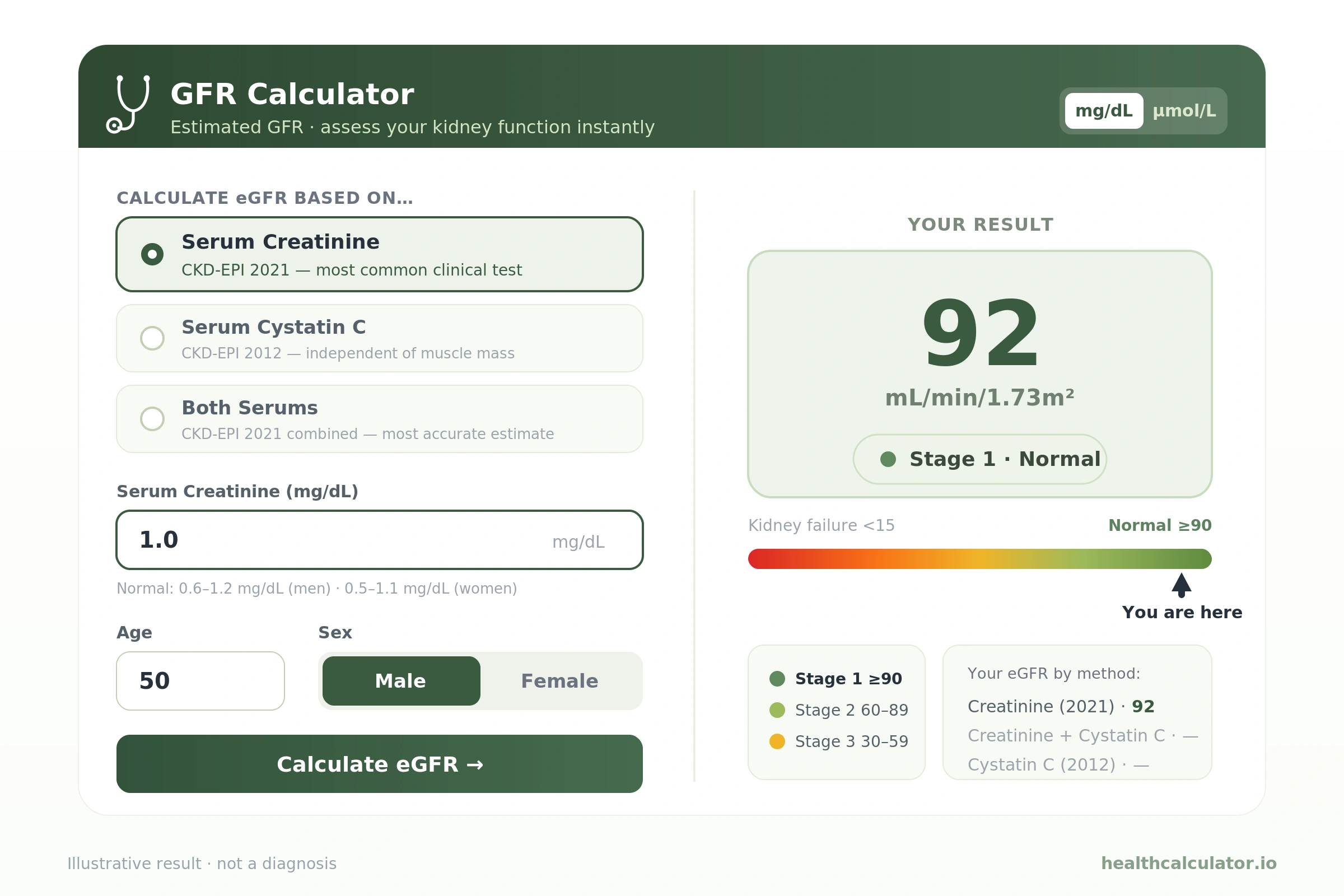
Enough theory. This is the part everyone actually wants: how to calculate GFR from creatinine, by hand, with real numbers. Take a 50-year-old man with a serum creatinine of 1.0 mg/dL.
Step 1 — Pick your constants. He’s male, so κ = 0.9 and α = −0.302.
Step 2 — Divide creatinine by kappa. 1.0 ÷ 0.9 = 1.111.
Step 3 — The min term. min(1.111, 1) = 1. Raise it to α: 1^−0.302 = 1. (Anything with a base of 1 stays 1, whatever the exponent.)
Step 4 — The max term. max(1.111, 1) = 1.111. Raise it to −1.200: 1.111^−1.200 = 0.881.
Step 5 — The age factor. 0.9938^50 = 0.733.
Step 6 — Multiply. 142 × 1 × 0.881 × 0.733 = 92 mL/min/1.73 m².
Ninety-two. Normal filtration, Stage 1. He’s male, so the 1.012 female factor never enters. Want to check it without touching a calculator? Here’s the same case run through our tool:
Now the female version, because the constants shift. Take a 55-year-old woman with a creatinine of 0.9 mg/dL. Now κ = 0.7 and α = −0.241. SCr/κ = 0.9 ÷ 0.7 = 1.286, so the min term is 1 and the max term is 1.286^−1.200 = 0.740. Age factor: 0.9938^55 = 0.710. Multiply, and this time keep her 1.012: 142 × 0.740 × 0.710 × 1.012 ≈ 75 mL/min/1.73 m².
What if your creatinine is in µmol/L?
Plenty of labs outside the US report creatinine in µmol/L, and the CKD-EPI formula wants mg/dL. One step fixes it: divide µmol/L by 88.4. So 106 µmol/L becomes 106 ÷ 88.4 = 1.2 mg/dL, and you’re back in business. Our calculator has a mg/dL ↔ µmol/L toggle built in, so you can paste the number straight off any lab report and skip the conversion entirely.
Calculating eGFR from cystatin C
Creatinine has one weakness: it rides on muscle. A bodybuilder, a frail 80-year-old, someone who’s lost a limb — their creatinine can lie, and the eGFR lies right along with it. That’s where cystatin C earns its place. It’s a protein nearly every cell in your body makes, and muscle mass barely touches it.
The cystatin C version runs the CKD-EPI 2012 equation:
eGFR = 133 × min(SCys/0.8, 1)^−0.499 × max(SCys/0.8, 1)^−1.328 × 0.996^Age × 0.932 [if female]
Same min/max logic, just a different marker (SCys, in mg/L) and its own constants. A normal cystatin C sits around 0.5–1.0 mg/L.
Here’s the current best practice, and it’s worth knowing. The KDIGO 2024 guideline recommends combining both markers — the eGFRcr-cys equation — whenever the number really matters: confirming a chronic kidney disease diagnosis, or dosing a drug where being wrong is dangerous. Two markers beat one. Our calculator runs all three side by side so you can compare them directly.
eGFR vs creatinine clearance vs MDRD: don’t mix them up
Half the confusion online comes from people grabbing the wrong equation. “Calculate GFR from creatinine clearance” and “calculate eGFR” sound identical. They aren’t. Different tests, different formulas, different answers.
| Equation | What it needs | Notes |
|---|---|---|
| CKD-EPI 2021 (creatinine) | Creatinine, age, sex | Current U.S. standard; race-free; result per 1.73 m² |
| CKD-EPI 2012 (cystatin C) | Cystatin C, age, sex | Muscle-independent; good backup marker |
| CKD-EPI 2021 combined | Creatinine + cystatin C, age, sex | Most accurate; preferred by KDIGO 2024 when precision counts |
| MDRD (older) | Creatinine, age, sex | Predecessor to CKD-EPI; less accurate above 60, now largely retired |
| Cockcroft-Gault (creatinine clearance) | Creatinine, age, sex, weight | Estimates creatinine clearance, not eGFR; still used for some drug dosing |
Two things to burn in. Creatinine clearance is not eGFR — Cockcroft-Gault needs your weight and estimates a slightly different thing. And MDRD is the old equation you skip whenever CKD-EPI 2021 is available. So a GFR clearance calculation (Cockcroft-Gault) and an eGFR calculation answer slightly different questions. The tell: if a calculator asks for your weight to find “GFR,” it’s running Cockcroft-Gault, not the modern eGFR.
The newer equations: EKFC and the 2024 shift
Kidney science didn’t stop in 2021. The European Kidney Function Consortium (EKFC) equation, from Hans Pottel and colleagues, is a newer race- and sex-adjusted approach that a 2024 comparison in the Clinical Kidney Journalfound edged out the 2021 CKD-EPI cystatin C equation in European populations. Accuracy is also local. A 2024 Pakistani cohort study pitted EKFC, a locally tuned CKD-EPI, and the 2021 race-free equation against each other in South Asian patients — and found real differences. No single formula is “right” for everyone, everywhere.
For everyday US use, CKD-EPI 2021 is still what your lab reports, so it’s what our calculator leads with. But the whole field is circling one conclusion: creatinine plus cystatin C beats either marker alone.
Common mistakes when calculating eGFR
A handful of errors show up again and again. Watch for these:
- Unit mismatch. Drop a µmol/L value into a formula expecting mg/dL and your answer is wildly off. Convert first (÷ 88.4).
- Using MDRD instead of CKD-EPI 2021. Old calculators still float around the web. Check which equation you’re on.
- Forgetting it’s an estimate. The “e” means estimated. It assumes your creatinine is stable and scales to a standard body size.
- Calculating mid-illness. If your creatinine is climbing fast — dehydration, infection, a new medication — a single eGFR can mislead. Kidney function reads best from a stable measurement, repeated over time.
- Reading Stage 1 as automatically sick. An eGFR of 90+ counts as CKD only when there’s also a marker of kidney damage, like protein in the urine. On its own, a high number just means good filtration.
What your number actually means
You’ve got a number. Now for the band it lands in. Broadly: 90 or above is normal filtration, 60–89 is mildly reduced, and anything under 60 that holds for three months or more is the usual line doctors use to flag chronic kidney disease, per the CDC. Below 15 is kidney failure.
Rather than reprint the whole staging chart here, run your numbers through the GFR calculator — it color-codes your result against the full KDIGO stage table and tells you exactly where you sit.
And if the goal is to protect your kidney function, two levers do most of the work: blood pressure and blood sugar. High blood pressure and diabetes are the two leading causes of kidney damage, so keeping both in range takes real strain off your filters. Track your blood pressure with our MAP calculator, your average glucose control with the A1C calculator, and your daily hydration target with the water intake calculator.
Medical disclaimer
This article is for informational purposes only and does not constitute medical advice or diagnosis. Always consult a qualified healthcare professional about your kidney function and any changes to your care.
Frequently asked questions
Take your serum creatinine (mg/dL), age, and sex, and enter them into the CKD-EPI 2021 equation: eGFR = 142 × min(SCr/κ, 1)^α × max(SCr/κ, 1)^−1.200 × 0.9938^Age, with a 1.012 factor added for women. Kappa is 0.7 (women) or 0.9 (men); alpha is −0.241 (women) or −0.302 (men). The result is your eGFR in mL/min/1.73 m².
Yes, you can. The CKD-EPI 2021 equation is just multiplication and two exponents, so a scientific calculator is enough. In practice almost no one does it manually because a single unit slip changes the answer, and your lab report already includes eGFR next to your creatinine. Use an online GFR calculator to check your work instantly.
Just three: serum creatinine, age, and sex. The modern CKD-EPI equation does not use weight or height because it reports the result normalized to a standard body surface area of 1.73 m². If a tool asks for your weight, it’s calculating creatinine clearance (Cockcroft-Gault), not eGFR.
No. eGFR is estimated with the CKD-EPI equation from creatinine, age, and sex. Creatinine clearance is a related but different measure, usually estimated with the Cockcroft-Gault formula, which also needs your weight. They often land close to each other but aren’t interchangeable, and some medication doses are still based specifically on creatinine clearance.
Divide the µmol/L value by 88.4. For example, 106 µmol/L ÷ 88.4 = 1.2 mg/dL. To go the other way, multiply mg/dL by 88.4. The CKD-EPI formula expects mg/dL, so convert before you calculate — or use a calculator with a built-in unit toggle so you never have to.
Because it reports eGFR already indexed to a standard body size of 1.73 m². Older methods like Cockcroft-Gault estimate raw creatinine clearance and need weight to do it. CKD-EPI’s design choice makes eGFR comparable from person to person and easy for labs to report automatically from a routine blood panel.
For most people, the combined creatinine-and-cystatin-C equation (eGFRcr-cys) is the most accurate, which is why the KDIGO 2024 guideline recommends it when an exact number affects a clinical decision. Creatinine alone (CKD-EPI 2021) is the practical everyday standard. Newer options like the EKFC equation are gaining ground, especially outside the US.
The same CKD-EPI 2021 equation is used at every adult age — the 0.9938^Age term simply lowers the estimate as age rises, reflecting the natural, gradual decline in filtration. Because creatinine can be misleading in frail or low-muscle older adults, doctors often add cystatin C for a more reliable reading in this group.