
GFR Calculator
Last updated:

Muhammad Hamza is the founder of Health Calculator, dedicated to building accurate and easy-to-use health tools for everyone.

Dr. Farah Taqueer is a qualified Pediatrician based in Karachi. She reviews all health calculators on this site for clinical accuracy and medical correctness.
Glomerular Filtration Rate (GFR) is a kidney function test and Renal function test that estimates how efficiently the kidneys filter waste from the blood per minute. Your kidneys quietly filter about 150 quarts of blood every day, and this tool tells you how well they are keeping up. Doctors use GFR and eGFR results for CKD screening and kidney disease diagnosis, especially when evaluating patients with abnormal creatinine blood test results.
Our eGFR calculator online estimates kidney function using standard clinical variables such as serum creatinine, age, and sex, based on the CKD-EPI 2021 equation.
The result helps you understand your kidney function status and whether it falls within a normal, reduced, or critical range. It matters because chronic kidney disease affects roughly 1 in 7 American adults, and most people have no idea until it is advanced, according to the Centers for Disease Control and Prevention.
Most GFR calculators hand you one method, this one gives you three ways to estimate: serum creatinine, cystatin C, or both together. That flexibility follows the latest KDIGO 2024 kidney disease guideline, which we explain below.
What Is Glomerular Filtration Rate (GFR)?
GFR is an estimate of the volume of blood plasma filtered by the glomeruli per minute per 1.73 m² body surface area.
In simple words, GFR measures how much blood your kidneys filter every minute. Healthy kidneys remove waste and extra fluid efficiently to maintain internal balance.
GFR rarely works alone. Doctors read GFR next to a creatinine blood test and a urine check to judge your overall renal health and spot damage early. The National Institute of Diabetes and Digestive and Kidney Diseases (NIDDK) calls it the single best indicator of how well your kidneys are working.
One heads-up before you start. This calculator is built for adults 18 and older. Kids and teens are estimated with different pediatric equations, so use a dedicated tool for anyone under 18.
How Our GFR Calculator Works: Three Ways to Estimate
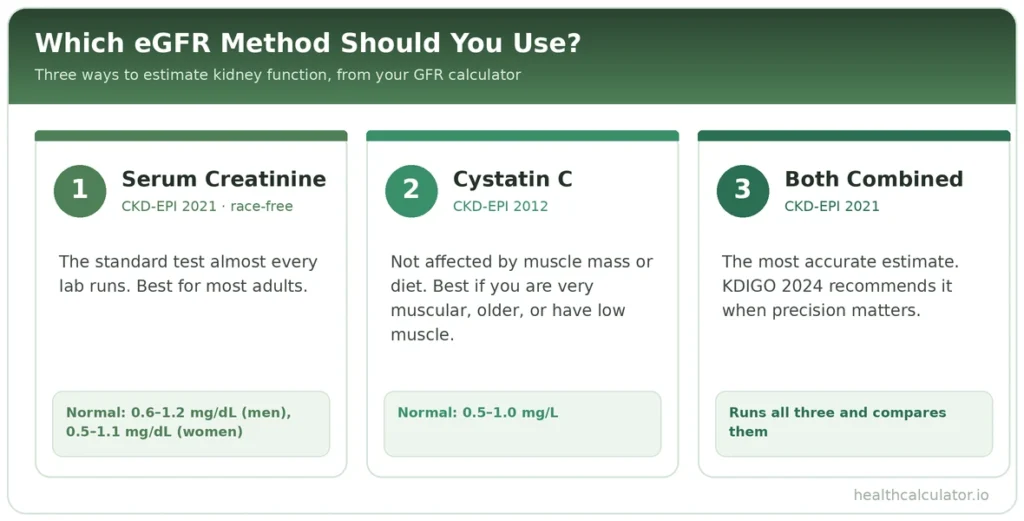
Real GFR is slow and expensive to measure directly, so labs estimate it (that estimate is called eGFR) from a simple blood test plus your age and sex. Pick the method that matches the labs you have:
1. Serum Creatinine (CKD-EPI 2021, race-free)
This is the standard test almost every lab runs. Creatinine is a waste product from normal muscle activity, and healthy kidneys clear it steadily. Normal is roughly 0.6 to 1.2 mg/dL for men and 0.5 to 1.1 mg/dL for women. Our tool uses the 2021 race-free version of this equation, now recommended by the National Kidney Foundation after race was removed as a variable in 2021.
Most modern clinical labs in the US use the CKD-EPI 2021 equation for eGFR reporting.
The CKD-EPI equation estimates GFR using serum creatinine, age, and sex with validated coefficients to improve accuracy.
It improves accuracy by adjusting for biological differences between individuals. It is currently recommended for adult kidney function estimation.
2. Serum Cystatin C (CKD-EPI 2012)
Cystatin C is a protein made by nearly every cell in your body and filtered almost entirely by the kidneys. Its big advantage: it is barely affected by muscle mass, diet, or age, so it is often more reliable for very muscular people, older adults, amputees, and anyone whose creatinine reading looks off. A normal value sits around 0.5 to 1.0 mg/L.
3. Both Serums Combined (CKD-EPI 2021)
When you enter creatinine and cystatin C together, the tool runs the combined equation and shows all three results side by side. The KDIGO 2024 guideline points to this combined estimate (eGFRcr-cys) as the most precise option, and recommends it when an accurate number really counts, such as confirming a CKD diagnosis or dosing medication safely.
You can also switch the creatinine input between mg/dL and µmol/L using the toggle at the top, so lab reports from any country drop straight in.
The eGFR Formula Our Calculator Uses
Here are the exact equations behind the calculator, straight from the source papers. SCr is serum creatinine, SCys is cystatin C, and κ (kappa) is a sex-specific constant.
Creatinine, CKD-EPI 2021:
eGFR = 142 × min(SCr/κ, 1)^α × max(SCr/κ, 1)^−1.200 × 0.9938^Age × 1.012 [if female] where κ = 0.7 (female) or 0.9 (male), and α = −0.241 (female) or −0.302 (male).
Cystatin C, CKD-EPI 2012:
eGFR = 133 × min(SCys/0.8, 1)^−0.499 × max(SCys/0.8, 1)^−1.328 × 0.996^Age × 0.932 [if female]
Combined creatinine + cystatin C, CKD-EPI 2021:
eGFR = 135 × min(SCr/κ, 1)^α × max(SCr/κ, 1)^−0.544 × min(SCys/0.8, 1)^−0.323 × max(SCys/0.8, 1)^−0.778 × 0.9961^Age × 0.963 [if female] where κ = 0.7/0.9 and α = −0.219 (female) or −0.144 (male).
A worked example
Say you are a 45-year-old man with a serum creatinine of 1.1 mg/dL. Plug that into the 2021 creatinine equation and you get an eGFR of about 84 mL/min/1.73m², which lands in CKD Stage 2 (mildly reduced). If your lab reported that same creatinine in µmol/L, it would read 97.2 µmol/L (since 1.1 × 88.4 = 97.2), and the calculator converts it for you automatically. Add a cystatin C of 1.0 mg/L, and the combined equation nudges the estimate to about 85.
Want the full step-by-step math, what every symbol (κ, α, min/max) means, and more examples worked by hand? See our companion guide: How to Calculate eGFR: The CKD-EPI Formula Explained Step by Step →.
eGFR vs Measured GFR: What Is the Difference?
You will see both "GFR" and "eGFR" on lab reports, so here is the distinction in one table. Both tests are part of standard kidney function testing and are interpreted alongside creatinine blood test results to support accurate kidney disease diagnosis.
| Feature | Measured GFR | eGFR (this calculator) |
|---|---|---|
| Type | Direct measurement | Estimate from a formula |
| Method | Special tracer test in a clinic | Routine blood test + age and sex |
| Accuracy | Highest precision | Practical and well validated |
| Cost & time | High, several hours | Low, part of a normal blood panel |
| Availability | Limited | Widely available |
| Everyday use | Rare, research or transplant work-ups | Standard for screening and monitoring |
Measured GFR is the gold standard, but it takes hours and specialized equipment. eGFR gives you a very good estimate from a single blood draw, which is why it is what your doctor uses in day-to-day care.
What GFR Measures in Kidney Function
Your GFR score reflects how efficiently your kidneys are doing their job. Specifically it measures:
- Waste removal efficiency from blood
- Overall kidney filtration performance
- Blood plasma cleansing rate per minute
Why GFR Is Important for Kidney Health
Early kidney disease often develops silently. Monitoring GFR helps detect problems before symptoms appear.
The Centers for Disease Control and Prevention (CDC) emphasizes early detection of kidney disease to prevent progression.
It is primarily used to detect, stage, and monitor chronic kidney disease (CKD).
Understanding Your Result: CKD Stages by eGFR
Once you have your number, this is what it means. The eGFR levels chart below follow the international KDIGO system that the calculator uses, and they match the color-coded scale in your results.
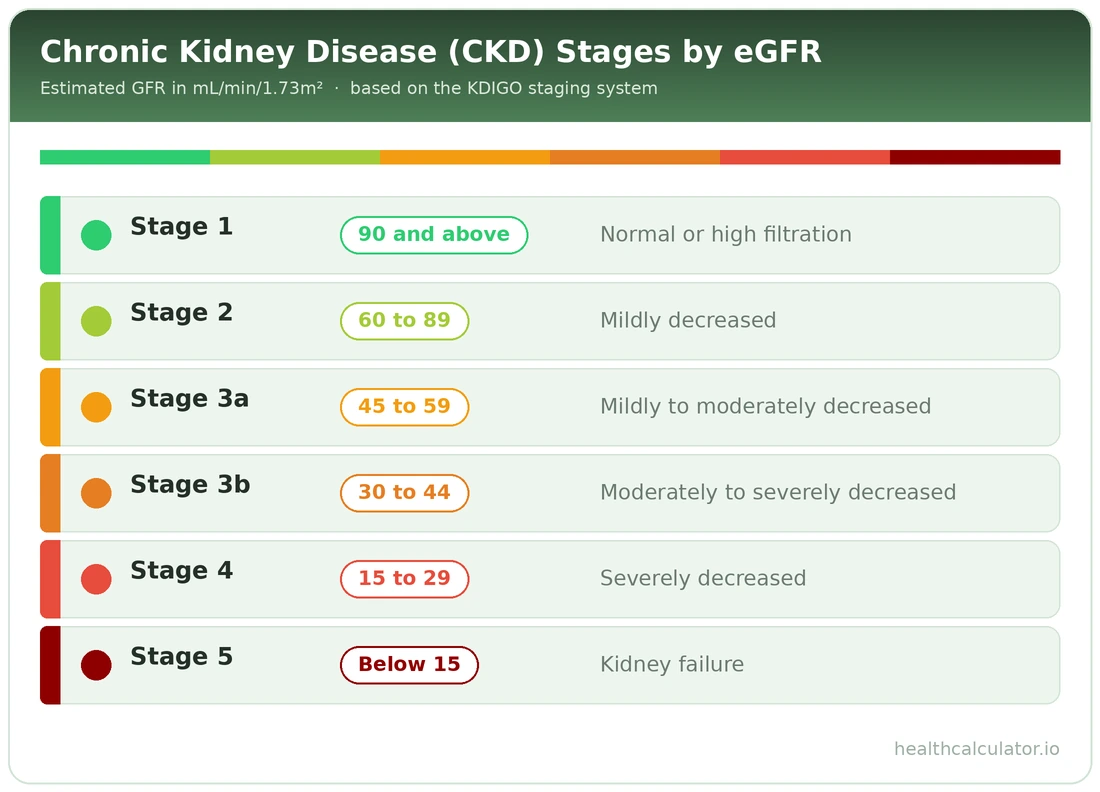
One important detail people miss: an eGFR of 90 or above is not automatically healthy. Stages 1 and 2 count as CKD only when there is also a marker of kidney damage, such as protein in the urine. On its own, a high number simply means good filtration.
| Stage | eGFR (mL/min/1.73m²) | What it means |
|---|---|---|
| Stage 1 | 90 or above | Normal or high filtration (CKD only if kidney damage is also present) |
| Stage 2 | 60 to 89 | Mildly decreased |
| Stage 3a | 45 to 59 | Mildly to moderately decreased |
| Stage 3b | 30 to 44 | Moderately to severely decreased |
| Stage 4 | 15 to 29 | Severely decreased |
| Stage 5 | Below 15 | Kidney failure |
What Is eGFR (Estimated Glomerular Filtration Rate)?
eGFR is estimated directly from kidney function test results, specifically serum creatinine, age, and sex — without requiring complex laboratory procedures used in direct renal function testing. This makes it the standard method for routine kidney function evaluation, as confirmed by the National Kidney Foundation.
Why eGFR Is Used in Clinical Practice
- Quick and non-invasive
- Based on routine blood tests
- Standardized in laboratories
- Useful for early disease detection
Which Test Doctors Rely On and Why
Doctors prefer eGFR because it is practical, cost-effective, and validated for large population use.
Limitations of Estimated GFR
Estimated GFR is widely used, but it has a few limitations you should know:
- Not a direct measurement
- Affected by muscle mass
- May vary with temporary conditions
- Best interpreted over time
Normal GFR Range by Age
GFR naturally declines with age due to reduced nephron function, even in healthy individuals.
Average GFR in Healthy Adults
GFR is highest in early adulthood and gradually declines with age. The following table shows typical average GFR values for healthy adults across different age groups.
| Age Group | Typical Average GFR | Interpretation |
|---|---|---|
| 20–29 years | 116 | Peak kidney function in healthy adults |
| 30–39 years | 107 | Normal age-related decline may begin |
| 40–49 years | 99 | Generally considered healthy kidney function |
| 50–59 years | 93 | Mild decline is common with aging |
| 60–69 years | 85 | Often normal if no signs of kidney disease are present |
| 70+ years | 75 | Lower GFR may occur naturally with age |
These are averages, not cutoffs. Your doctor weighs your eGFR against urine tests, symptoms, and medical history rather than the number alone.
Key Points
- For most healthy adults, GFR typically falls within the 90–120 mL/min/1.73 m² range.
- GFR generally begins to decline gradually after age 30–40.
- A mild reduction in GFR can be a normal part of aging and does not always indicate kidney disease.
- Healthcare providers interpret GFR results alongside urine tests, symptoms, and medical history rather than relying on GFR alone.
What Does Low GFR Mean?
Low GFR indicates reduced kidney filtering ability. The severity depends on how low the value is and whether the decline is temporary or chronic. A GFR below 60 for more than 3 months is commonly used as a diagnostic threshold for CKD.
Low GFR is often confirmed using repeat kidney function tests and correlates strongly with abnormal creatinine blood test levels, which may indicate impaired renal function.
What Causes a Sudden Drop in GFR?
A sudden drop in GFR may indicate acute kidney injury (AKI), especially if accompanied by rapid symptom onset
Temporary Causes
A sudden drop in GFR is often caused by short term causes like:
- Dehydration
- Infection
- Certain medications
Chronic Causes
Long term GFR decline is usually linked to ongoing health conditions such as:
- Diabetes
- High blood pressure
- Chronic kidney disease
When a Sudden Drop Is Dangerous
A sudden drop in GFR becomes medically concerning and requires prompt evaluation in these situations:
- Persistent decline — If GFR drops sharply and does not recover within 48–72 hours despite hydration and rest, it may indicate acute kidney injury (AKI) requiring immediate medical attention.
- Symptoms appear — The sudden onset of symptoms such as decreased urine output, swelling, confusion, or extreme fatigue alongside a GFR drop signals a potential kidney emergency.
- GFR enters CKD range — A sudden fall below 60 mL/min/1.73m² that persists beyond a few days may indicate transition from acute injury to early chronic kidney disease, requiring specialist evaluation.
Symptoms of Low Kidney Function
Early Stage (Mild CKD Symptoms)
In the early stages, low kidney function often develops silently with subtle changes that are easy to overlook:
- Fatigue — The kidneys produce a hormone called erythropoietin that signals the body to make red blood cells. When kidney function declines, this hormone drops, leading to anemia and persistent tiredness.
- Mild swelling — Reduced kidney filtration causes fluid to accumulate in the body, commonly appearing as puffiness around the ankles, feet, or eyes.
- Urination changes — You may notice more frequent urination at night, foamy urine indicating protein loss, or changes in urine color and volume.
Late Stage (Advanced CKD Symptoms)
As kidney function declines further, waste builds up in the bloodstream and symptoms become more severe, significantly affecting daily life:
- Shortness of breath — Fluid accumulates in the lungs when kidneys can no longer remove excess water efficiently, making breathing difficult even at rest.
- Severe swelling — Fluid retention becomes pronounced, affecting the legs, ankles, and abdomen due to loss of protein through urine.
- Nausea and vomiting — Buildup of waste products like urea in the blood, a condition called uremia, causes persistent nausea, loss of appetite, and vomiting.
How Accurate Is eGFR and When Can It Be Misleading?
It is primarily used in CKD screening and is interpreted alongside other renal function tests to improve accuracy in kidney disease diagnosis.
Factors That Affect Accuracy
eGFR is calculated using formulas, so these factors can change the result:
- Muscle mass
- Age
- Hydration
- Medical conditions
When eGFR May Be Misleading?
In some cases, the eGFR number doesn’t reflect actual kidney functions well like:
- Elderly patients
- Very muscular individuals
- Acute illness
Can GFR Improve?
Sometimes, yes. When a low reading comes from a temporary cause, filtration often bounces back once the cause is fixed. Rehydrating usually restores eGFR within days. Stopping or adjusting a kidney-stressing medication frequently reverses the dip. Recovering from an infection or acute illness typically returns kidney function to baseline.
When damage is more established, the goal shifts from reversal to slowing progression, and lifestyle does a lot of the heavy lifting:
- Control your blood pressure. High blood pressure is a top cause of kidney damage. Keeping it in range takes real strain off your filters, and you can track your numbers with our MAP calculator.
- Manage your blood sugar. Diabetes is the number one cause of CKD, so steady glucose protects the kidneys. If you are monitoring diabetes, our A1C calculator helps you see your average control over time.
- Stay well hydrated. Adequate water supports filtration and helps flush waste. Our water intake calculator gives you a simple daily target.
When lifestyle is not enough, doctors add medical treatment: managing the underlying diabetes or hypertension (often with ACE inhibitors or ARBs, which protect the kidneys directly), routine blood and urine monitoring to catch changes early, and adjusting or swapping medications that are hard on the kidneys.
Key Takeaways
- eGFR is the standard clinical method for estimating kidney filtration using serum creatinine, age, and sex.
- Diabetes and high blood pressure are leading causes of low GFR
- A GFR below 60 for more than 3 months may indicate chronic kidney disease (CKD)
- Early kidney disease may develop without noticeable symptoms
- A GFR below 15 indicates kidney failure and requires urgent medical attention
Medical disclaimer:
This calculator is for educational purposes only and does not replace professional medical advice, diagnosis, or treatment. This content follows evidence-based kidney disease guidelines from NIDDK and CDC sources.
Frequently Asked Questions (FAQs)
A GFR of 90 or above is generally considered normal kidney function in healthy adults, provided there are no signs of kidney damage.
A low GFR indicates reduced kidney filtration function and may be a sign of chronic kidney disease (CKD), especially if it remains low over time.
A GFR of 60 may indicate early stage kidney disease and should be monitored regularly to check if it remains stable or declines.
Yes, dehydration can temporarily lower GFR results by reducing blood flow to the kidneys.
A GFR below 15 mL/min/1.73m² is considered kidney failure and usually requires urgent medical evaluation.
Yes, GFR may return to normal if the underlying cause is temporary, such as dehydration, infection, or medication effects.
GFR is a direct measurement of kidney filtration, while eGFR is an estimated value calculated using blood test results.
Kidney function testing frequency depends on individual risk factors. Healthy individuals may be tested annually, while high-risk patients (diabetes, hypertension, CKD) may require more frequent monitoring.