
Chronological Age Calculator
Last updated:

Muhammad Hamza is the founder of Health Calculator, dedicated to building accurate and easy-to-use health tools for everyone.

Dr. Farah Taqueer is a qualified Pediatrician based in Karachi. She reviews all health calculators on this site for clinical accuracy and medical correctness.
Want your exact age down to the day? Enter your date of birth in the tool and you'll get your chronological age in years, months, and days in a split second, no sign-up, nothing stored. Chronological age is simply the time that has passed since you were born, and it's one of the strongest single predictors of age-related disease doctors have.
What Is Chronological Age?
Chronological age is simply the calendar time that's passed since you were born — written as years, months, and days. It's the number you scribble on forms without thinking. The one that law, medicine, and schools all run on: driving, voting, retirement, grade placement, every one of them keyed to it.
Here's the thing, though. It doesn't care whether you're fit. Marathon runner or lifelong couch dweller — if you were born on the same day, you share the exact same chronological age. That's what makes it so useful: it's an objective, universal measure of time that increases at exactly the same rate for everyone.
How to Calculate Your Chronological Age
The idea is straightforward, you subtract your birth date from the date you're measuring against (today, by default). Doing it by hand just means keeping the borrowing rules in mind.
The Formula (Plain Version)
Line up both dates as Year / Month / Day and subtract each part:
- Years = current year − birth year
- Months = current month − birth month
- Days = current day − birth day
If the days come out negative, borrow one month and add that month's number of days. If the months then come out negative, borrow one year (12 months). The result is your exact age in whole years, months, and days.
A Worked Example
Say you were born on October 8, 2000, and you check your age as of July 5, 2026. Line the dates up and subtract:
- Years: 2026 − 2000 = 25
- Months: 7 − 10 = −3
- Days: 5 − 8 = −3
The days come out negative, so borrow one month — June has 30 days, giving 5 + 30 − 8 = 27 days. That drops the month count to June (6), and 6 − 10 is still negative, so borrow one year: 6 + 12 − 10 = 8 months, and the years settle at 25.
The result: 25 years, 8 months, and 27 days — exactly what you'll see when you enter that birth date. But the tool doesn't stop at the headline number. It breaks your life into totals: 9,401 days, 1,343 weeks, 308 months, and 225,624 hours lived. It even names the weekday you arrived on — October 8, 2000 was a Sunday — and counts down the days left to your next birthday.
One thing worth knowing: the calculator counts complete years, months, and days, and it handles leap years automatically. If you were born on February 29, it still tracks your age correctly across the years that don't have that extra day.
Want the full manual method broken down step by step — borrowing rules, leap years, and corrected age for preemies? See our step-by-step guide to calculating chronological age by hand.
What Your Chronological Age Is Actually Used For
Beyond satisfying curiosity, your exact age drives real decisions:
- Medical screening schedules. Age is baked into when tests are recommended — for example, colorectal cancer screening now starts at 45 in the US. Your chronological age is also a core input in clinical risk calculators, including kidney function estimates — you can see this in action in our GFR calculator, which uses age alongside creatinine.
- Child development. Pediatricians and speech-language pathologists rely on precise age in years and months to place a child against the right milestone norms. A few months in either direction can change which peer group a child is compared to.
- Everyday eligibility. Insurance forms, visa applications, sports leagues, scholarships, and pension milestones all hinge on your age "as of" a specific date.
- Health planning. Hydration and nutrition needs shift with age, which is why a tool like our water intake calculator factors your age into its recommendation.
Chronological Age vs Biological Age
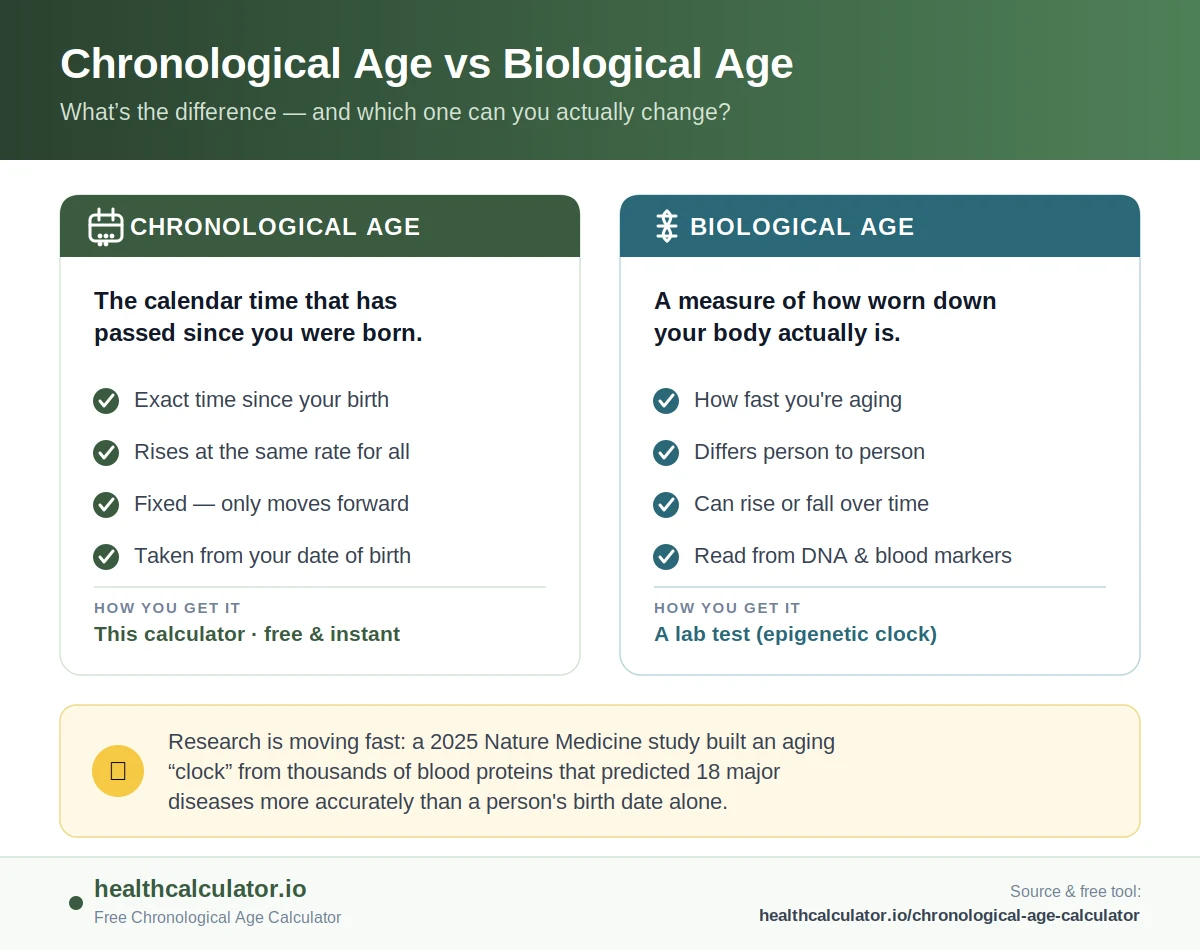
This trips a lot of people up, so let's clear it up. Your chronological age counts calendar time. Your biological age tries to measure how worn down your body actually is — and the two don't always match.
Someone who sleeps well, moves often, and eats sensibly can have a body that behaves years younger than their birth certificate says. The reverse is true too. Researchers now estimate biological age using "aging clocks" built from DNA and blood markers, and this has become an active frontier in clinical medicine. A 2025 study in Nature Medicine built a clock from thousands of blood proteins that tracked the onset of eighteen major diseases more closely than birth date alone.
Here's the encouraging part: unlike your chronological age, which only moves forward, your biological age appears to be somewhat changeable. In the CALERIE trial, adults who cut their calorie intake for two years slowed their measured pace of aging on the DunedinPACE clock.
To be clear, our calculator measures chronological (calendar) age only — the exact, objective time since your birth. It doesn't estimate biological age, which requires lab testing.
Why People Sometimes Get Different Age Results
If two calculators disagree by a day, it's usually not a bug — it's how they handle the messy parts of the calendar:
- End-of-month dates. Going from, say, January 31 to February 28 can reasonably be counted as either "one month" or "28 days," depending on the method. Both are defensible.
- Leap years. The extra day in February shifts totals slightly, and different tools round it differently.
- Time zones. Down at the hours-and-minutes level, your location relative to the birth time can nudge the count.
Our tool uses consistent, standard date logic so your result stays the same every time you check it.
Why Use Our Chronological Age Calculator?
- It's genuinely private. Every calculation runs right in your browser. Your birth date is never sent anywhere, stored, or shared.
- It's instant. Type your date and read your age — no loading, no button-hunting.
- Any date you like. Leave the Age at date fields blank to use today, or tap Use Today — or set any past or future date. Great for "how old will I be on September 1?" questions.
- Exact, not rounded. You get years, months, and days, plus total days, weeks, months, and hours lived — not just a headline number.
- More than a number. It also shows the day of the week you were born, a countdown to your next birthday, and one-tap Share, Copy.
- Free, forever, no account. Nothing to sign up for.
This Tool Is for Information, Not Medical Advice
A quick but important note: this calculator is for information and screening only — it isn't medical advice or a diagnosis. Chronological age is one factor among many in any health decision. Always consult a qualified healthcare professional for guidance about your individual situation.
Frequently Asked Questions
Your chronological age is the exact time that has passed from your birth date to today, expressed in years, months, and days. Enter your date of birth in the calculator above and it returns your precise age instantly, along with your total days, weeks, months, and hours lived. It updates automatically to the current date.
Chronological age is the calendar time since you were born — a fixed number that rises at the same rate for everyone. Biological age estimates how old your body seems based on health markers, and it can be higher or lower than your chronological age. Our tool calculates chronological age only.
Write both dates as year, month, and day, then subtract each part. If the days go negative, borrow a month and add that month's days; if the months go negative, borrow a year. What's left is your age in whole years, months, and days. The calculator above does all of this for you in a second.
Yes. Leave the Age at date fields blank to use today, or type your own date there instead. This lets you find out how old you were on a specific past day, or how old you'll be on an upcoming one — handy for eligibility cutoffs, anniversaries, and planning ahead.
The calculator shows the exact weekday of your birth alongside your age. Someone born on October 8, 2000, for example, arrived on a Sunday. It's worked out straight from your date of birth, so the answer appears the moment you calculate — no separate lookup needed.
The tool counts down for you. It shows the date of your next birthday and exactly how many days remain — for instance, an October 8 birthday reads as 95 days away when checked on July 5, 2026. Calculate again on any date and the countdown reflects the time left from that day.
It counts the actual number of days between your birth date and the target date, so every February 29 in that span is automatically included and your totals stay exact. One detail worth knowing: if you were born on February 29, the birthday countdown lands on February 28 in non-leap years, then returns to the 29th on the next leap year.
Age is used to compare you against the right reference group. Doctors use it to time screenings and interpret results, and educators and clinicians use precise age in years and months to score developmental and academic assessments. Being off by even a couple of months can shift which norms apply.
No. All calculations happen locally in your browser. Your date of birth is never uploaded, saved, or transmitted to us or anyone else. Once the page loads, the calculator works entirely on your device, so your personal information stays with you.