
Army Body Fat Calculator (2026 WHtR Standard)
Last updated:

Muhammad Hamza is the founder of Health Calculator, dedicated to building accurate and easy-to-use health tools for everyone.
If you came here for an Army body fat calculator, the rules changed underneath you. On July 7, 2026, the Army threw out its entire body composition system: the height and weight tables, the tape test, and the DXA and Bod Pod appeals. Army Directive 2026-13 replaced all of it with one number. Your waist divided by your height must come out under 0.55. Enter your two measurements in the calculator and our calculator applies the official math, including the truncation rule that decides borderline cases.
Wrong branch or not in the military? Sailors have a separate two-step assessment, so use the Navy body fat calculator instead. If you just want to track your body fat generally, the body fat calculator runs four methods.
Key Takeaways
- One standard for every soldier: waist at the navel divided by height, under 0.55. No age brackets, no separate male and female tables.
- The ratio is truncated at three decimals and never rounded, so 0.549 passes and 0.550 fails.
- The tape test, height and weight tables, lab appeals, and the AFT 465 exemption are all rescinded.
- Screenings happen at least twice per calendar year, and a fail triggers a same-day confirmation before anything reaches your record.
What Changed on July 7, 2026
If you trained for the one-site tape test, that preparation is now obsolete. The Army's own announcement frames the switch as aligning the service with medically validated practice across the joint force. Here is the before and after:
| What changed | Old system (rescinded) | Current system (AD 2026-13) |
|---|---|---|
| Screening | Height and weight tables, then tape if you exceeded them | WHtR for everyone, at least twice per calendar year |
| Measurement | Abdomen plus body weight in a sex-specific equation | Waist at the navel divided by height |
| Standard | Body fat limits by age and sex, 20% to 36% | WHtR under 0.55, identical for every soldier |
| Appeals | DXA, InBody 770, or Bod Pod | None. WHtR is the sole authorized method |
| Fitness exemption | AFT 465 or higher waived the assessment | Rescinded. No AFT score exempts you |
| Forms | DA Form 5500 and DA Form 5501 | DA Form 5500 plus ATIS; DA 5501 retired |
There is a deadline attached, and it is closer than most soldiers realise. Every soldier must have a WHtR completed and recorded in ATIS within 90 days of the directive, which puts the cutoff around the start of October 2026. That obligation sits with your command rather than with you, so if your unit has not taped you yet, expect it shortly. Knowing your number before they do is the point of this page.
How to Calculate Your Army WHtR
The formula is one line, and both measurements use the same unit:
WHtR = waist circumference at the navel ÷ height
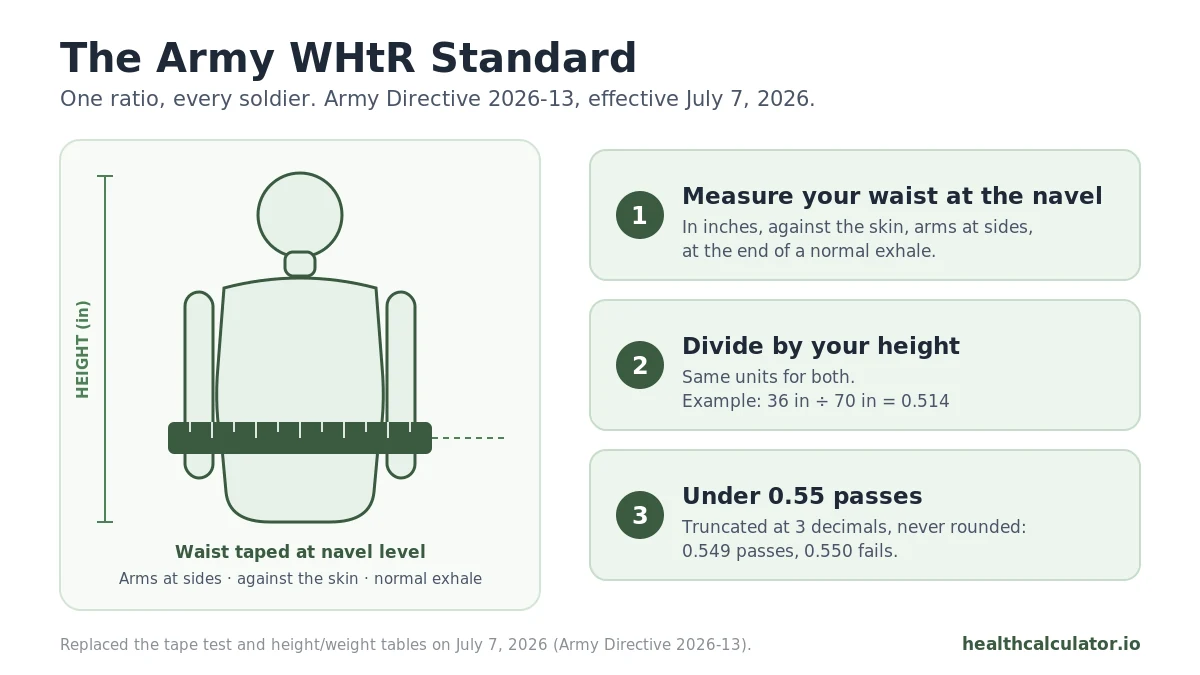
Because it is a ratio, inches and centimeters give an identical answer. What trips people up is the recording rule. The Army takes the ratio to three decimal places and truncates it, discarding everything after. Nothing rounds up. The official FAQ spells out the consequence: 0.549 is a passing score and 0.550 is a failing one.
Work through a clear pass. A soldier standing 70 inches with a 36-inch waist: 36 ÷ 70 = 0.51428, truncated to 0.514. Comfortable, with 2.5 inches of waist to spare before hitting the 38.5-inch ceiling for that height.
Now a painful one. At 66 inches tall with a 36.5-inch waist, the math gives 36.5 ÷ 66 = 0.55303, truncated to 0.553. That fails by roughly two tenths of an inch of waist, because the limit at 66 inches is 36.3 inches. Margins that thin are exactly why tape technique matters.
The calculator above returns both figures, the exact ratio and the official truncated one, plus your maximum allowable waist so you can see the gap in inches rather than decimals.
Want the whole chart rather than your own number? Our guide to the Army height and weight standards lists the maximum waist for every height from 5'0" to 6'6", including the largest half-inch reading that still passes.
How to Measure for the Assessment
- Measure height without shoes, standing straight, in inches.
- Wrap the tape at navel level, against the skin, parallel to the floor the whole way around, arms at your sides.
- Read at the end of a normal exhale. Do not draw the stomach in.
- Divide waist by height using the same unit for both.
- Truncate at three decimals. Under 0.550 passes.
Waist readings drift with meals, hydration, and hard training. Measure at a consistent time of day when tracking yourself, and stay normally hydrated in the days before an official screening; the daily water intake calculator helps keep that steady.
What the Research Actually Says
The Army's stated reasoning is that WHtR is a superior predictor of long-term cardiovascular and metabolic risk compared with the legacy methods. The evidence supports the idea that central fat matters, though the picture is more nuanced than a clean win.
Pooled evidence backs the risk signal. A systematic review in the International Journal of Obesity found that a higher WHtR raised all-cause mortality risk by 23% in categorical comparisons, with cardiovascular mortality up 39%, across 20 cohort studies.
Whether it beats the alternatives is the honest caveat. The largest cohort analysis to date, covering 50,618 women and 43,783 men followed from 1997 to 2018, reported that a WHtR at or above 0.55 carried an elevated risk of death, with a relative risk of 1.23 in women and 1.11 in men against the under-0.50 group. The same PLOS One analysis found BMI and waist circumference predicted mortality at a similar magnitude, not a worse one.
So WHtR is a legitimate risk marker that is fast, cheap, and hard to game. Just do not expect it to be dramatically sharper than the BMI figure it replaced. Its practical advantages, one measurement and no equipment, arguably matter more to the Army than any accuracy edge.
If You Fail the Screening
One bad reading changes nothing on its own. A confirmation measurement by a different team is required on the same duty day before your commander may act. If that second reading also lands at 0.55 or above, you are flagged and enrolled in the Army Body Composition Program.
Parts of the program got gentler. Active component and AGR soldiers receive a commander-directed medical exam to rule out an underlying cause. Mandatory monthly assessments are rescinded, and you leave the program as soon as you meet the standard. Units may begin separation paperwork, but the directive states plainly that no soldier will be separated for a WHtR failure until Headquarters finishes a 180-day review and issues further guidance.
Working the number down means losing fat, not just weight, since your waist is what gets taped. Keeping protein high during a deficit protects lean mass; the protein calculator sets a target.
Rules Most Summaries Skip
Screenings must fall at least 7 days after your AFT or CFT so the assessment does not interfere with test performance, and commanders may compress that window for operational needs. Commanders may also order a WHtR check at any time if they believe a soldier misses the standard. The policy reaches the Regular Army, National Guard, and Reserve, plus West Point and Senior ROTC cadets. Medical exemptions for pregnant and postpartum soldiers survive unchanged. Results go on DA Form 5500 and into ATIS, and the flag for non-compliance remains non-transferable.
Which Calculator Should You Use?
The services no longer share a standard, so pick the one that applies to you:
| Your situation | Use this |
|---|---|
| Soldier, Guard, Reserve, or cadet | This page. WHtR under 0.55 per Army Directive 2026-13. |
| Sailor | The Navy two-step BCA, which screens at 0.5499 then checks body fat. |
| Civilian tracking body fat | Our general body fat tool, with tape, RFM, skinfold, and BMI methods. |
The Army and Navy thresholds look almost identical but are not interchangeable. The Army truncates the ratio at three decimals and passes under 0.55; the Navy uses four decimals and passes at 0.5499 or lower. Small difference, same idea, different paperwork.
Why Use This Army Body Fat Calculator
Most military body fat calculators still run the rescinded tape formula, answering a question the Army stopped asking. This one implements the truncation rule exactly, shows your waist ceiling in inches, accepts either unit system, and cites the directive and the FAQ so you can verify every rule yourself. Free, instant, nothing stored.
This Is a Screening Tool, Not an Official Determination
Your record number comes from your unit's measurement, not this page. The standard is also new and under review, so confirm anything career-related with your chain of command.
This calculator is for informational and screening purposes only and does not constitute medical advice, diagnosis, or an official military body composition determination. Always consult a qualified healthcare professional about your health, and your unit's ABCP personnel for official standards.
Frequently Asked Questions
Anything under 0.55. The ratio is recorded to three decimal places and truncated rather than rounded, so 0.549 passes and 0.550 fails. The same threshold applies to every soldier regardless of age or sex under Army Directive 2026-13, effective July 7, 2026.
One way only: waist circumference taped at the navel, in inches, divided by height in inches. Every soldier is screened at least twice per calendar year, results are recorded on DA Form 5500 and in ATIS, and commanders may direct an assessment at any time.
No. The directive rescinded the one-site tape test, the height and weight tables, and all supplemental assessments including DXA, InBody 770, and Bod Pod. WHtR is the sole authorized method, and its result cannot be challenged with a different measurement type.
Not anymore. The exemption for scoring 465 or higher on the Army Fitness Test was rescinded along with Army Directive 2025-17. Every soldier must meet the under-0.55 standard regardless of fitness performance, though units still leave at least 7 days between your AFT or CFT and the screening.
A different team runs a confirmation measurement the same duty day before any action is taken. Fail that too and you are flagged and enrolled in the Army Body Composition Program. Active component soldiers then receive a commander-directed medical exam, and you leave the program once you meet the standard.
No. Unlike the old body fat limits that ran from 20% to 36% by age and sex, the WHtR standard is universal: under 0.55 for everyone, including West Point and Senior ROTC cadets. Established medical exemptions, such as those for pregnant and postpartum soldiers, remain in place.
Multiply your height in inches by 0.55 and stay below it. At 66 inches tall the waist ceiling is 36.3 inches; at 70 inches it is 38.5; at 74 inches it is 40.7. The calculator above works this out automatically and shows your remaining margin.
Close, but not identical. Both now screen on waist divided by height. The Army passes anything under 0.55, truncated at three decimals. The Navy passes at 0.5499 or lower, taken to four decimals, and adds a second body fat step if you miss it. Sailors should use the Navy BCA page.
Sources
Every figure on this page is drawn from government health statistics or peer-reviewed research. Last verified August 2026.
- Secretary of the Army. Army Directive 2026-13 (Army Body Composition Program and Standards). Headquarters, Department of the Army; effective 7 July 2026.
- Army Public Affairs. Army Modifies Body Composition Program, Adopts Waist-to-Height Ratio. U.S. Army; published 7 July 2026.
- U.S. Army. Army Body Composition Program and Standards: Frequently Asked Questions. Department of the Army; effective 7 July 2026.
- Qorbani M, Mahdavi-Gorabi A, Khatibi N, et al. Waist to height ratio as a simple tool for predicting mortality: a systematic review and meta-analysis. International Journal of Obesity. 2023;47(12):1286–1301. doi:10.1038/s41366-023-01388-0.
- Patel AV, Faw K, Rees-Punia E, et al. Is waist to height ratio better at assessing cause-specific mortality risk than body mass index or waist circumference? A prospective analysis in a large U.S.-based cohort. PLOS One. 2025;20(8):e0328760. doi:10.1371/journal.pone.0328760.