Visceral Fat Calculator
Published:

Written by
Muhammad Hamza
, Founder & Content Researcher
Muhammad Hamza is the founder of Health Calculator, dedicated to building accurate and easy-to-use health tools for everyone.
Published:
Muhammad Hamza is the founder of Health Calculator, dedicated to building accurate and easy-to-use health tools for everyone.
The visceral fat calculator above turns a tape measure into a number in square centimeters, the same unit a CT scan reports. It runs the Samouda equations, built against CT scans in 253 adults aged 18 to 78. Enter your waist and thigh in inches or centimeters, and you get three things: the area, the honest error band around it, and which published threshold actually applies to you.
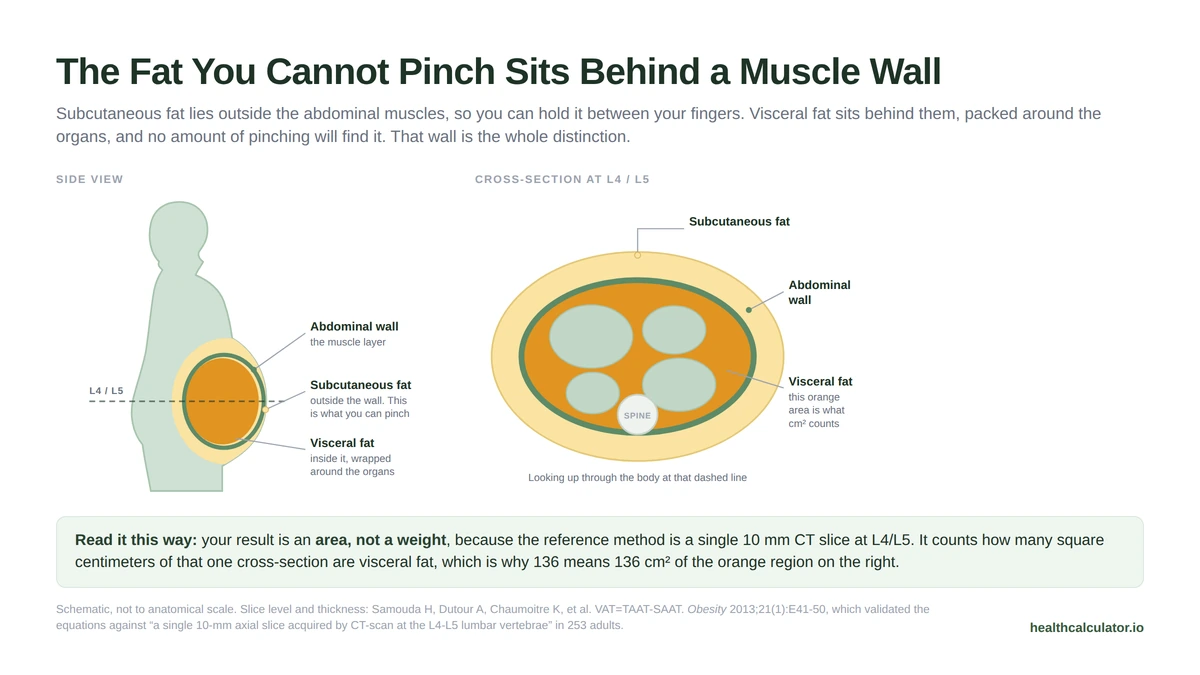
Visceral fat is packed in and around your organs, behind the abdominal wall. It is not the fat you can pinch, which is subcutaneous fat sitting outside the muscle.
Square centimeters is an area, not a weight, because the reference method is one CT slice between your fourth and fifth lumbar vertebrae. How much of that cross section is visceral fat tracks your whole store closely enough to have become the standard.
Your result lands on a dial with two marks, 100 and 130. Both are real published cut points, and they disagree with each other.
Every other visceral fat page picks one threshold, usually 130 cm², and calls it the line between fine and not fine. It is not that simple.
A 2024 systematic review in Obesity Reviews harmonized every published visceral fat risk threshold across CT, MRI and DXA, 52 papers in all. In the authors' words, no single threshold could indicate elevated risk for both sexes across varying BMI, race and age. Thresholds ran from 70 to 165.9 cm², consistently lower in women. Asian populations showed elevated risk between 70 and 136 cm². Caucasian populations, between 85.6 and 165.9.
Then in July 2025, an American Journal of Clinical Nutrition study measured visceral fat by DXA in 8,286 US adults and asked which threshold best flagged each condition. It got three answers: 84 cm² for insulin resistance, 103 for metabolic syndrome, 119 for type 2 diabetes, and recommended a sex independent threshold of about 100.
| Threshold | Source | Flags |
|---|---|---|
| 84 cm² | NHANES, 8,286 US adults, 2025 | Insulin resistance |
| 100 cm² | JASSO, Japan, 2024 | Visceral fat obesity |
| 103 cm² | NHANES, 2025 | Metabolic syndrome |
| 119 cm² | NHANES, 2025 | Type 2 diabetes |
| 130 cm² | Hunter 1994, used by the Luxembourg Institute of Health | Visceral obesity |
How to read your result against that. If you are of Asian descent, the lower numbers fit you, and Japan's own guidance says why: Japanese adults develop obesity related conditions at lower thresholds than Western populations do. If you are a woman, the evidence runs lower too, and lower again before menopause. If blood sugar is your worry, 119 is your number. If it is insulin resistance, 84 is.
That is why the calculator shows both 100 and 130 rather than picking one. A result of 115 means you cleared one line and not the other, and which one matters depends on who you are.
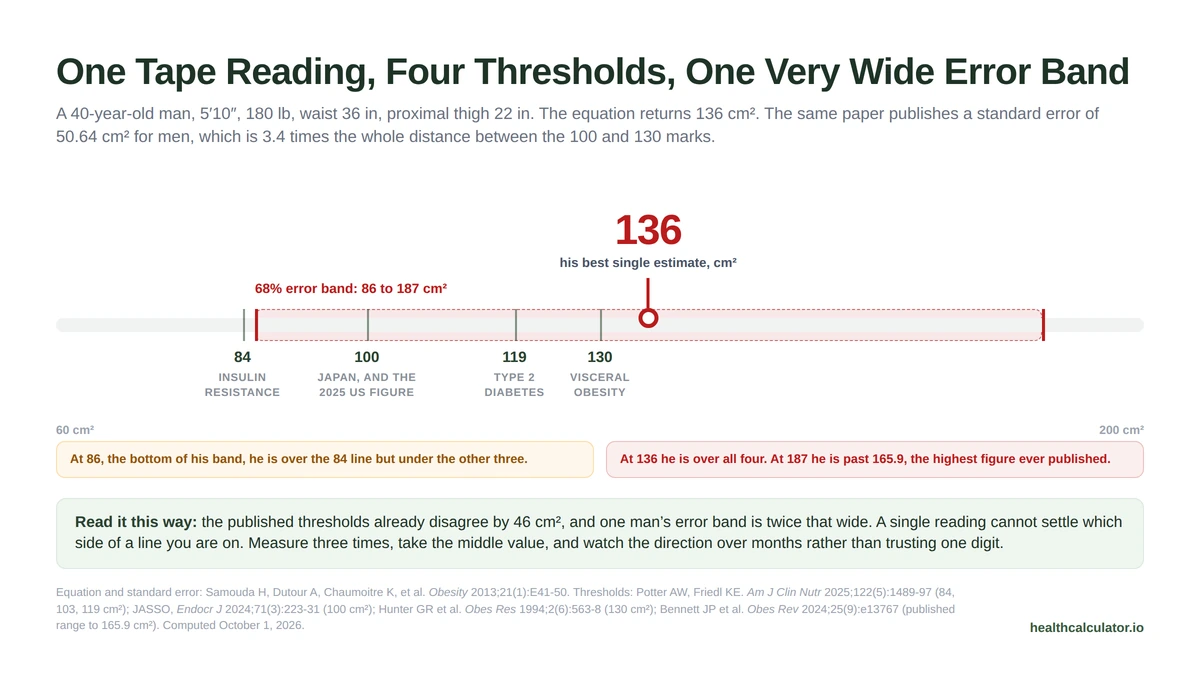
The Samouda paper publishes a standard error of estimate next to the equations, and it should change how you treat your result. For men it is 50.64 cm². For women, 31.94.
Set that against the dial. The gap between the thresholds, 100 to 130, is 30 cm² wide. A man's 68% error band is 101 cm² wide. That is 3.4 times the whole distance between the two lines he is judged against. For women it is 2.1 times.
Take the example the calculator uses. A 40 year old man, 5 feet 10, 180 pounds, waist 36 inches, thigh 22 inches. The equation returns 136 cm², the visceral obesity range. His band runs from 86 to 187. At 86 he is under three of the four thresholds above. At 187 he is past every published figure.
That is not a reason to ignore it. It is a reason to use it differently:
Two tape measurements decide your whole result.
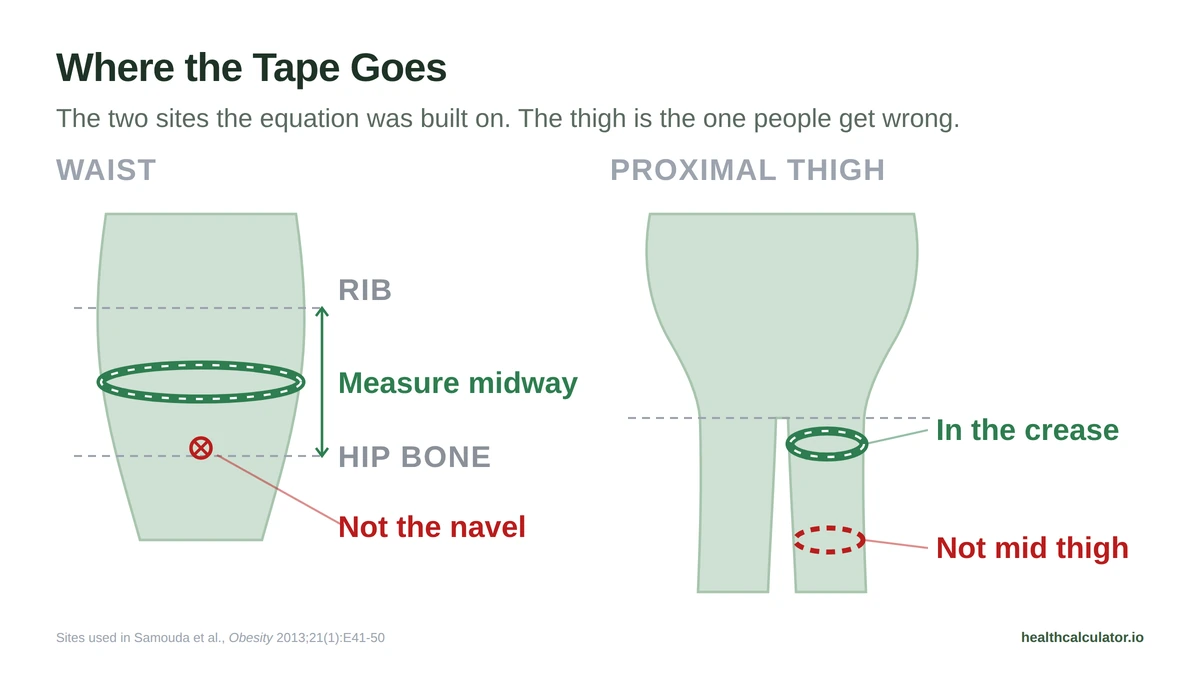
Waist. Find the bottom of your lowest rib and the top of your hip bone, and wrap the tape midway between them. Breathe out normally, then read it. Do not suck in or pull hard enough to dent your skin. This is the site the Samouda study used, and the one NICE tells the public to use.
Proximal thigh. Proximal means at the top, right in the crease where your buttock meets your thigh. Stand with your weight even on both feet and slide the tape as high as it goes. Most people measure mid thigh by mistake, which reads smaller, and a smaller thigh pushes your result up.
Here is what a slip costs you, straight out of the coefficients:
| Measurement error | Moves a man's result | Moves a woman's result |
|---|---|---|
| Waist off by 0.5 in | 7.6 cm² | 2.7 cm² |
| Waist off by 1 in | 15.2 cm² | 5.5 cm² |
| Thigh off by 0.5 in | 5.6 cm² | 4.6 cm² |
| Thigh off by 1 in | 11.2 cm² | 9.2 cm² |
Look at the women's column again, because it is the opposite of what everyone assumes. Her equation multiplies waist by 2.15 and thigh by 3.63. If you are a woman, your thigh measurement matters more than your waist, by nearly two to one. No other visceral fat page tells you that.
Errors also stack. A man who measures his waist an inch high and his thigh an inch low is off by 26 cm², most of the way across the gap between the thresholds.
If you own a body composition scale, it probably reports a visceral fat level between 1 and 59 rather than an area. That mismatch is why people get confused: the scale says 9, a calculator says 95.
They are the same thing in different clothes. Tanita publishes the conversion. One point on its rating index corresponds with 10 cm² of visceral fat on an MRI scan, with 1 to 12 counted as healthy and 13 to 59 as too high. Multiply your scale reading by ten and read it against the chart below.
| Scale level | Area | Lines up with |
|---|---|---|
| 7.0 | 70 cm² | Lowest threshold in the 2024 review |
| 8.4 | 84 cm² | Insulin resistance, US adults |
| 10.0 | 100 cm² | Japan's obesity criterion |
| 11.9 | 119 cm² | Type 2 diabetes, US adults |
| 12 | 120 cm² | Top of Tanita's healthy band |
| 13.0 | 130 cm² | Visceral obesity, Hunter |
| 16.6 | 166 cm² | Highest in the published range |
So if you have been searching whether a level of 7.0 is bad: 7.0 is 70 cm², the floor of the entire published range rather than a figure near any threshold, and inside Tanita's healthy band with room to spare. Watch the direction, not the number.
The calculator uses a different equation for each sex, and the women's version needs your height and weight while the men's does not.
That is not an oversight. In the source study, waist and thigh alone predicted men's visceral fat with an R² of 0.803. For women the model needed BMI too, to reach 0.836, because women carry more fat subcutaneously, so a waist number alone says less about what is behind the abdominal wall. Two things follow.
Women's waist targets move when their weight does. With BMI in the equation, the waist needed to reach 100 cm² is not fixed. The calculator holds your weight steady when it works that target out, and says so.
The men's equation can return a negative number. A lean man with muscular legs can push the thigh term past everything else: a 40 year old with a 22 inch thigh crosses below zero at a waist under 27 inches. There is no negative visceral fat, so the calculator shows 0. That is the equation running out of range, not a bug.
Where the sexes differ in risk is the threshold, not the formula. Published values run lower for women, so a woman at 110 cm² is in a different position than a man at 110.
This is where the internet gets loudest and the evidence gets quietest, so here is the honest version.
A meta analysis of 89 studies in the International Journal of Obesity compared visceral and subcutaneous fat loss across diet, exercise, weight loss drugs and surgery. Its conclusion was blunt: no intervention preferentially targets visceral fat, and visceral fat loss is linked to subcutaneous fat loss. No food, exercise or supplement goes after your belly specifically.
The same analysis found something you can use. With every strategy, the percent decrease in visceral fat beat the percent decrease in subcutaneous fat. You have far less of it to start with, so a bigger share of that store goes. This number moves before the bathroom scale does, the real argument for tracking it.
Then comes the finding that reframes everything. In June 2026, Circulation published 5 and 10 year follow up on 366 participants from two 18 month trials. They regained all the weight they had lost. Their visceral fat reduction partly held anyway, and a 10% visceral fat loss carried a 28% lower risk of type 2 diabetes afterwards. Visceral fat loss rather than weight loss, the authors concluded, is the target for lasting cardiometabolic health.
So aim at a 10% cut in this number, not a number on the scale. For the man above, 10% means 136 down to 123 cm², which the calculator works out as about 0.9 inches off his waist. For the calorie and protein side, our body recomposition calculator handles it, and if blood sugar is why you are here, the A1C calculator shows where you stand.
Free, instant, no sign up, and nothing you type leaves your browser.
The equations were built in adults in the south of France, and the authors limited their conclusion to that population. They have not been validated in other ethnic groups, so if you are not of European descent, treat the area as rough and lean on the lower thresholds.
Outside the validation range of ages 18 to 78 and BMI 16.3 to 52.9 the calculator still answers but flags the result as rough. It is not built for children, pregnancy, or anyone with abdominal fluid, where a waist measurement stops meaning what the equation assumes.
This is a screening estimate, not a diagnosis. A high result is a reason to take blood pressure, glucose and lipids seriously, not a condition in itself. Bring it to a clinician rather than acting on it alone.
Measure your waist midway between your lowest rib and hip bone, and your thigh at the buttock crease, then enter both with your age, height and weight. The visceral fat calculator applies the sex specific Samouda equations and returns your area in square centimeters with its error band.
No. A scale level of 7.0 converts to roughly 70 cm² of visceral fat, because Tanita counts one rating point as 10 cm². That sits at the bottom of the published risk range of 70 to 165.9 cm², and inside Tanita's healthy band of 1 to 12.
Under 100 cm² is the safest answer. That is both Japan's official visceral fat obesity criterion and the sex independent threshold recommended by a 2025 analysis of 8,286 US adults. The widely quoted 130 cm² is a higher bar, and the honest range runs 70 to 165.9 cm².
Nothing targets it specifically. A meta analysis of 89 studies found no intervention preferentially removes visceral fat, and that its loss tracks subcutaneous fat loss. It did find that visceral fat falls by a larger percentage than other fat with any method that works, so this number improves first.
Stand with your weight even on both feet and slide the tape as high up one thigh as it goes, into the crease where your buttock meets it. Mid thigh is the common mistake and reads smaller, which inflates your result. For women it moves the answer more than the waist.
Yes, and it is common. A 40 year old man at 5 feet 10 and 180 pounds has a BMI of 25.8, which charts call merely overweight. With a 36 inch waist and a 22 inch thigh, his estimated visceral fat is 136 cm², inside the visceral obesity range.
Every figure on this page is drawn from peer-reviewed research or national clinical guidance. Each source was opened and checked against the sentence it supports. Last verified October 2026.