Bench Press Calculator
Last updated:

Written by
Muhammad Hamza
, Founder & Content Researcher
Muhammad Hamza is the founder of Health Calculator, dedicated to building accurate and easy-to-use health tools for everyone.
Last updated:
Muhammad Hamza is the founder of Health Calculator, dedicated to building accurate and easy-to-use health tools for everyone.
Punch a recent hard set into the calculator above, weight and reps, and it hands back your estimated one rep max in seconds. That single number is the backbone of nearly every serious training program, and our bench press calculator builds your full percentage chart from it automatically. No max-out attempt required. No spotter drama. Just a recent set and about ten seconds of your time.
You need two numbers, and you probably already know them both.
One tip from us: enter the total weight, bar included. That 45 lb (20 kg) Olympic bar counts.
Your one rep max (1RM) is the heaviest weight you can bench press for one complete repetition with proper form. Coaches treat it as the reference point for programming, because percentage-based plans, from a basic 5x5 to a powerlifting peaking block, assign every working weight as a percentage of your 1RM.
It is also a number worth caring about beyond the gym. The World Health Organization recommends muscle-strengthening activity at least twice a week, and a large meta-analysis in the British Journal of Sports Medicine found that 30 to 60 minutes of weekly resistance exercise was associated with a 10 to 17 percent lower risk of early death, cardiovascular disease, and several cancers. Tracking your bench strength is one simple way to stay accountable to that habit.
This calculator runs on the Epley formula, published in 1985 and still the most widely used 1RM equation in strength research:
1RM = weight × (1 + reps ÷ 30)
Here is the math with real numbers. Say you pressed 185 lb for 5 clean reps. The formula works out to 185 × (1 + 5 ÷ 30) = 215.8, and the calculator rounds it to 216 lb. Working in kilograms? Same logic: 60 kg for 8 reps estimates a 76 kg max. And if you enter a true single, the calculator returns exactly what you lifted, because one rep at max effort already is your 1RM.
More accurate than most lifters expect, inside its lane. Validation research comparing seven prediction equations found Epley among the most accurate for the bench press when reps stay at 10 or fewer, typically landing within a few pounds of a tested max. For perspective, a 2023 systematic review in Sports Medicine found that even individualized barbell-velocity tracking, the lab-grade alternative, carries a standard error of roughly 10 percent. A 2025 study in Scientific Reports reached a similar verdict: velocity methods estimate well only within a narrow load range. A simple, honest formula holds up remarkably well against expensive tech.
Past 10 reps, though, accuracy fades. That is why the calculator flags 1 to 10 reps as the sweet spot, and why a 20 rep burnout set makes a poor input.
Add your bodyweight and the calculator scores your estimated max against bodyweight-ratio milestones drawn from Strength Level's database of 48.7 million logged bench press lifts, the largest public dataset of its kind.
| Level | Men (× bodyweight) | Women (× bodyweight) | Meaning |
|---|---|---|---|
| Beginner | 0.50x | 0.30x | Stronger than 5% of lifters |
| Novice | 1.00x | 0.50x | Stronger than 20% of lifters |
| Intermediate | 1.25x | 0.75x | Stronger than 50% of lifters |
| Advanced | 1.50x | 1.10x | Stronger than 80% of lifters |
| Elite | 2.00x | 1.45x | Stronger than 95% of lifters |
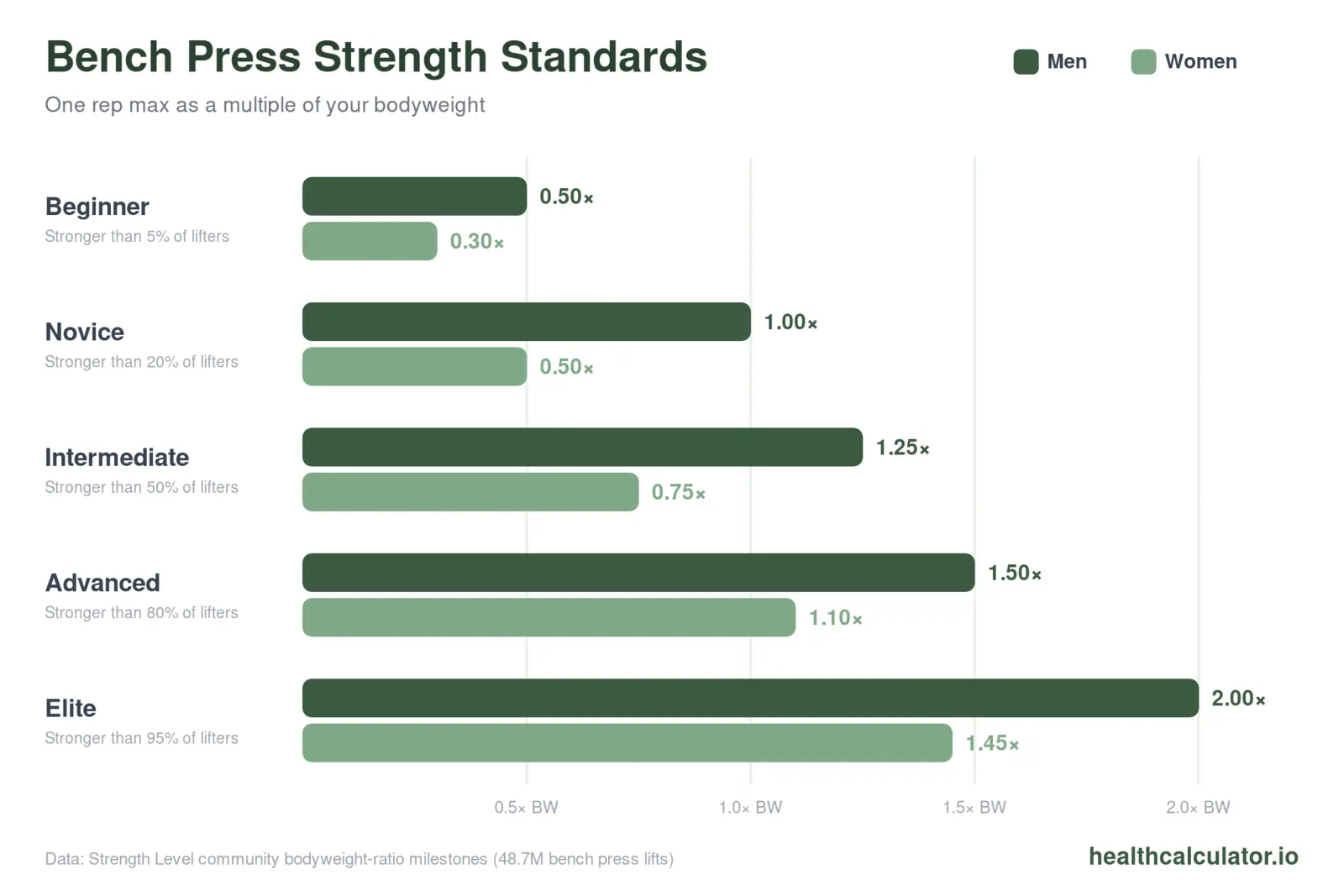
In that community, the average male bench press 1RM is 212 lb and the average female 1RM is 112 lb. Here is what the table looks like in practice: our 185 lb x 5 lifter from earlier has an estimated max of 216 lb. At a bodyweight of 180 lb that is a 1.20x ratio, a solid Novice score, and just 9 lb shy of the 1.25x Intermediate line. Suddenly the next training block has a very specific goal.
Two honest caveats: heavier lifters typically carry slightly lower ratios at the same level, and people who log workouts in an app train harder than the general public, so this bar is set high. A Novice badge still puts you ahead of most people who have never touched a barbell.
The percentage table under your result is where the estimate earns its keep. Each row pairs a load with the rep range and training goal it serves best, following the classic strength and conditioning continuum: 100 percent for testing, 95 to 85 percent for building maximal strength and power, 80 to 75 percent for muscle growth, and 70 percent down to 60 for endurance work and warm-ups.
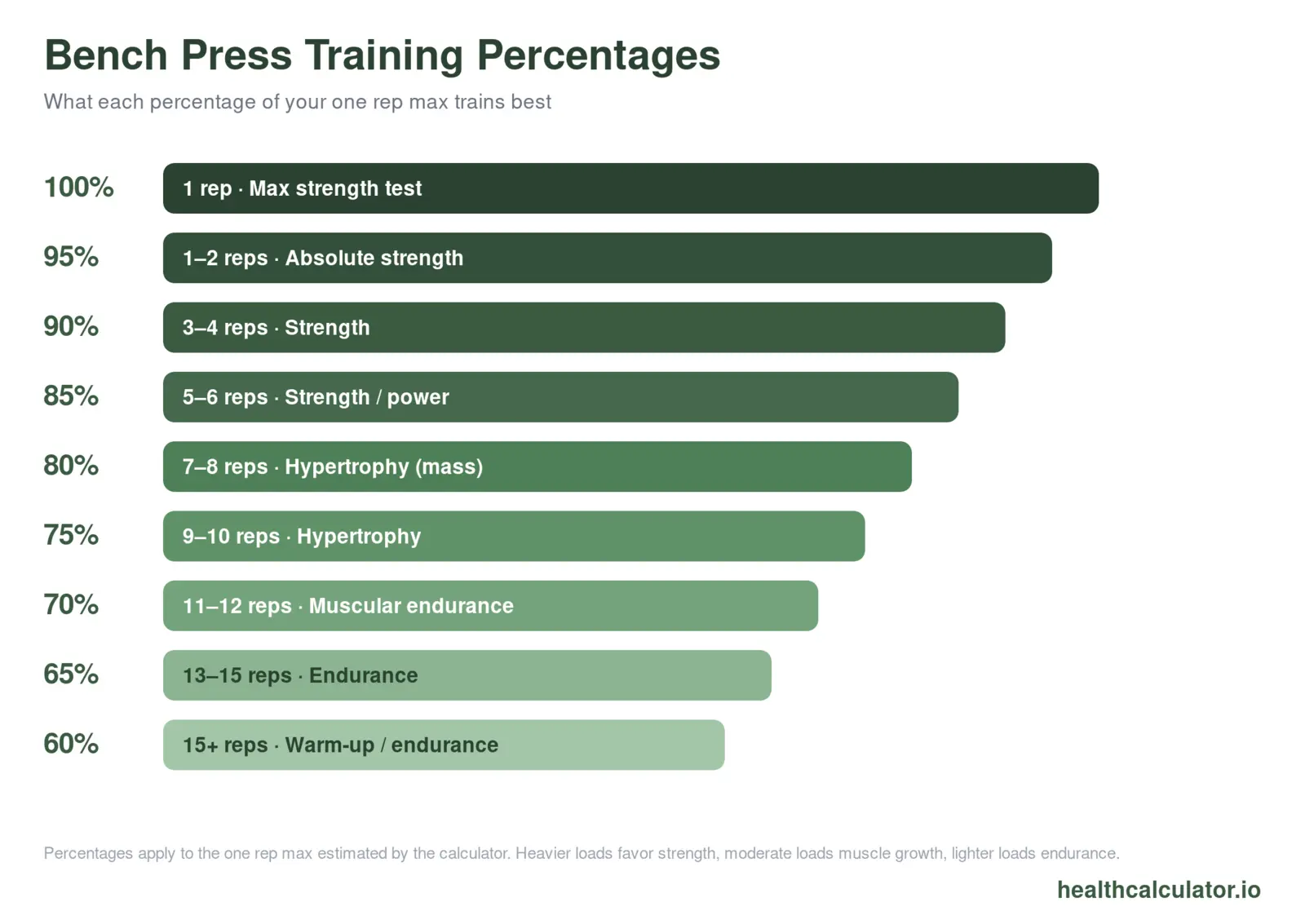
Modern research adds useful nuance. Schoenfeld and colleagues' re-examination of the repetition continuum concluded that loads of 80 percent and above remain the clear winner for maximal strength, while muscle growth turns out to be achievable across a surprisingly wide load range, provided sets get close to failure. So treat the table as a map, not a cage. If your estimated max is 216 lb, your 80 percent row says 173 lb for sets of 7 to 8. That is a working weight you can walk into the gym with tonight.
It runs instantly in your browser, works in pounds and kilograms, and asks for no sign-up and no personal data. Estimate, percentage chart, and strength level in one calculation, and every claim on this page describes exactly what the tool computes.
We would rather you trust this number for the right reasons, so here is where any 1RM formula bends.
Daily readiness moves the target. Sleep, stress, and accumulated fatigue can swing true max performance meaningfully from one week to the next. Technique matters too: touch-and-go reps inflate the input compared with paused reps, and a practiced heavy single is a skill in itself. Lifters who rarely handle near-maximal weights often test below their estimate on the platform.
There is also a structural limit baked into every classic equation. A 2026 analysis of 303,494 real training sets, still awaiting peer review, found that the relationship between reps and max strength shifts with the load on the bar, something no fixed formula fully captures. Epley remains the best-validated simple tool available, which is exactly why we use it. Just read the output as a smart planning number, not a promise.
An estimate costs nothing. A failed max attempt can. If you decide to test a true single, warm up thoroughly, take a spotter or use safety pins, and never press to failure alone. New to lifting? Skip true max attempts for your first few months entirely. Estimating from a 5 to 8 rep set gives you everything you need for programming while your joints, tendons, and technique catch up to your enthusiasm.
This calculator is for informational and fitness planning purposes only and does not constitute medical advice. If you have a heart condition, high blood pressure, a current injury, or any health concern, talk to a qualified healthcare professional before maximal strength testing.
Strength is built between sessions as much as during them. Your muscles need raw material, and our protein calculator shows the daily intake that supports muscle growth. Hydration quietly drives training performance too, so check your target with the water intake calculator. And if you are tracking body composition alongside strength, the BMI calculator adds useful context to your bodyweight ratio.
Within a few percent when your input set is 1 to 10 reps. Validation studies rank the Epley equation among the most accurate 1RM predictors for the bench press in that range. Past 10 reps the estimate drifts upward, which is why the calculator flags 1 to 10 as the sweet spot.
Among lifters who log their training on Strength Level, the average male bench press 1RM is 212 lb and the average female 1RM is 112 lb. Those averages skew strong because they come from people who track workouts. A meaningful early goal is 0.50x bodyweight for men and 0.30x for women.
Yes. In Strength Level's data, a bodyweight bench marks the Novice milestone for men, and that community skews strong, so it beats most of the general population. For women, pressing bodyweight lands between the Intermediate and Advanced milestones, a lift the majority of gym-goers never reach.
Ten. The Epley formula rates 225 lb for 10 reps at exactly 300 lb: 225 × (1 + 10 ÷ 30) = 300. That said, 10 reps sits at the outer edge of the formula's reliable range, so confirm with a lower-rep set before loading three plates.
Yes, always enter the total weight including the bar. A standard Olympic barbell weighs 45 lb (20 kg). Two 45 lb plates per side plus the bar is 225 lb, not 180 lb. Miscounting the bar is the most common cause of a surprising result.
Match the load to the goal. Research supports 80 percent and above for maximal strength, while muscle growth is achievable across a wide range of loads when sets approach failure. The classic zones in your results table, heavy for strength, moderate for size, lighter for endurance, remain a sound starting map.
Most coaches program a true max attempt only every 8 to 12 weeks, usually at the end of a training block. Between tests, run your recent 3 to 5 rep sets through this calculator. You track progress with far less fatigue and far less injury risk than frequent maxing.
A formula cannot see your leverages, your sleep last night, or how practiced you are with heavy singles. Lifters who rarely handle near-maximal weights often test under their estimate, while seasoned pressers sometimes beat it. Treat the number as a planning tool and let the barbell settle the debate.
Yes, and it is the safer route. Estimate your max from a 5 to 8 rep set instead of attempting a true single during your first months of training. Your connective tissue and technique need time to handle maximal loads, and the estimate gives you everything programming requires.