
Height Calculator
Last updated:

Muhammad Hamza is the founder of Health Calculator, dedicated to building accurate and easy-to-use health tools for everyone.

Dr. Farah Taqueer is a qualified Pediatrician based in Karachi. She reviews all health calculators on this site for clinical accuracy and medical correctness.
Three tools, one page. Convert any height between centimeters and feet-and-inches, see how you stack up against the average adult, and predict a child's adult height two different ways. Scientists estimate that about 80 percent of your adult height is set by the DNA you inherited — which is why your parents' heights tell us so much about where you'll end up.
Nothing you type leaves your device.
What Our Height Calculator Does
The height converter at the top handles the everyday job: 175 cm into feet and inches, 5'9" back into centimeters, either direction. Pick your sex and it also plots you against the average American adult.
Below that sit two child height predictors, and they answer slightly different questions.
The Khamis-Roche predictor is the more accurate of the two. Feed it a child's age, sex, current height and weight plus both parents' heights, and it estimates adult stature without a bone-age X-ray. It works from age 4 up to 17.5.
The mid-parental calculator needs only two numbers — mom's height and dad's height. Less precise, but it works before a baby is even born.
Use whichever fits what you actually know.
How to Convert Height: cm to Feet and Inches
The math never changes: one inch equals exactly 2.54 centimeters. Divide centimeters by 2.54 to get total inches, then split those inches into feet and a remainder.
Try it by hand. You're 178 cm. Divide by 2.54 and you get 70.1 inches. Split that — 70.1 ÷ 12 leaves 5 feet with 10.1 inches over. So 178 cm is 5 feet 10.1 inches. Going backwards, add your feet and inches into a single inch total and multiply by 2.54.
Quick cm to Feet and Inches Chart
Rounded to the nearest inch. The converter above gives you the exact figure to one decimal.
| Centimeters | Feet & inches |
|---|---|
| 155 cm | 5'1" |
| 160 cm | 5'3" |
| 165 cm | 5'5" |
| 170 cm | 5'7" |
| 175 cm | 5'9" |
| 180 cm | 5'11" |
| 185 cm | 6'1" |
| 190 cm | 6'3" |
Going the other way, the most-searched ones: 5'4" is 162.6 cm, 5'7" is 170.2 cm, 5'8" is 172.7 cm, 5'9" is 175.3 cm, 5'10" is 177.8 cm, and 6'0" is 182.9 cm.
How Do You Measure Up? Average Adult Height
Choose your sex before converting and the tool draws your height against the national average.
The comparison figures come from bodies actually measured in a clinic, not from people guessing on a survey — and that gap matters, because we tend to round ourselves up. The CDC's National Center for Health Statistics puts the average American man at 68.9 inches and the average woman at 63.5 inches, based on examinations conducted between August 2021 and August 2023.
| Group | Average adult height (CDC measured) |
|---|---|
| Men, US, age 20+ | 175.0 cm — 68.9 in — 5'8.9" |
| Women, US, age 20+ | 161.3 cm — 63.5 in — 5'3.5" |
These are US numbers. Averages move a lot between countries, so read your result as "compared to American adults," not "compared to humanity."
Curious how your height and weight fit together? Run the same number through our BMI calculator.
How to Predict a Child's Adult Height
Method 1: Khamis-Roche (use this one if you can)
Developed by Harry Khamis and Alex Roche from the Fels Longitudinal Study and published in Pediatrics in 1994, this method is the accepted non-invasive standard for adult height prediction in children aged 4 and up. Its reported 90% error bound is roughly ±5.3 cm for boys and ±4.3 cm for girls — meaning 9 in 10 predictions land within that distance of the child's true adult height — noticeably tighter than anything you can get from parental heights alone.
Here's how to use it:
- Pick the child's sex and enter their exact age in years. Half-years matter; the coefficients change every six months.
- Enter the child's current height and weight. Measure without shoes, standing straight against a wall.
- Enter both biological parents' heights.
- Read the prediction — you'll get an adult height estimate plus the likely range around it, and a comparison against the genetic target from the parents alone.
Why does weight belong in a height formula? Because it acts as a stand-in for skeletal maturity. Heavier-for-age children tend to be further along in bone development, meaning less growing time left; lighter children are often late bloomers with more runway. The formula uses that signal instead of an X-ray.
The arithmetic, if you want to see it: predicted adult height in inches = intercept + (b₁ × height in inches) + (b₂ × weight in pounds) + (b₃ × mid-parent height in inches). Take a 9-year-old boy at 133 cm and 28 kg with a 165 cm mother and a 180 cm father. In imperial that's 52.36 in, 61.7 lb, and a 67.91 in mid-parent height. Run the age-9 coefficients and you get −11.16 + 55.07 − 2.79 + 29.05 = 70.17 inches, or 178.2 cm (5'10.2").
Method 2: The Mid-Parental (Tanner) Formula
When you don't have the child's measurements — or the child doesn't exist yet — this is the fallback. Tanner described it in 1970 and pediatric clinics still reach for it. It averages the parents and shifts by 13 cm to cover the adult male-female height gap:
- Boy: (mother's height + father's height + 13) ÷ 2
- Girl: (mother's height + father's height − 13) ÷ 2
With a 165 cm mother and a 180 cm father: a son lands at (165 + 180 + 13) ÷ 2 = 179 cm, a daughter at (165 + 180 − 13) ÷ 2 = 166 cm.
What the ±8.5 cm Range Actually Means
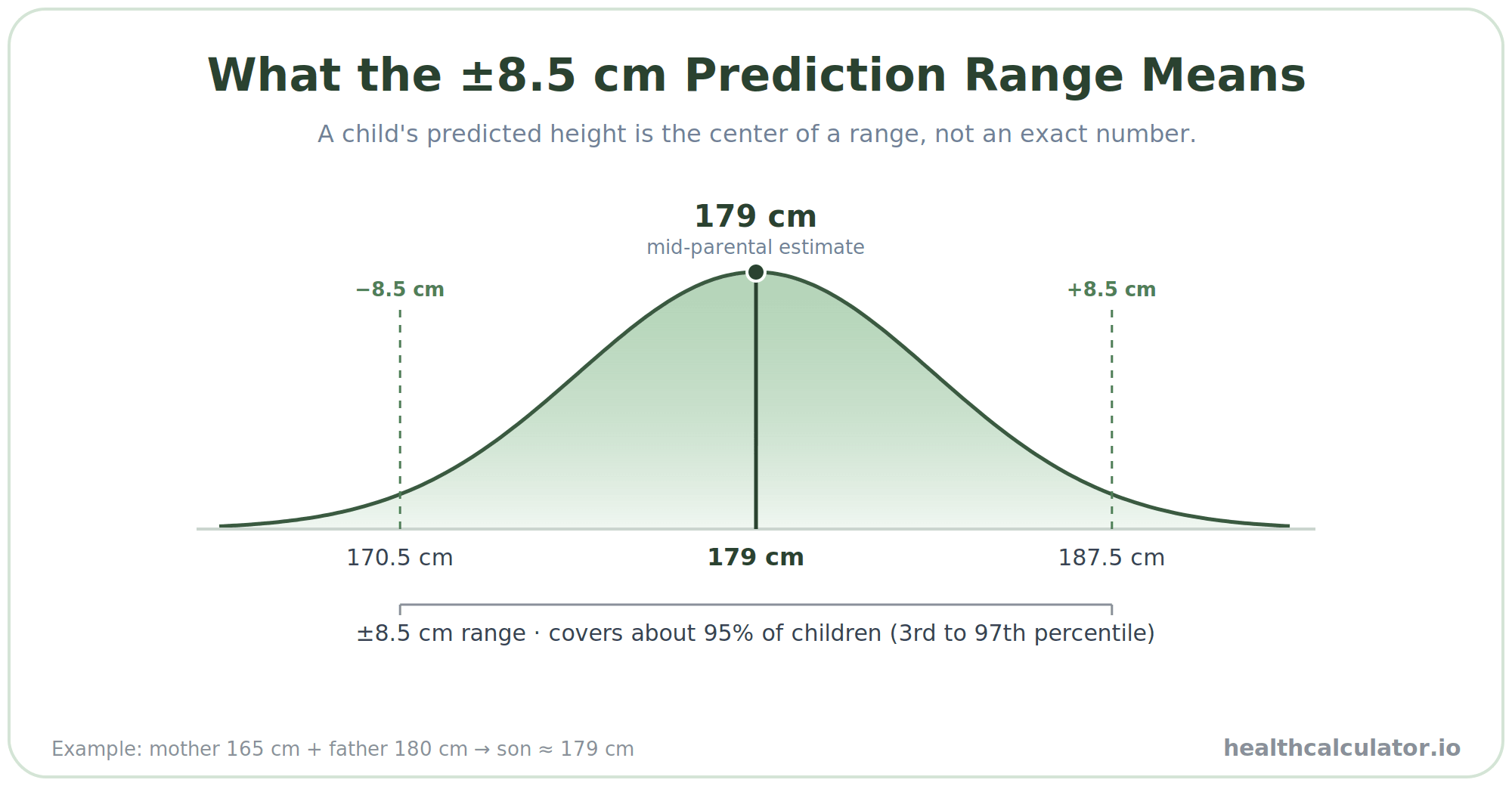
Tanner derived the ±8.5 cm band theoretically, as the spread covering roughly the 3rd to 97th percentile of outcomes. He later widened it to ±9 cm for girls and ±10 cm for boys, and the cutoffs endorsed by the pediatric endocrine societies are wider still — about ±10.6 cm for girls and ±11.7 cm for boys under CDC standards.
That is a big window. It is also honest.
And the method has a known tilt. A 2024 study in Children followed 23 unusually large families — a mean of 11 adult children each, all finished growing — and found that standard mid-parental height explained just 36% of the variance in the children's heights, with children finishing on average 2.7 cm taller than their target predicted. Correcting for parental age, swapping the flat 13 cm sex adjustment for a proportional one, and accounting for regression to the mean pushed variance explained to 40% and cut that bias to 0.14 cm.
Translation: if your mid-parental result feels a touch low, the research agrees with you.
Height Prediction Methods Compared
| Method | What it needs | Best for | Typical accuracy |
|---|---|---|---|
| Mid-parental (Tanner) | Both parents' heights | A genetic target at any age, even pre-birth | Wide — ±8.5 cm covers roughly the 3rd–97th percentile |
| Khamis-Roche | Child's age, height and weight, plus parents' heights | Children aged 4–17.5, no imaging available | ±5.3 cm (boys), ±4.3 cm (girls) |
| Bone age (Greulich-Pyle, TW3) | A hand and wrist X-ray | Clinical growth evaluations | Most precise, but needs imaging and a clinician |
Both non-imaging methods are built into this page. The third one needs a radiologist.
What Actually Determines Height?
Genetics carries most of the load, and the scale of it is startling. A 2022 study in Nature from the GIANT Consortium analyzed 5.4 million people across diverse ancestries and pinned down 12,111 independent genetic variants associated with height — clustered in 7,209 genomic segments covering about 21% of the genome, and together explaining nearly all the common-variant heritability.
So there is no "tall gene." Height is polygenic: more than 700 individual variants have well-characterized effects, each one nudging the total by a fraction. A 2025 paper in Cell traced why, mapping the regulatory activity of growth-plate cartilage cells across the developing skeleton and finding that variants active across more skeletal sites are the ones most strongly associated with height.
The rest comes down to environment, especially during the growing years: solid nutrition (enough protein, calcium, vitamin D, and zinc), good sleep, general health, and hormones. This is also why very tall or very short parents tend to have children closer to average than themselves, a pattern geneticists call regression to the mean.
When Do Boys and Girls Stop Growing?
Girls' growth spurt peaks around age 11.5 and slows around 16. Boys run later — peaking near 13.5 and slowing around 18.
Growth ends when the growth plates at the ends of the long bones fuse, which is visible on an X-ray. Once they've closed, adult height is set. That's the practical reason a prediction made at 15 beats one made at 5: most of the uncertainty has already resolved.
Tracking a child's growth against their exact age? Our chronological age calculator gives you the decimal age these formulas want.
Limitations: When These Predictions Miss
Every method here is a population estimate applied to one individual, and that gap is where the error lives.
The mid-parental formula ignores the child completely — no current height, no weight, no bone maturity, no puberty stage. It also drifts when parents' heights are far apart or far from average, and it systematically underestimates, as the 2.7 cm bias above shows.
Khamis-Roche is tighter but not immune. It was derived from the Fels cohort, which was predominantly white American children, so accuracy can shift for other populations. It assumes healthy, well-nourished growth and typical puberty timing. It won't account for growth hormone deficiency, precocious puberty, chronic illness, or a child on a treatment that alters growth.
And the converter has no limits worth worrying about — 2.54 is 2.54.
If a child's growth genuinely worries you, a pediatrician with a growth chart and, if needed, a bone-age film will beat any calculator on this page. Nutrition questions are worth raising too; calcium status in particular is easy to overlook, and our corrected calcium calculator is there if a lab result has you wondering.
Why Use Our Height Calculator?
- Three tools, one page — converter, Khamis-Roche predictor, mid-parental predictor.
- Metric or imperial — enter cm and kg, or feet-inches and pounds. Your call.
- No X-ray, no clinic visit — Khamis-Roche was designed precisely to avoid both.
- Private by default — no account, no email, no stored data. Everything computes locally.
- Current sources — CDC measured data from 2021–2023, published regression coefficients, cited throughout.
Want the whole toolkit? Browse our full list of health calculators.
This Tool Is Not a Substitute for Medical Advice
This calculator is for informational and educational purposes only and does not constitute medical advice, diagnosis, or treatment. Height predictions are statistical estimates carrying a wide margin of error, and a result outside the expected range is not a diagnosis of anything. Always consult a qualified healthcare professional about concerns regarding growth or health.
Frequently Asked Questions
Divide your height in centimeters by 2.54 to get total inches, because one inch equals exactly 2.54 cm. Then split those inches into feet and a remainder. For example, 170 cm ÷ 2.54 is 66.9 inches, which is 5 feet 6.9 inches — about 5'7". The converter above does it instantly in both directions.
Enter your child's age, sex, current height and weight plus both parents' heights, and the Khamis-Roche predictor estimates their adult height with 90% of predictions landing within about ±5.3 cm for boys and ±4.3 cm for girls. If you only know the parents' heights, the mid-parental calculator gives a rougher genetic target instead.
Mid-parental height uses only the parents, giving a genetic target with a wide ±8.5 cm band. Khamis-Roche adds the child's own age, height and weight, roughly halving the error. Use mid-parental before a child can be measured, and Khamis-Roche from age 4 onward — this page runs both.
Weight acts as a proxy for skeletal maturity, which would otherwise require a bone-age X-ray. Children who are heavier for their age tend to have more advanced bone development and less growing time remaining, while lighter children often mature later and grow for longer. Khamis-Roche uses that signal to adjust the prediction.
It gives a genetic ballpark, not a number. A 2024 study found it explained only 36% of the variance in children's final heights, with children finishing on average 2.7 cm taller than predicted. Tanner's ±8.5 cm band covers roughly the 3rd to 97th percentile, and the pediatric endocrine societies use wider cutoffs still.
Based on CDC measured examinations from 2021 to 2023, the average American man is 68.9 inches — 175.0 cm, or 5'8.9". The average American woman is 63.5 inches, which is 161.3 cm or 5'3.5". These are measured figures rather than self-reported, so they run slightly shorter than survey numbers, and they vary by country.
Girls' growth spurt peaks around age 11.5 and slows near 16. Boys peak around 13.5 and slow near 18. Growth finishes when the growth plates in the long bones fuse, which a doctor can confirm on an X-ray. After fusion, adult height is essentially fixed.
Largely. The NIH estimates that about 80 percent of height variation is genetic, and the trait is polygenic — a 2022 Nature study of 5.4 million people identified 12,111 contributing variants, none of them decisive on its own. The remaining share reflects nutrition, sleep, hormones, and general health during childhood.
Five feet nine inches is 175.3 cm. The math: 5 feet is 60 inches, plus 9 makes 69 inches, and 69 × 2.54 comes to 175.26 cm. That sits just above the measured average for an adult American man, which the CDC puts at 68.9 inches.
You can't override genetics, but you can help a child reach their full potential. Adequate protein, calcium, vitamin D and zinc, enough sleep, and treatment of any underlying condition all support normal growth. Severe deficiency can cost final height; extra nutrition beyond what's needed will not add any.
Not the Khamis-Roche panel — its published coefficients start at age 4, because growth before then is too volatile to model reliably. Use the mid-parental calculator instead for a genetic target, and rely on your pediatrician's growth chart to track whether a toddler is following their own curve.
Sources
Every figure on this page is drawn from government health statistics or peer-reviewed research. Last verified August 2026.
- National Center for Health Statistics. FastStats — Body Measurements. Centers for Disease Control and Prevention; reviewed 26 June 2025.
- National Center for Health Statistics. Anthropometric Reference Data for Children and Adults: United States, August 2021–August 2023. Vital and Health Statistics, Series 3, No. 50; 2025.
- Khamis HJ, Roche AF. Predicting adult stature without using skeletal age: the Khamis-Roche method. Pediatrics. 1994 Oct;94(4 Pt 1):504–507. Erratum in: Pediatrics. 1995 Mar;95(3):457.
- Zeevi D, Ben Yehuda A, Nathan D, Zangen D, Kruglyak L. Accurate Prediction of Children's Target Height from Their Mid-Parental Height. Children (Basel). 2024;11(8):916. doi:10.3390/children11080916.
- Yengo L, Vedantam S, Marouli E, et al. A saturated map of common genetic variants associated with human height. Nature. 2022 Oct;610(7933):704–712. doi:10.1038/s41586-022-05275-y.
- Richard D, Muthuirulan P, Young M, et al. Functional genomics of human skeletal development and the patterning of height heritability. Cell. 2025 Jan 9;188(1):15–32.e24. doi:10.1016/j.cell.2024.10.040.
- MedlinePlus Genetics. Is height determined by genetics? National Library of Medicine, National Institutes of Health.
- MedlinePlus Medical Encyclopedia. Adolescent development. National Library of Medicine; reviewed 1 January 2025.