
A1C Calculator
Last updated:

Muhammad Hamza is the founder of Health Calculator, dedicated to building accurate and easy-to-use health tools for everyone.

Dr. Farah Taqueer is a qualified Pediatrician based in Karachi. She reviews all health calculators on this site for clinical accuracy and medical correctness.
Convert HbA1c percentage to estimated blood glucose instantly with our A1C converter, powered by the ADAG formula (ADA standard, 2008).
Hemoglobin A1c (HbA1c) is the percentage of your hemoglobin in your red blood cells that is coated with glucose. Results show: A1C <5.7% = normal; 5.7–6.4% = prediabetes; ≥6.5% = diabetes. A1C reflects your average blood sugar over 3 months, making it more informative than single glucose readings.
KEY TAKEAWAY: A1C Diagnostic Thresholds
| A1C Level | Category | Average Glucose | What It Means | Your Action |
| < 5.7% | ✓ Normal | < 117 mg/dL (6.5 mmol/L) | Healthy blood sugar control | Maintain current habits; retest every 3 years |
| 5.7–6.4% | ⚠ Prediabetes | 117–137 mg/dL (6.5–7.6 mmol/L) | Reversible with lifestyle changes | Diet + exercise can prevent diabetes |
| ≥ 6.5% | ✗ Diabetes | ≥ 140 mg/dL (≥ 7.8 mmol/L) | Diabetes diagnosis | See your doctor for evaluation and treatment planning. Management may include lifestyle changes, medication, or both |
Source: CDC Diabetes Diagnosis | ADA Standards of Care 2026
What is A1C and Why It Matters
What is Hemoglobin A1c?
Hemoglobin is the oxygen-carrying protein inside red blood cells. When glucose enters your bloodstream, it naturally attaches itself to hemoglobin in a process called glycation. Once attached, the glucose remains bound for the entire lifespan of the red blood cell, roughly 90–150 days.
Because red blood cells live approximately 3 months, your A1C reflects your average blood sugar over that time, not just a single moment. This makes A1C far more informative than a single fasting glucose reading. It shows how well your body has managed blood sugar over a full quarter-year cycle.
Why A1C Matters for Your Health
A1C is one of the most common ways healthcare professionals screen for prediabetes and type 2 diabetes, because it reveals long-term glucose patterns. CDC research shows that knowing your A1C helps you and your doctor:
- Assess diabetes risk early — identify prediabetes when it's still reversible with lifestyle changes
- Monitor glucose control — if you have diabetes, A1C tracks whether your current treatment is working
- Prevent serious complications — chronically high blood sugar damages blood vessels (heart disease, stroke) and nerves (neuropathy) over time
Even in people without diabetes, an abnormal A1C is associated with increased risk of heart disease, because high blood sugar damages blood vessels over time. This is why screening matters at every age.
CDC A1C Screening Guidelines (2026)
General Population Screening Schedule (No Diabetes Risk Factors)
| Age | Who should be screened | How often |
|---|---|---|
| 35 and older | Everyone, regardless of risk factors | Every 3 years (sooner if your risk changes) |
| Under 35 | Only if you are overweight or obese with at least one risk factor | Every 3 years |
Risk Factors for Ages 20–34:
Get screened only if you have ≥1 of these risk factors:
- Overweight or obese (BMI ≥ 25) — calculate your BMI here: https://healthcalculator.io/bmi-calculator/
- Family history of diabetes
- History of gestational diabetes
- High blood pressure (≥130/80 mmHg) — check with MAP calculator
- High cholesterol or triglycerides
- Physically inactive (<3x exercise/week)
- Ethnicity: Black/African American, Hispanic/Latino, Native American, Asian American, Pacific Islander
Prediabetes Screening Schedule (A1C 5.7–6.4%)
| Stage | A1C Level | Screening Frequency | What It Means | Your Action |
| Year 1 | 5.7–6.4% | Every 3–6 months | Tracking progress | Diet + exercise + stress management |
| Stabilized | 5.7–6.4% (stable) | Every 12 months | A1C not rising | Maintain lifestyle changes |
| Progressing | Rising trend | Urgent: See an endocrinologist | Moving toward diabetes | Medication + specialist care |
Good news: prediabetes is often reversible. Steady changes to food, movement, and weight have a strong track record of bringing A1C back into the normal range. Results vary from person to person.
Diabetes Screening Schedule (A1C ≥ 6.5%)
| Diagnosis Stage | A1C Level | Screening Frequency | A1C Target | Treatment Focus |
| New Diagnosis | ≥6.5% | Every 3 months | Individualized* | Establish baseline + adjust meds |
| Stable on Treatment | ≥6.5% (controlled) | Every 3–6 months | Individualized* | Maintain glucose control |
Target A1C by Profile:
- Younger, healthier adults: Target A1C < 6.5%
- Most adults: Target A1C < 7.0% (standard ADA goal)
- Older adults or complex conditions: Target A1C 7–8% (safer, lower hypoglycemia risk)
Ask your doctor what's best for your age, health, and medications.
A1C vs. eAG: Understanding the Conversion
A1C (%) measures the percentage of hemoglobin with glucose attached. eAG (mg/dL or mmol/L) is the average blood glucose value calculated from your A1C
They measure the same thing, glucose control, but in different units.
Example: An A1C of 7.0% corresponds to an eAG of 154 mg/dL (8.6 mmol/L).
Why Both Matter
- A1C is what your lab measures (the "gold standard" for long-term control)
- eAG is what your home glucose meter displays (helps you understand your A1C in daily terms)
If your lab reports only A1C, use our calculator above to see what your average daily blood sugar has been. This helps you connect the 3-month average to what you see on your meter.
A1C to Blood Sugar Conversion Chart
Here's how each A1C percentage translates into your average blood sugar, in both mg/dL and mmol/L.
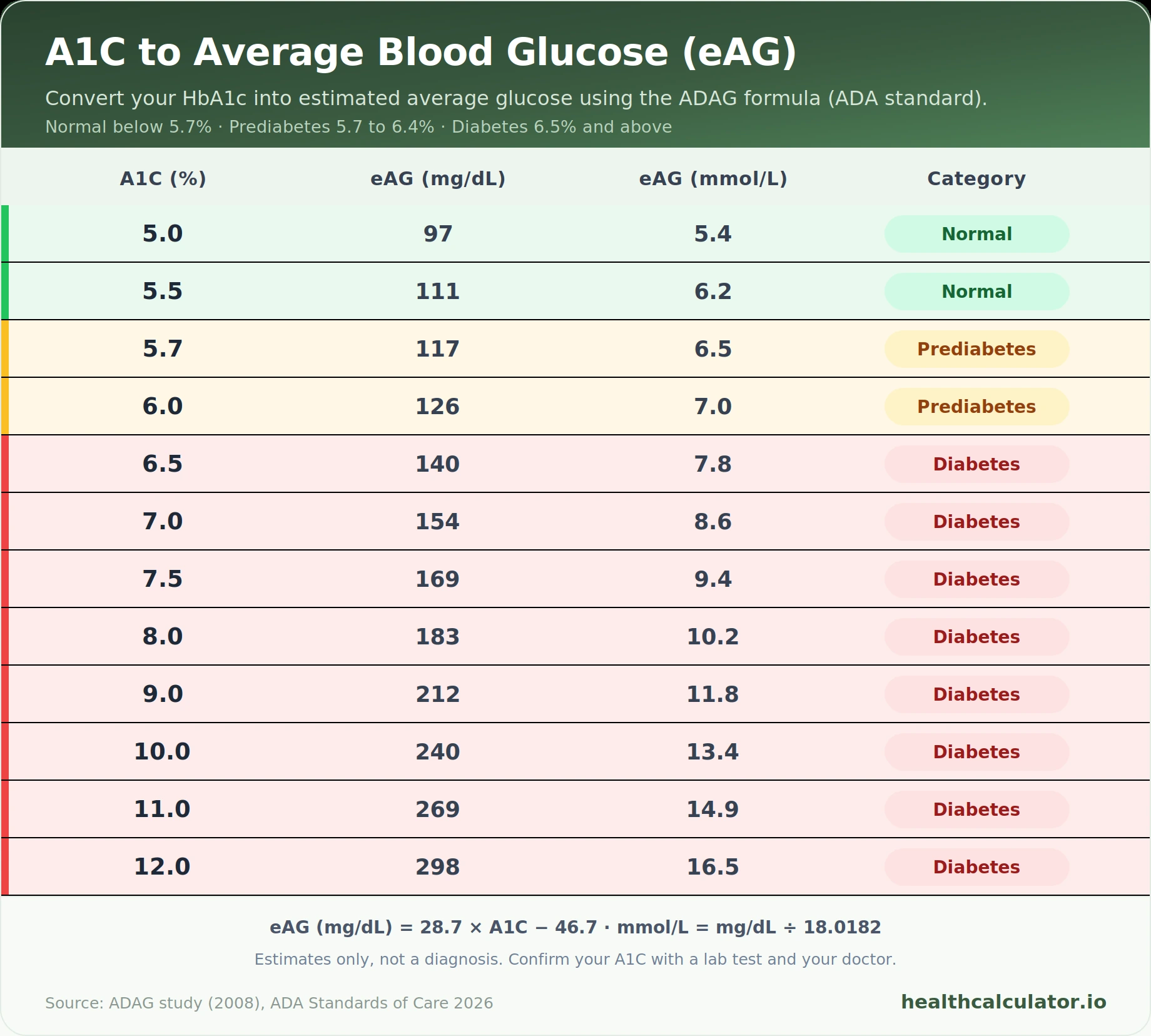
| A1C | eAG mg/dL |
| 5.0 | 97 |
| 5.5 | 111 |
| 6.0 | 126 |
| 6.5 | 140 |
| 7.0 | 154 |
| 8.0 | 183 |
| 9.0 | 212 |
| 10.0 | 240 |
How to Calculate A1C from Blood Glucose
The ADAG Formula (ADA Standard)
The A1C-Derived Average Glucose (ADAG) study established the internationally recognized formula in 2008, now the ADA standard:
A1C to eAG (mg/dL):
eAG (mg/dL) = (A1C × 28.7) − 46.7
eAG to A1C:
A1C (%) = (eAG + 46.7) ÷ 28.7
For mmol/L conversions:
eAG (mmol/L) = eAG (mg/dL) ÷ 18.0182 For example, an eAG of 154 mg/dL is 154 ÷ 18.0182 = 8.6 mmol/L.
Worked Example (Metric & Imperial)
Scenario: Your lab result is A1C = 6.5% and you want to know your average blood glucose.
Step 1: Use the formula (mg/dL)
eAG = (6.5 × 28.7) − 46.7
eAG = 186.55 − 46.7
eAG = 139.85 mg/dL ≈ 140 mg/dL
Interpretation: Your average blood sugar over the past 3 months has been roughly 140 mg/dL.
Step 2: Convert to mmol/L (if needed)
140 mg/dL ÷ 18 = 7.8 mmol/L
Step 3: Check your A1C category
- A1C 6.5% = Diabetes diagnosis threshold
- Action: Book an appointment with your doctor to start a treatment plan
Reverse example: If your home readings average about 155 mg/dL, your estimated A1C is roughly 7.0%. (If you enter 155 in the eAG → A1C tab, that is exactly what the calculator returns.)
A1C vs. Other Glucose Tests
Not all glucose tests are created equal. Here's how A1C compares:
| Test | Time Period | What It Measures | Best For | Limitations |
| A1C (HbA1c) | 3 months | % of hemoglobin with glucose | Long-term diabetes screening & diagnosis | Unreliable if you have anemia, recent blood loss, or blood disorders |
| Fasting Glucose | 1 moment | Blood sugar after an 8-hour fast | Diabetes diagnosis (≥126 mg/dL = diabetes) | Doesn't catch post-meal glucose spikes |
| Random Glucose | 1 moment | Blood sugar at any time | Quick screening | Highly variable; affected by food, stress, and sleep |
| 2-Hour Glucose Tolerance Test (GTT) | 2 hours | Sugar level 2 hours after a 75g glucose drink | Diagnose gestational diabetes; detailed screening | Time-consuming, uncomfortable |
| Continuous Glucose Monitor (CGM) | 2 weeks | Real-time glucose patterns, minute-by-minute | Diabetes management: spot glucose trends | Costs vary depending on device type, insurance coverage, and location. |
Bottom line: A1C is the gold standard for long-term monitoring, but it works best alongside fasting glucose and daily home readings (ADA Standards 2026).
Difference between A1C and CGM (Continuous Glucose Monitor)
| Feature | A1C | CGM |
| What it measures | % of hemoglobin with glucose | Real-time glucose levels |
| Time period | 3 months (average) | 2 weeks (current patterns) |
| How often tested | Every 3–6 months | Worn continuously |
| Cost | ~$30–50/test (often covered by insurance) | Costs vary depending on device type, insurance coverage, and location. |
| Best for | Long-term diabetes diagnosis & monitoring | Daily meal/exercise decisions; pattern spotting |
For people with conditions that make A1C unreliable (anemia, kidney disease, pregnancy): CGM-derived metrics (Time-in-Range, Glucose Management Indicator) are more accurate.
Bottom line: Both tools are complementary. A1C shows your overall control; CGM shows your daily patterns.
Health Risks of High A1C
Prediabetes (A1C 5.7–6.4%): The Reversible Stage
According to the CDC, about 115 million U.S. adults, more than 2 in 5, have prediabetes, and roughly 8 in 10 of them don't know it (CDC National Diabetes Statistics).
The encouraging part: prediabetes is often reversible. Lifestyle programs that combine better food, more movement, and modest weight loss have helped many people move back into the normal range. A retest every 3 to 6 months shows you whether it's working.
Diabetes (A1C ≥ 6.5%): Complications Risk
When diabetes is uncontrolled, chronically high blood sugar damages blood vessels and nerves, increasing the risk of:
- Cardiovascular disease — heart attack, stroke
- Chronic kidney disease — kidney failure (requiring dialysis)
- Diabetic neuropathy — nerve damage, numbness, pain in feet/hands
- Diabetic retinopathy — vision loss, blindness
- Frequent infections — urinary tract, skin, fungal
- Diabetic foot — ulcers, potential amputation
The good news: Early diagnosis and consistent management (medication + diet + exercise) prevent or delay these complications by decades (NIH Research).
5 ways of Managing Your A1C: Lifestyle & Medication
The following are the 5 ways to manage your A1C.
1. Diet & Nutrition
Eating a balanced diet rich in whole foods stabilizes blood sugar and prevents glucose spikes. Focus on:
- Non-starchy vegetables (spinach, broccoli, bell peppers, leafy greens) — unlimited
- Lean proteins (chicken, fish, tofu, legumes, nuts) — 25–30g per meal
- Whole grains & fiber (brown rice, oats, quinoa, beans) — slow glucose absorption
- Healthy fats (olive oil, avocado, nuts) — reduce inflammation
Avoid ultra-processed foods: Higher consumption of ultra-processed foods has been associated with an increased risk of developing type 2 diabetes.
Weight loss impact: the 2026 ADA Standards point to losing 5 to 7% of your body weight as a realistic target that meaningfully improves blood sugar. If you weigh 200 lbs, that is roughly 10 to 14 lbs. Start with our BMI Calculator to set your target weight.
2. Physical Activity
Physical activity helps your body use insulin more efficiently, so it can better process glucose. Regular exercise lowers blood glucose and improves A1C, while also reducing the risk of heart disease and stroke.
Target: CDC recommends 150 minutes of moderate-intensity exercise per week (e.g., brisk walking, cycling, swimming).
Pro tip: Studies show that 10–15 minute walks after meals can significantly reduce post-meal glucose excursions and improve daily glucose control.
3. Stress Management & Sleep
The cortisol connection: Chronic stress triggers cortisol release, which raises blood glucose by promoting the liver to release stored glucose. Chronic stress has been associated with poorer glucose control and higher A1C levels in some individuals.
Sleep & glucose: Chronic sleep deprivation is associated with impaired insulin sensitivity and an increased risk of developing prediabetes and type 2 diabetes. During deep sleep, your body regulates glucose uptake; without it, your cells become less responsive to insulin.
Actionable steps:
- Target 7–9 hours nightly (7 hours minimum for glucose control)
- Stress reduction: 10–15 minutes of mindfulness or meditation may help reduce stress and support healthy glucose management when combined with other lifestyle measures.
- Consistency matters: A regular sleep schedule is more important than "catching up" on weekends
4. Monitor & Track Progress
Retest every 3 months if you have prediabetes or newly diagnosed diabetes. Progress is tracked in A1C cycles, one 3-month period = one blood cell lifespan. Use our A1C Calculator to track your lab results over time and visualize improvement.
5. Medication (If Lifestyle Alone Isn't Enough)
If A1C remains high after 3–6 months of lifestyle changes, talk to your doctor about medication. Common first-line drugs:
- Metformin — improves insulin sensitivity; minimal side effects
- GLP-1 agonists (Ozempic, Victoza) — helps body use insulin + supports weight loss
- SGLT2 inhibitors (Farxiga) — reduces glucose in urine
- Sulfonylureas or insulin — for more advanced diabetes
Never adjust or stop medications without medical guidance. Work with your doctor or endocrinologist to find the right combination.
Important: This Calculator is a Screening Tool, Not a Diagnosis
This calculator is for informational and screening purposes only and does not constitute medical advice or diagnosis.
Why your lab result may differ from calculated estimates:
- Individual variation in red blood cell lifespan
- Anemia or blood disorders (sickle cell, thalassemia, iron deficiency)
- Advanced kidney disease
- Recent blood loss or blood transfusion
- Pregnancy (A1C can be temporarily falsely low)
Medical disclaimer
This calculator is for informational and screening purposes only and does not constitute medical advice or diagnosis. Always consult a qualified healthcare professional before making health decisions or changes to your diabetes management plan. Individual results may vary based on red blood cell lifespan, anemia, kidney disease, pregnancy, and other medical conditions.
Frequently Asked Questions
A1C measures your average blood sugar over 3 months (long-term control); a blood glucose reading shows your sugar level at one moment (snapshot). A1C is steady and less affected by meal timing; daily readings fluctuate with food, stress, and exercise. Together, they give a full picture: A1C shows if your treatment is working; daily readings help you spot patterns and adjust meals/exercise in real time.
Not exactly. A1C requires a lab test that measures actual hemoglobin glycation using specific biochemical techniques.
However, If you have multiple home readings over weeks (from your glucose meter or continuous glucose monitor), you can estimate an average glucose and use our calculator to estimate what A1C might be — then confirm with a lab test. This is a rough estimate, not a diagnosis.
Best practice: Get an official lab A1C every 3–6 months; use daily readings to guide meal/exercise decisions between tests.
A1C can be unreliable in people with:
- Anemia (iron deficiency) — falsely raises A1C by 0.4–0.7%
- Hemolytic anemia falsely lowers A1C
- Sickle cell disease or thalassemia — blood disorders that shorten RBC lifespan
- Advanced kidney disease affects red blood cell turnover
- Recent blood loss or transfusion
- Pregnancy — A1C may be temporarily lower
If A1C is unreliable for you: Your doctor may use alternative tests like fasting glucose, continuous glucose monitoring (CGM), or glucose management indicator (GMI).
Yes. Research shows that structured lifestyle interventions, including weight loss, improved nutrition, and physical activity, can reduce A1C by approximately 0.5–1.0 percentage points in many individuals with prediabetes or type 2 diabetes.
Proven strategies:
- 5–10% weight loss → lowers A1C significantly
- 150 min/week moderate exercise → improves insulin sensitivity
- Whole-food diet (low ultra-processed) → stabilizes glucose
- Stress management + 7–9 hrs sleep → reduces cortisol, improves insulin response
Results vary by individual. Some people reverse prediabetes entirely; others need medication alongside lifestyle changes. Consistency (not perfection) is key.
General screening (no diabetes):
- Age 35+: Every 3 years
- Age 20–34 with risk factors: Every 3 years (or annually if recommended by your doctor)
With prediabetes (A1C 5.7–6.4%):
- First year: Every 3–6 months (track progress with lifestyle changes)
- Stabilized: Every 12 months
With diabetes (A1C ≥ 6.5%):
- New diagnosis: Every 3 months
- Stable on medication: Every 3–6 months
It depends on your age and health:
- Most adults with diabetes: A1C < 7.0% is the standard ADA target
- Younger, healthier adults: Target < 6.5% (lower risk)
- Older adults or complex health conditions: Target 7–8% (safer; lower hypoglycemia risk)
Bottom line: Ask your doctor or endocrinologist what A1C target is right for your situation. There's no one-size-fits-all answer.
Primary Sources: