
Protein Calculator
Last updated:

Muhammad Hamza is the founder of Health Calculator, dedicated to building accurate and easy-to-use health tools for everyone.

Dr. Farah Taqueer is a qualified Pediatrician based in Karachi. She reviews all health calculators on this site for clinical accuracy and medical correctness.
Protein does a lot of quiet work: it rebuilds muscle after training, keeps your immune system stocked, and protects the lean mass you lose naturally with age. Our Protein Calculator turns that into one clear number. Enter your weight, activity level, and goal, and it tells you how many grams to aim for each day, then breaks it down per meal so you actually know what to put on the plate.
Here is the short version most people are looking for. The old Recommended Dietary Allowance of 0.8 g/kg is really a floor, the amount that keeps a sedentary adult from running short. The 2025–2030 Dietary Guidelines for Americans raised the working target for adults to 1.2–1.6 g of protein per kilogram of body weight per day, and active people and adults over 65 often sit at the top of that band or just above it. That shift is exactly what this tool is built around.
What Is Protein and Why It Matters
What Is Protein?
Protein is one of three essential macronutrients (along with carbohydrates and fats) that your body uses for energy, structure, and function. Proteins are composed of amino acids — organic compounds that link together in chains. Your body can produce 11 amino acids on its own, but you must obtain the other 9 essential amino acids from food.
Foods that contain all nine essential amino acids are called complete proteins. Examples include meat, poultry, fish, eggs, dairy, soy, and quinoa. Incomplete proteins (found in nuts, legumes, grains, and seeds) lack one or more essential amino acids, but you can combine different incomplete proteins throughout the day to get a complete amino acid profile.
How Protein Impacts Your Health
Protein serves dozens of critical functions in your body:
- Muscle maintenance and growth — Essential for building lean tissue, especially during strength training or recovery from injury.
- Enzyme and hormone production — Proteins regulate metabolism, immune response, and nutrient transport.
- Immune function — Antibodies (proteins) protect you from viruses, bacteria, and pathogens.
- Tissue repair — Supports wound healing and cellular regeneration.
- Satiety — Protein keeps you feeling full longer than carbs or fats, which helps with weight management.
Inadequate protein intake can lead to muscle loss, slower wound healing, weakened immune function, and poor recovery from exercise.
To check water intake estimate, our water intake calculator pairs well with a higher-protein diet.
How Our Protein Calculator Works
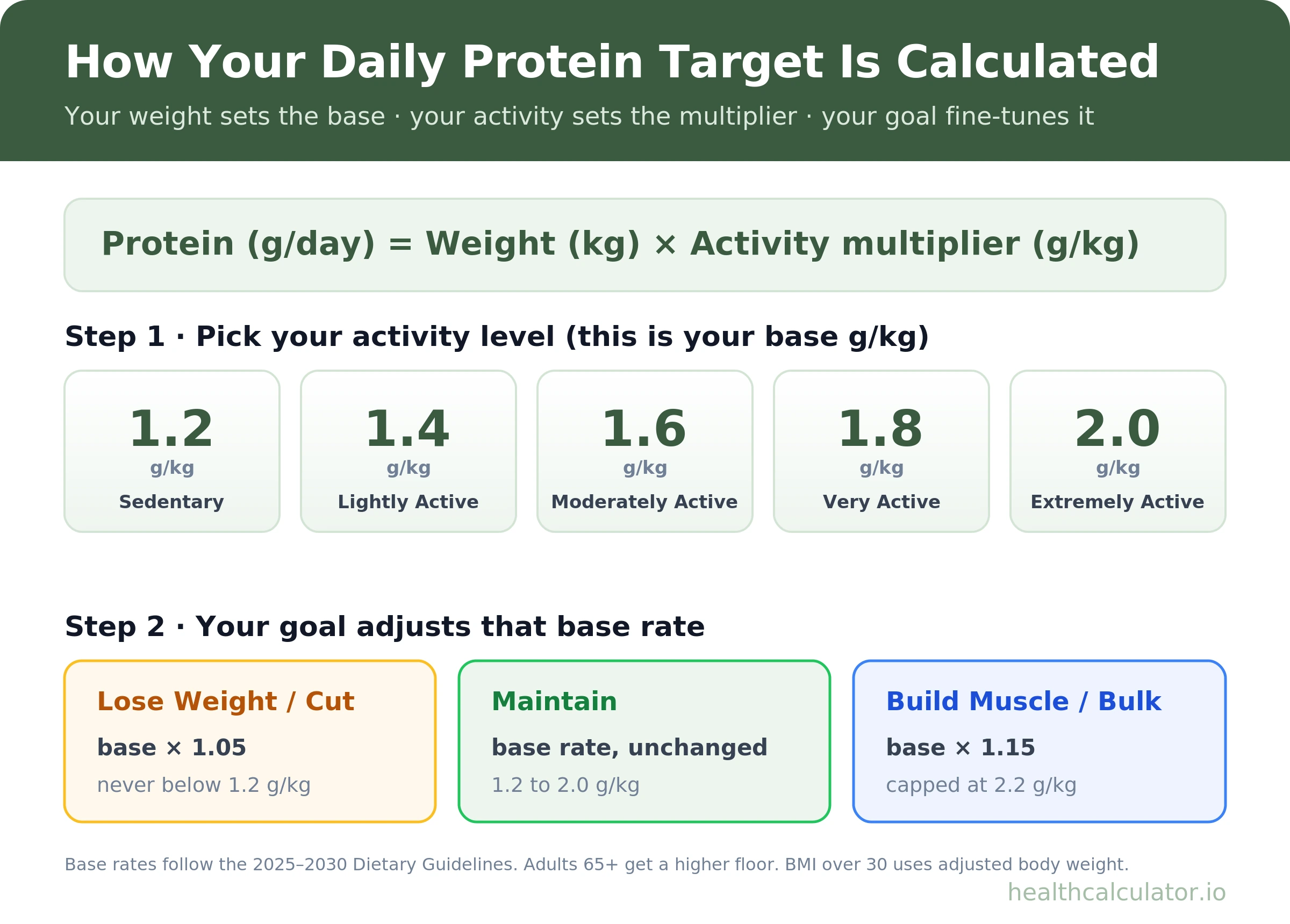
The math is refreshingly simple, and it helps to see it. Your daily target is your body weight in kilograms multiplied by a protein rate that depends on how active you are:
Protein (g/day) = weight (kg) × activity multiplier (g/kg)
If you enter pounds, we convert first (1 lb = 0.4536 kg). You pick an activity level, which sets your base rate, and then your goal fine-tunes it. Here is the actual rate our tool uses, not a generic chart:
| Activity level | Base rate (Maintain) | Lose weight / Cut | Build muscle / Bulk |
|---|---|---|---|
| Sedentary | 1.2 g/kg | 1.3 g/kg | 1.4 g/kg |
| Lightly Active | 1.4 g/kg | 1.5 g/kg | 1.6 g/kg |
| Moderately Active | 1.6 g/kg | 1.7 g/kg | 1.8 g/kg |
| Very Active | 1.8 g/kg | 1.9 g/kg | 2.1 g/kg |
| Extremely Active | 2.0 g/kg | 2.1 g/kg | 2.2 g/kg |
A couple of rules make those goal columns behave. Choosing Cut raises your base rate by about 5% but never drops below 1.2 g/kg, because protein is what protects muscle while you lose fat. Choosing Bulk adds about 15% but caps at 2.2 g/kg, since the research shows almost nobody benefits from going higher. Maintain simply uses your base rate as-is.
A quick worked example (metric)
Say you weigh 75 kg, you train a few days a week (Moderately Active), and you want to maintain. Your rate is 1.6, so:
75 × 1.6 = 120 g of protein per day
The tool then splits that for you: roughly 40 g across 3 meals, or 30 g across 4 meals, with a safe working range of about 60 g to 165 g marking the low and high ends for your weight.
The same example (imperial)
Prefer pounds? Enter 165 lb. We convert to 74.8 kg, then apply the same 1.6 rate:
74.8 × 1.6 ≈ 120 g of protein per day
Practically identical, which is the point. The unit you use never changes your answer.
Two Numbers, One Better Target: Body Weight vs Lean Mass
Your result actually shows two figures, and the difference is worth thirty seconds of your time.
The standard number is the guideline method above: your body weight times your protein rate. It is what the Dietary Guidelines and the major sports-nutrition bodies use, and it is the one to follow by default.
The lean-mass number takes a different route. It uses the Boer formula to estimate how much of your weight is actually muscle, from your sex, height, and weight, then targets protein per kilogram of that lean mass. Because men and leaner people carry more muscle at the same scale weight, this figure runs a little higher for them and lower for anyone carrying more body fat. That is why two people who weigh exactly the same can see different lean-mass targets, and it is the honest way sex and height enter the picture.
So which number is yours? In practice, your real requirement usually sits between the two. Use the standard figure as your everyday guide, lean toward the lean-mass figure if you are notably lean or muscular, and toward the lower end if you carry more body fat. One caveat worth stating plainly: the lean-mass number is an estimate from a formula, not a body-composition scan, so treat it as a smart guide rather than a hard line.
What If Your BMI Is Over 30? (the adjustment most calculators skip)
Multiplying total body weight by a protein rate works well until someone carries a lot of extra fat, because fat tissue needs far less protein than muscle does. Run the raw math on a 110 kg frame and you get a target near 176 g, which is more than the body can use.
So when your BMI is above 30, our calculator switches to an adjusted body weight. It counts your full weight up to the point where your BMI would be 30, then adds only a quarter of the weight above that, because the excess is mostly fat, which needs far less protein than muscle. That adjusted figure, not your scale weight, gets multiplied by your protein rate. The change is smooth, so there is no sudden jump right at the BMI 30 line.
Worked example: a 110 kg man at 5 ft 7 in (BMI about 38) would weigh roughly 87 kg at a BMI of 30. Adding a quarter of the 23 kg above that gives an adjusted body weight near 93 kg, so at a Moderately Active maintain rate his target is 148 g per day, not the 176 g his raw weight would suggest. It keeps your number honest without an abrupt cliff. If your BMI is at or below 30, this never kicks in and the tool just uses your real weight. You can check where you land with our BMI calculator.
How Much Protein Do You Actually Need?
The older baseline of 0.8 g/kg (the RDA minimum) is still adequate for preventing deficiency, but current evidence shows that higher intakes optimize muscle retention, recovery, and metabolic health — especially with age and exercise.
There is no single number, but there is a reliable range. The Recommended Dietary Allowance of 0.8 g/kg prevents deficiency, and the newer 2025–2030 Dietary Guidelines move the everyday target to 1.2–1.6 g/kg. From there it depends on what your body is doing:
- Mostly sitting, just maintaining: around 1.2 g/kg, the guideline minimum, covers the basics. (The old 0.8 RDA only prevents deficiency.)
- Training or trying to lose fat: 1.4–1.7 g/kg. The International Society of Sports Nutrition puts the sweet spot for exercisers at 1.4–2.0 g/kg.
- Adults 65 and older: at least 1.0–1.2 g/kg, per the ESPEN expert group, to slow the muscle loss that comes with aging.
- Pregnant or nursing: roughly 1.1–1.3 g/kg, guided by your provider.
One useful anchor from the research: a large British Journal of Sports Medicine meta-analysis of nearly 1,900 people found that muscle gains from strength training keep improving with protein up to about 1.6 g/kg, then flatten out. That is why our tool treats 1.6 as the "very active" mark rather than pushing everyone toward 2 g/kg.
Daily Protein Needs by Body Weight & Activity Level
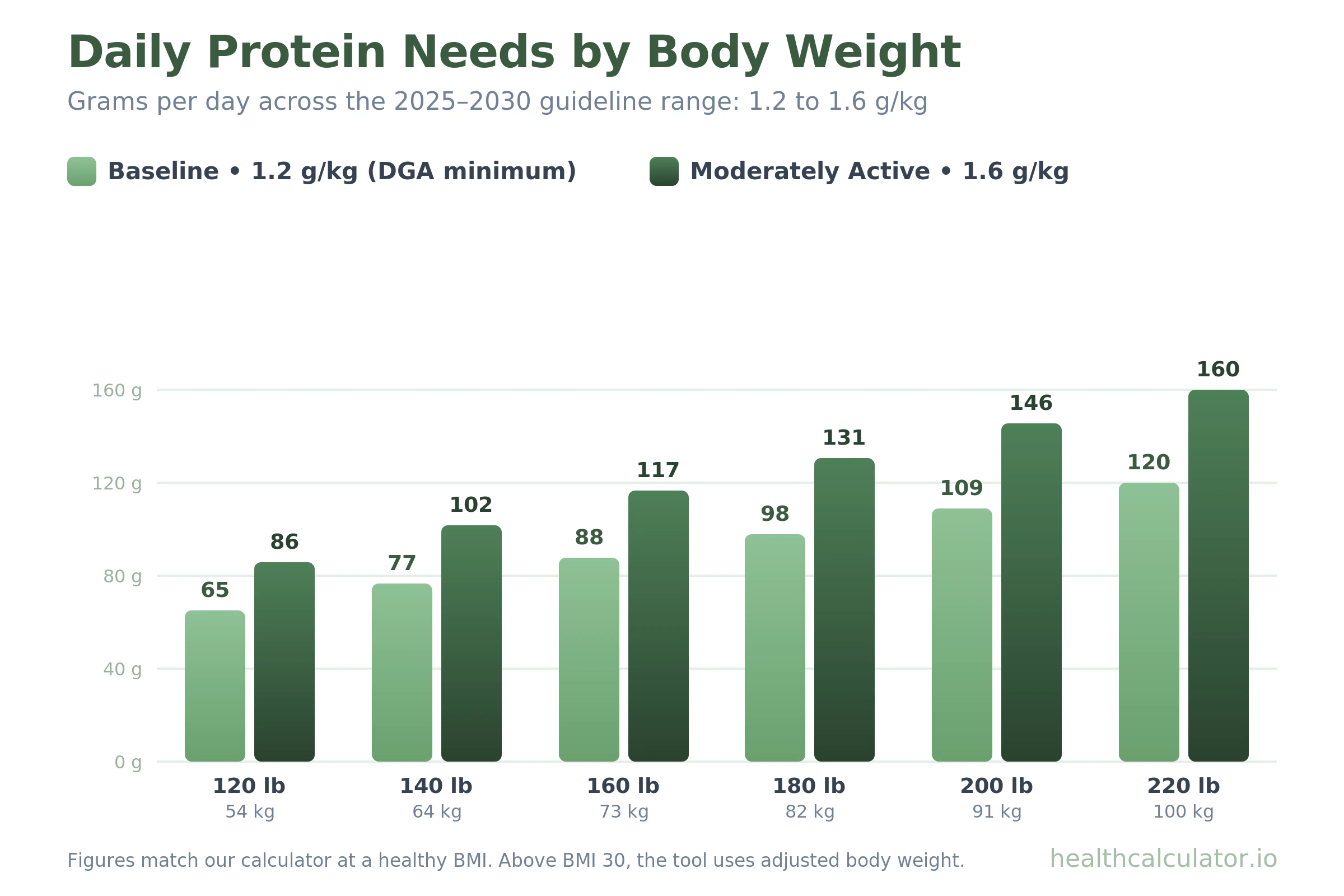
The table below shows estimated daily protein needs based on body weight and activity level using 1.2 g/kg for baseline health and 1.4–1.6 g/kg for active individuals and fitness goals.
| Body Weight | Sedentary (1.2 g/kg) | Active (1.4–1.6 g/kg) |
|---|---|---|
| 120 lb (54 kg) | 65 g | 76–87 g |
| 140 lb (64 kg) | 77 g | 90–103 g |
| 160 lb (73 kg) | 88 g | 102–117 g |
| 180 lb (82 kg) | 98 g | 115–131 g |
| 200 lb (91 kg) | 109 g | 127–145 g |
| 220 lb (100 kg) | 120 g | 140–160 g |
What Your Result Band Means
After you calculate, the tool drops a marker on a Low-to-High track. That band is based on your protein rate per kilogram, and here is how to read it:
| Band | Rate (g/kg) | What it means |
|---|---|---|
| Low | under 1.2 | Below the 2025–2030 guideline minimum for adults. |
| Adequate | 1.2 to 1.6 | Meets the recommended daily range. Right where most people should sit. |
| Optimal | 1.6 to 2.0 | The active, muscle-preserving zone for regular training. |
| High | 2.0 and up | Built for heavy training or an aggressive cut. |
Most adults maintaining their health land in "Adequate," which is exactly where the guidelines want you. "Optimal" and above are for people training hard or protecting muscle during a diet, not a target everyone needs to chase.
Signs You May Not Be Getting Enough Protein
Protein is essential for maintaining muscle, supporting immune function, repairing tissues, and producing enzymes and hormones. While severe protein deficiency is uncommon in developed countries, consistently consuming too little protein may lead to noticeable symptoms over time.
- Muscle Loss and Reduced Strength
- Frequent Hunger and Increased Cravings
- Slow Recovery After Exercise or Injury
- Fatigue and Weakness
- Hair Thinning
- Brittle Nails
- Delayed Wound Healing
- Frequent Illness
Best Protein Sources
Complete Proteins (All 9 Essential Amino Acids)
Complete proteins provide all nine essential amino acids that your body cannot produce on its own. These foods can help support muscle growth, recovery, immune function, and overall health.
| Protein Type | Food | Protein Content |
|---|---|---|
| Animal-Based | Chicken Breast | 31 g per 3 oz |
| Turkey | 29 g per 3 oz | |
| Tuna | 25 g per 3 oz | |
| Salmon | 25 g per 3 oz | |
| Lean Beef | 25 g per 3 oz | |
| Cottage Cheese | 11 g per 100 g | |
| Greek Yogurt | 10 g per 100 g | |
| Milk | 8 g per cup | |
| Egg | 6 g per large egg | |
| Plant-Based | Soy Foods (Tofu, Tempeh, Edamame) | 8–16 g per serving |
| Hemp Seeds | 10 g per 3 tablespoons | |
| Quinoa | 8 g per cooked cup | |
| Buckwheat | 6 g per cooked cup |
High-Protein Incomplete Sources
These foods are excellent sources of protein but do not contain all nine essential amino acids in optimal amounts. Consuming a variety of legumes, grains, nuts, and seeds throughout the day can help provide a complete amino acid profile.
| Food | Protein Content |
|---|---|
| Chickpeas | 12 g per cooked half-cup |
| Lentils | 9 g per cooked half-cup |
| Black Beans | 8 g per cooked half-cup |
| Peanut Butter | 8 g per 2 tablespoons |
| Almonds | 6 g per ounce |
| Whole Grains | 3–5 g per serving |
| Broccoli | 2–3 g per cup |
Tip: Aim to consume approximately 25–30 grams of protein per meal and spread protein intake throughout the day. Combining foods such as beans and rice, lentils and whole grains, or nuts and legumes can help ensure a complete amino acid profile.
Protein Across Different Life Stages
Protein requirements vary across life stages due to differences in growth, metabolism, and physiological needs.
| Population | Protein Guidance | Why |
|---|---|---|
| Older Adults (65+) | 1.1–1.2 g/kg daily | Older adults naturally lose muscle mass (sarcopenia). Higher protein intake combined with resistance training helps maintain strength, balance, and independence. |
| Pregnant / nursing | 1.1–1.3 g/kg daily | Pregnancy increases protein needs for fetal growth and maternal tissue development. Breastfeeding also increases protein requirements for milk production. Additional calorie needs should be guided by a healthcare provider. |
| Children and Teens | Varies by age (consult guidelines) | Protein needs are higher relative to body weight to support growth and development. Recommendations vary by age, so pediatric guidance or a healthcare provider should be consulted. |
A Few Honest Limitations
This tool gives you a strong, evidence-based estimate, not an exact prescription. It works from your weight, height, sex, and activity, so it cannot see your true muscle mass, how you carry fat, or how hard you actually train. That is exactly why it shows you two numbers instead of one false-precise figure. Treat your result as a smart starting point, then fine-tune over a few weeks based on real-world feedback: your energy, recovery, strength, and how full you feel between meals.
Important Disclaimer
This calculator is for informational and screening purposes only and does not constitute medical advice or diagnosis. Protein needs vary based on individual metabolism, medications, health conditions, and goals. If you have kidney disease, liver disease, diabetes, or any chronic condition, consult a registered dietitian or physician before making significant changes to your protein intake. The 2025–2030 Dietary Guidelines are for generally healthy adults; special populations may have different needs.
Frequently Asked Questions
Most healthy people can safely consume up to 2–2.2 g/kg per day. Beyond that, excess protein is converted to energy or stored as fat. For those with kidney or liver disease, upper limits are lower — consult your doctor.
Protein has 4 calories per gram (same as carbs, less than fat at 9 per gram). Excess calories from any source can lead to fat gain. High-protein diets often support weight loss because protein increases satiety and preserves muscle during a cut.
Yes. You need to consume a variety of plant proteins (legumes, grains, nuts, seeds, soy) throughout the day to ensure all nine essential amino acids. Many plant-based athletes meet their targets this way.
Spreading protein evenly across 2–3 meals (25–30g per meal) is more effective for muscle synthesis than concentrating it in one meal. There's no strict "post-workout window," but consuming protein within a few hours of exercise supports recovery.
Use a food scale and a nutrition app (MyFitnessPal, Cronometer) to log meals. Most nutrition labels list protein per serving. Aim to hit your daily target within 5–10 grams.
Whole foods are ideal. Supplements (powders, bars, shakes) are convenient for meeting targets if whole food is unavailable, but they are not necessary. Food should be your primary source.
To maximize muscle growth, aim for 1.6–2.0 grams of protein per kilogram of body weight daily, combined with strength training and adequate calories. Research shows that consuming 25–30 grams of high-quality protein per meal optimizes muscle protein synthesis. A 150-pound person building muscle should target 109–136 grams per day. Consistency with both protein and resistance training matters most.
During a caloric deficit for weight loss, prioritize 1.4–1.6 g/kg daily, the upper end of the recommended range. High protein intake preserves lean muscle mass while you lose fat, increases satiety (keeping you full longer), and reduces hunger hormones. A 150-pound person cutting should consume 95–109 grams per day, distributed across 2–3 meals for optimal muscle retention.
It depends on your body weight and goals. A 150-pound sedentary adult needs 82–109g daily (1.2–1.6 g/kg); 100g falls within this range. A 180-pound athlete building muscle needs 122–153g; 100g is too low. Use the Protein calculator above rather than guessing.
For people with normal kidney function, intakes up to 2.0–2.2 g/kg have not been shown to harm the kidneys. The excess is simply used for energy or cleared in urine. But if you have kidney disease, diabetes, or high blood pressure, your needs are different, so talk to your provider before increasing protein. Do not self-manage a kidney concern.