

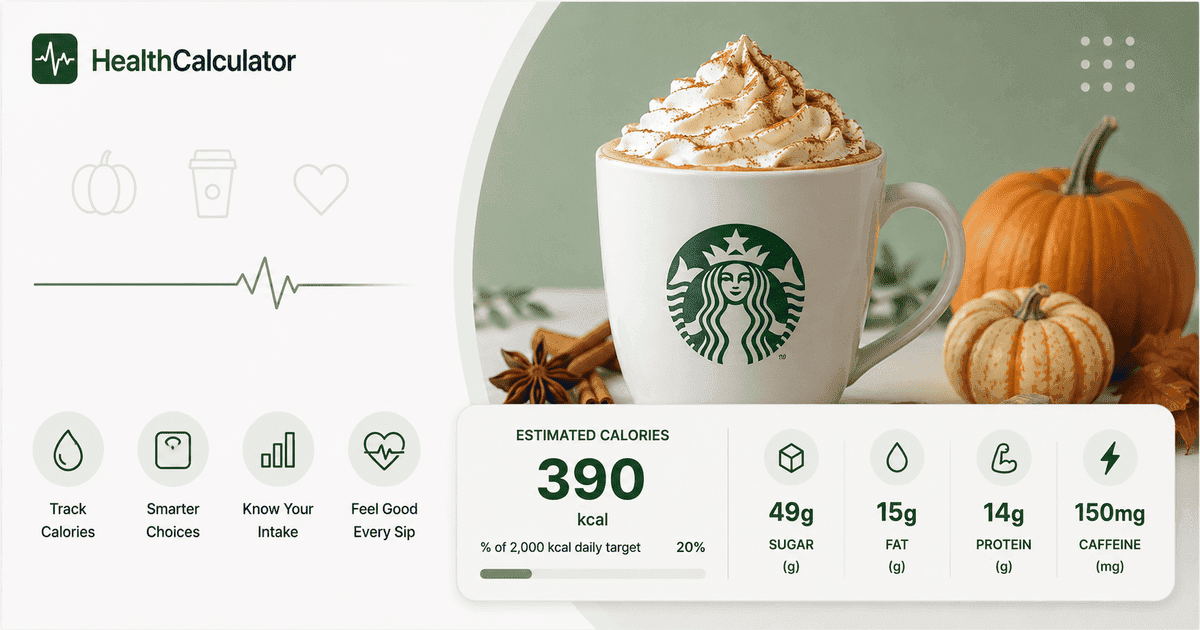
A Grande (16 oz) Pumpkin Spice Latte made with 2% milk has 310 calories and 48 g of sugar without whipped cream, or 390 calories and 49 g with it. A Tall runs 233 calories; a hot Venti runs 419. Your milk choice moves that number by up to 125 calories.
That’s the answer. Now here’s the part the menu board never tells you.
What’s actually in a Pumpkin Spice Latte
A PSL is not a coffee with pumpkin in it. It’s espresso, steamed milk, and pumpkin spice sauce — a sweetened condensed-milk base flavoured with cinnamon, nutmeg and clove. Whipped cream and pumpkin-pie topping go on last, unless you say otherwise.
The drink first appeared in 2003 and has anchored Starbucks’ autumn menu ever since. Nutritionally, the sauce is what matters. It carries more sugar and condensed milk than actual pumpkin purée, and it is the single biggest reason a PSL lands so far above a plain latte.
One number frames the whole thing: a Grande Caffè Latte with the same milk is 190 calories. The pumpkin sauce and the whip do the rest.
Pumpkin Spice Latte calories by size
Every figure below is for 2% milk, the Starbucks default. Run any variation through our Starbucks calorie calculator if your order looks different.
| Size | Volume | Calories (no whip) | With whip | Sugar (no whip) | Protein | Caffeine |
|---|---|---|---|---|---|---|
| Tall | 12 oz | 233 | 313 | 36 g | 11 g | 75 mg |
| Grande | 16 oz | 310 | 390 | 48 g | 14 g | 150 mg |
| Venti (hot) | 20 oz | 419 | 499 | 65 g | 19 g | 150 mg |
A quick note on that last column: a Tall gets one espresso shot, a Grande and a hot Venti both get two. So sizing up from Grande to Venti buys you 109 more calories and no extra caffeine at all. If you’re after the kick rather than the volume, that’s the wrong lever.
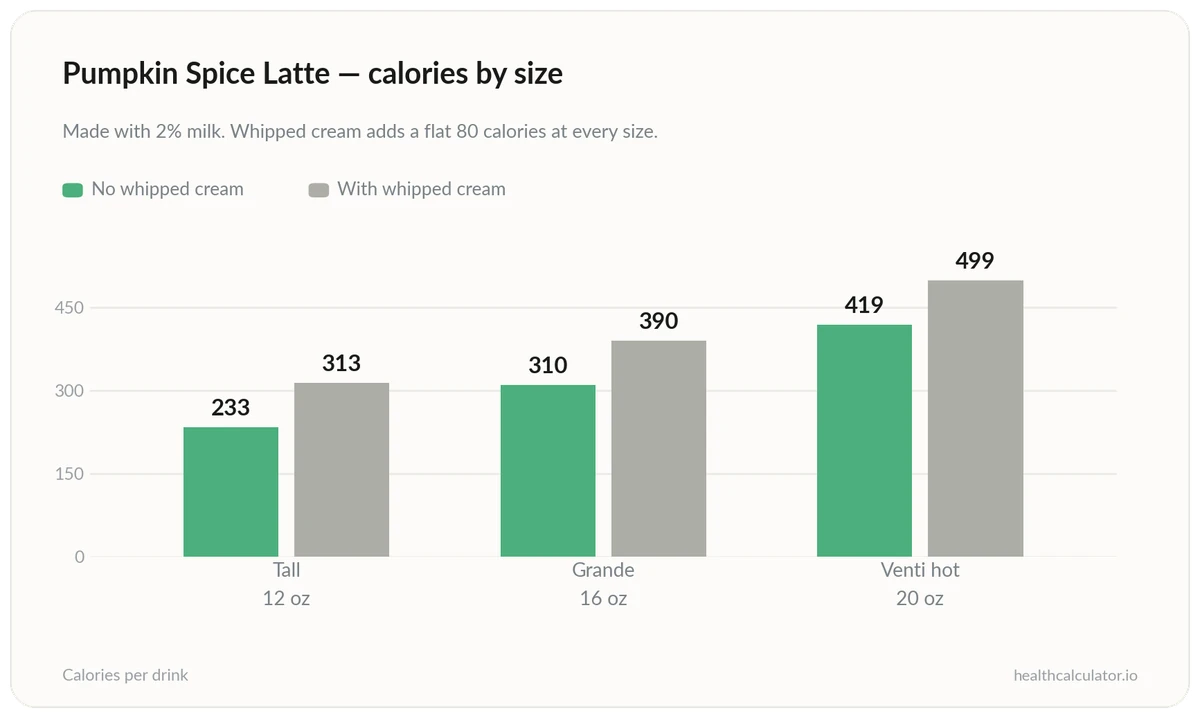
Look at the jump from Tall to Venti. Same drink, same shop — 186 extra calories, before anyone touches the whipped cream. Sizing up is the most expensive single decision on the menu, and it’s the one people make without thinking.
For context, the Center for Science in the Public Interest points out that a Grande PSL with whip beats a Starbucks Chocolate Croissant (300) and a Pumpkin Cream Cheese Muffin (350). You’d notice eating either of those. A drink slips past unnoticed.
Where those calories actually come from
This is the part I find genuinely useful, and almost nobody publishes it.
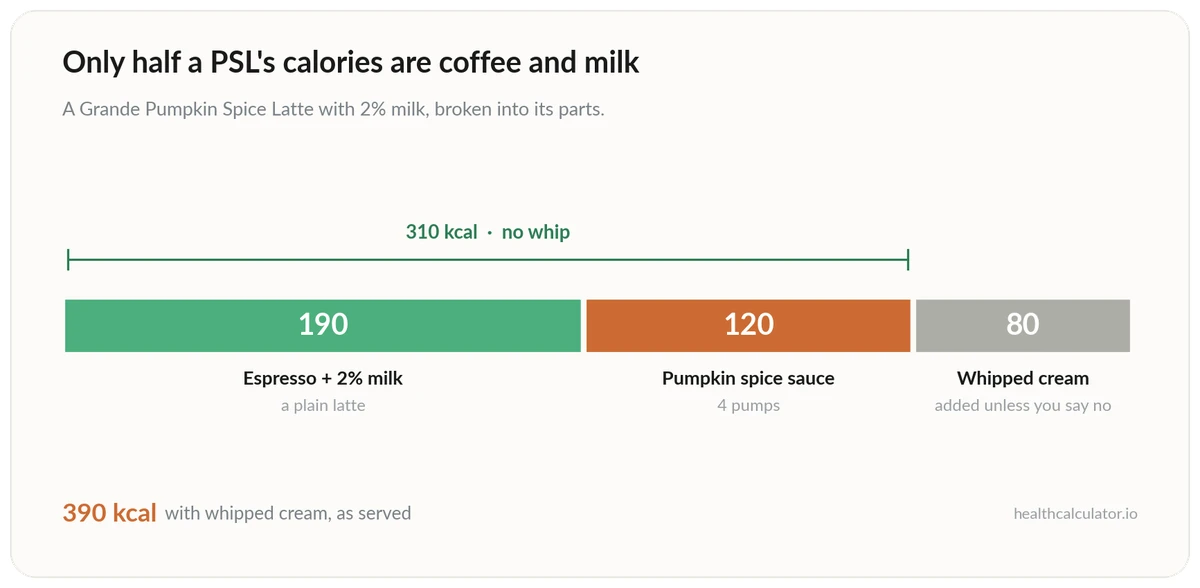
Roughly half a PSL’s calories are the latte — espresso and milk, which bring 14 g of protein and 50% of your daily calcium along with them. That half is food. It does something for you.
The other half is sauce and cream. About 120 calories of pumpkin spice sauce, then 80 more if you keep the whip.
Why does that split matter? Because it tells you exactly which lever to pull. Dropping the whip saves 80 calories and costs you nothing but texture. Swapping the milk can save up to 90, but it takes protein with it. Cutting sauce pumps hits the sugar hardest of all.
How your milk changes the number
Milk is the easiest swap at the till, and the results surprise most people.
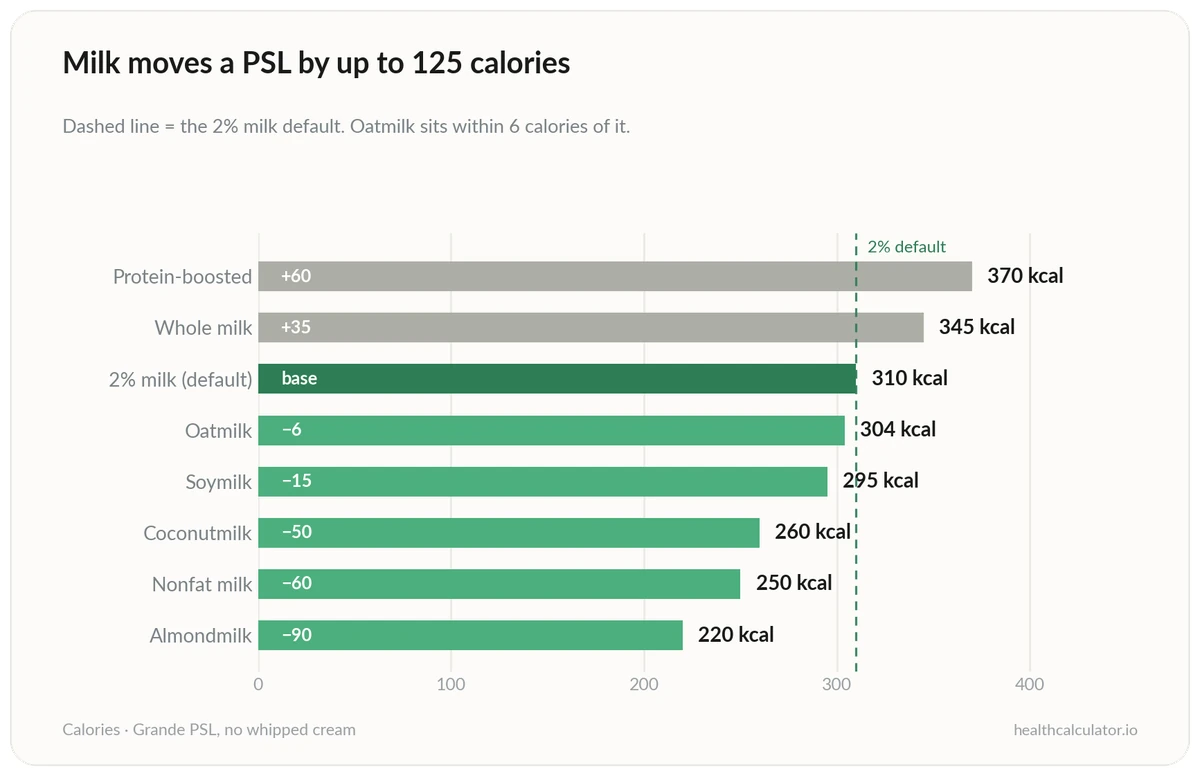
The full numbers:
| Milk | Calories | vs 2% | Sugar | Protein |
|---|---|---|---|---|
| Protein-boosted milk | 370 | +60 | 48 g | 29 g |
| Whole milk | 345 | +35 | 48 g | 14 g |
| 2% milk (default) | 310 | — | 48 g | 14 g |
| Oatmilk | 304 | −6 | 46 g | 8 g |
| Soymilk | 295 | −15 | 50 g | 12 g |
| Coconutmilk | 260 | −50 | 42 g | 3 g |
| Nonfat milk | 250 | −60 | 48 g | 14 g |
| Almondmilk | 220 | −90 | 35 g | 4 g |
| No milk | 135 | −175 | 30 g | 2 g |
Here’s the one that catches people out: oatmilk is not the light choice. It lands within six calories of 2% milk. It’s a fine swap for taste or for going dairy-free — it is not a calorie cut, and it gets sold as one constantly.
Almondmilk saves the most, at 90 calories and 13 grams of sugar. But look at the protein column before you commit: almond drops you from 14 g to 4 g. Nonfat saves 60 calories and keeps every gram of that protein, which is why I’d point most people there first.
Starbucks’ protein-boosted milk goes the other way — 60 more calories for 15 more grams of protein. Whether that’s a good trade depends entirely on what your daily target is, and our protein calculator will tell you that in about five seconds.
How to order a lighter PSL, step by step
You don’t have to give it up. Six steps, in the order that saves the most:
- Drop one size. Venti to Grande saves 109 calories. Grande to Tall saves 77. Nothing else on this list comes close.
- Switch to almondmilk. 90 calories and 13 g of sugar. Nonfat saves 60 and keeps the protein if that matters to you.
- Ask for two fewer pumps. Each pump of pumpkin sauce is about 30 calories and 6 g of sugar. Going from the standard four down to two takes a Grande from 310 to 250.
- Skip the whip. 80 calories and 8 g of fat, gone, without changing the flavour underneath.
- Add a shot, not a pump. An extra espresso shot costs about 5 calories and brings ~75 mg of caffeine. Sweetness costs far more.
- Order it iced if you’re going long. You’ll drink it slower and be less tempted to size up.
Stack the first four and a Venti with whip goes from 499 calories and 65 g of sugar to a Grande at 160 calories and 23 g of sugar. Same drink. Same shop. You never say the word “skinny.”
Case study: two people, one drink, 325 calories apart
Two friends order “a pumpkin spice latte.” Same store, same minute.
Order A — Venti, oatmilk, whipped cream. 490 calories and 63 g of sugar.
Order B — Tall, almondmilk, no whip. 165 calories and 26 g of sugar.
Same drink name. Order A is three times Order B — a 325-calorie gap and 37 g of sugar between two people standing in the same queue.
Neither of them did anything unusual. One sized up and kept the default toppings; the other sized down and changed two things. That’s the entire difference.
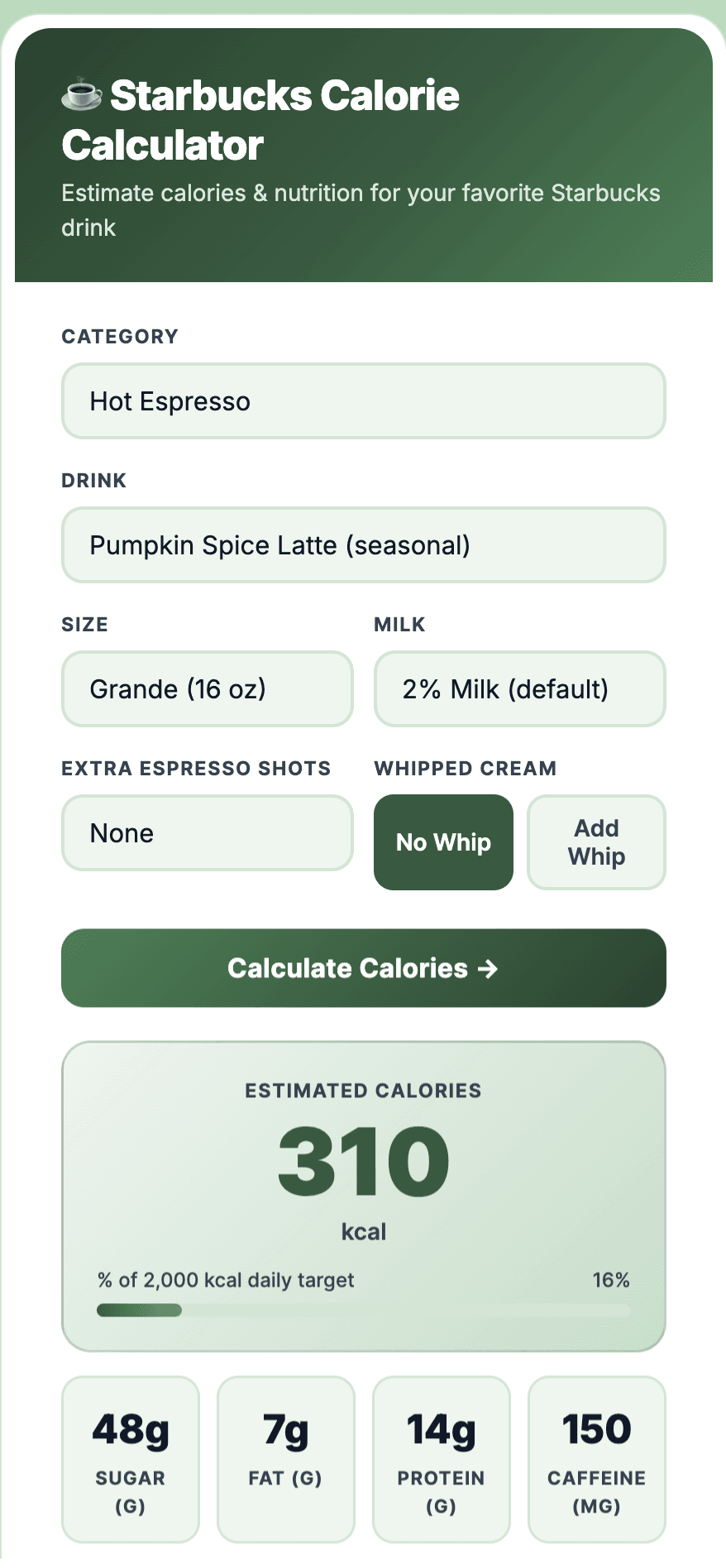
That’s the whole reason the tool exists. You can check your exact order in about ten seconds, and the number updates as you change the milk, the size, and the whip.
The sugar question
Calories are only half the story here. Sugar is the half that carries the health weight.
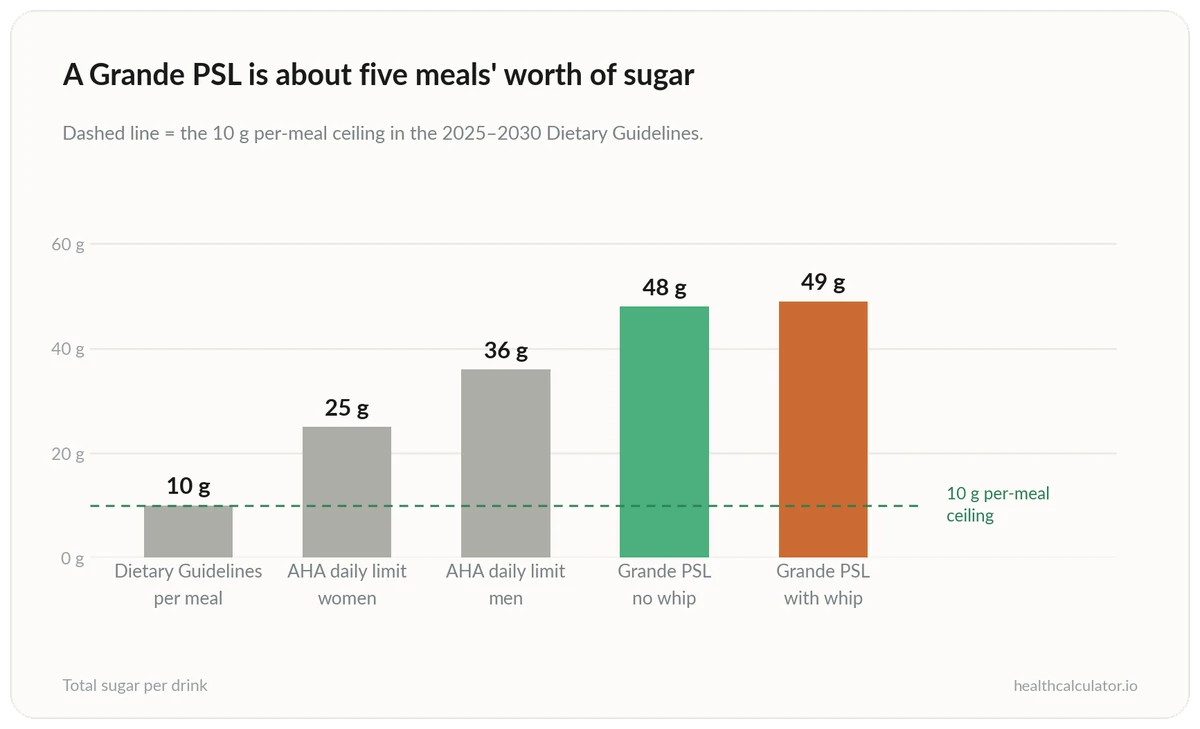
In January 2026, HHS and USDA released the 2025–2030 Dietary Guidelines for Americans, which took the firmest line yet: no single meal should contain more than 10 g of added sugars — about two teaspoons. A Grande PSL clears that roughly five times over.
The American Heart Association sets its ceiling daily rather than per meal, at no more than 6% of calories — about 25 g for women and 36 g for men. One Grande PSL with whip exceeds both.
Not all of that is added sugar, to be fair. Some is lactose from the milk. CSPI estimates roughly 7½ teaspoons (32 g) is genuinely added, from the sauce and the cream. That’s still above the AHA’s entire daily allowance for women.
And in March 2026, the AHA’s updated dietary guidance in Circulation named minimising added sugars in beverages and foods as one of nine defining features of a heart-healthy pattern — listing beverages first.
Why a drink hits differently than a slice of cake
Here’s the finding that changed how I think about seasonal drinks.
A 2024 prospective cohort in Frontiers in Public Health followed 69,705 Swedish adults aged 45–83 for over two decades, tracking seven separate cardiovascular outcomes. It separated sugar by source — something most sugar research never bothers to do.
The result was not what you’d expect. Sweetened beverage intake showed positive linear associations with ischemic stroke, heart failure, atrial fibrillation and abdominal aortic aneurysm. Sweetened treats — pastries, ice cream, chocolate, sweets — showed negative linear associations with all outcomes.
Read that again. The pastry didn’t track with risk. The drink did.
The authors are careful, and so am I: this is observational, treats-eaters may simply differ from non-eaters in ways the model can’t fully strip out, and they say plainly it warrants further investigation. But it lines up with the mechanism. Liquid sugar arrives fast, doesn’t fill you up, and doesn’t get compensated for at the next meal the way a solid does.
The scale is not small either. A 2025 modelling study in Nature Medicine attributed 2.2 million new type 2 diabetes cases and 1.2 million new cardiovascular disease cases worldwide in a single year to sugar-sweetened beverages — 9.8% and 3.1% of all new cases respectively.
None of which means you can never have a PSL. It means the honest framing is that a drink carrying nearly 50 grams of sugar is a dessert, and it’s better ordered knowingly. If blood sugar is already something you watch, our A1C calculator shows how average glucose maps onto your A1C.
PSL vs the rest of the autumn menu
If you want the season without the sugar load, the alternatives are not equal.
| Drink (Grande unless noted) | Calories | Sugar |
|---|---|---|
| Pecan Oatmilk Cortado (8 oz, standard) | 120 | 13 g |
| Pumpkin Cream Cold Brew | 250 | 31 g |
| Pumpkin Spice Latte, no whip | 310 | 48 g |
| Pumpkin Spice Latte, with whip | 390 | 49 g |
The Pecan Oatmilk Cortado is the quiet winner, and largely because its 8-oz “short” size is the standard pour rather than an upsell. Portion, again, doing most of the work.
Mistakes people make counting PSL calories
Assuming the menu number is your number. Posted figures are for the default build. Change the milk, the size or the whip and you’ve changed the drink.
Forgetting the whip is on by default. Unless you say “no whip,” it’s coming. That’s 80 calories nobody ordered on purpose.
Treating oatmilk as the healthy swap. It sits within six calories of 2% milk. If you want a real cut, almondmilk is the one.
Counting a PSL as a coffee. At 310–499 calories it competes with lunch, not with a flat white.
Assuming a bigger cup means more caffeine. A hot Venti and a Grande both get two shots — about 150 mg either way. The FDA puts 400 mg a day as the general ceiling for healthy adults, and pregnant people should follow their own clinician’s lower limit.
Order it, enjoy it, know what it is. That’s the whole trick.
This article is for informational purposes only and does not constitute medical advice or diagnosis. Nutrition values are estimates based on standard recipes and publicly available Starbucks data; actual values vary by store, barista and season. This page is not affiliated with, endorsed by, or sponsored by Starbucks Corporation. Always consult a qualified healthcare professional or registered dietitian for personalised guidance.
Frequently Asked Questions
A Grande (16 oz) Pumpkin Spice Latte with 2% milk has about 310 calories and 48 g of sugar without whipped cream, or 390 calories and 49 g of sugar with it. It also delivers 14 g of protein and half your daily calcium from the milk.
About 80 calories and 8 g of fat, at every size. Whipped cream is added by default unless you ask for it without, so saying “no whip” is the fastest cut you can make. It changes the texture but not the pumpkin flavour underneath.
A Grande with almondmilk, two fewer pumps and no whipped cream comes to about 160 calories and 23 g of sugar — roughly half a standard Grande. A Tall built the same way lands near 120. Size, milk and pump count each move the number more than most people expect.
A Grande carries 48–49 g of total sugar, of which roughly 32 g is added sugar from the pumpkin sauce and cream. The 2025–2030 Dietary Guidelines cap added sugar at 10 g per meal, so one Grande is about five times that ceiling.
Barely — oatmilk lands within six calories of 2% milk in a Grande PSL, so it is not the light option most people assume. Almondmilk saves the most at about 90 calories, while nonfat saves 60 and keeps all 14 g of protein. Oatmilk is a taste and dairy-free choice, not a calorie cut.
A Grande contains about 150 mg from two espresso shots; a Tall has roughly 75 mg from one. The FDA cites 400 mg per day as generally safe for healthy adults, but pregnant people and anyone with a heart condition should follow their clinician’s lower limit.
On calories, a Grande PSL with whip beats a Starbucks Chocolate Croissant. In one large Swedish cohort, sweetened beverages tracked with several cardiovascular outcomes while sweetened treats did not — though that study is observational and the authors call for more research.
Yes, if you budget for it. A Tall with almondmilk and no whip is about 165 calories — snack territory. A Venti with oatmilk and whip is roughly 490, which competes with a meal. Size, pump count and whipped cream move the number far more than the milk alone.
Sources
Every figure on this page is drawn from government health statistics, industry nutrition data or peer-reviewed research. Last verified August 2026.
- Moyer L. How much sugar is in a pumpkin spice latte? Nutrition Action, Center for Science in the Public Interest; updated September 2025.
- Eat This Much. Starbucks Pumpkin Spice Latte with 2% Milk and No Whip, Grande — Nutrition Facts. Eat This Much Inc.; accessed August 2026.
- U.S. Department of Health and Human Services & U.S. Department of Agriculture. Dietary Guidelines for Americans, 2025–2030. HHS/USDA; January 2026.
- American Heart Association. Added Sugars. American Heart Association; last reviewed August 2, 2024.
- Lichtenstein AH, Khera A, Anderson CAM, et al. 2026 Dietary Guidance to Improve Cardiovascular Health: A Scientific Statement From the American Heart Association. Circulation. 2026 Mar 31. doi:10.1161/CIR.0000000000001435.
- Janzi S, Ramne S, González-Padilla E, et al. Added sugar intake and its associations with incidence of seven different cardiovascular diseases in 69,705 Swedish men and women. Frontiers in Public Health. 2024;12:1452085. doi:10.3389/fpubh.2024.1452085.
- Lara-Castor L, O’Hearn M, Cudhea F, et al. Burdens of type 2 diabetes and cardiovascular disease attributable to sugar-sweetened beverages in 184 countries. Nature Medicine. 2025;31:552–564. doi:10.1038/s41591-024-03345-4.
- U.S. Food & Drug Administration. Spilling the Beans: How Much Caffeine is Too Much? FDA; content current as of August 28, 2024.