
Water Intake Calculator
Last updated:

Muhammad Hamza is the founder of Health Calculator, dedicated to building accurate and easy-to-use health tools for everyone.

Dr. Farah Taqueer is a qualified Pediatrician based in Karachi. She reviews all health calculators on this site for clinical accuracy and medical correctness.
Our Water Intake Calculator gives you a personalised daily hydration target based on your weight, age, gender, activity level, and climate, and displayed in fluid ounces, cups per day, 500 ml bottles, and ounces per hour. Unlike the outdated "8 glasses a day" rule, which has no real scientific basis for any one person, your number is built from the same Dietary Reference Intake logic the National Academies of Sciences, Engineering, and Medicine (NASEM) uses to set adult water needs at roughly 2.7 to 3.7 liters a day.
What Is Daily Water Intake?
Water intake is the amount of fluid a person needs each day to replace water lost through breathing, sweating, urination, and digestion. Most adults require between 2.7 and 3.7 liters daily, but needs vary by weight, activity level, climate, and age. Daily water intake is the total fluid your body needs to replace losses through:
- Breathing (400–500 ml lost overnight alone)
- Sweating (varies by activity and climate)
- Urination (primary fluid loss pathway)
- Digestion (saliva, gastric juices, bile)
Your body is approximately 60% water by weight. Because needs vary by body size, activity, and environment, a single universal recommendation is not accurate for most people.
Hourly Water Intake (Oz Per Hour)
Your hourly water intake (oz per hour) shows how much water you should drink each hour to evenly meet your daily hydration needs.
How This Water Intake Calculator Works (The Formula Behind Your Number)
Most water calculators multiply your weight by a single flat rate. This one runs four adjustments on top of your weight so the result reflects your real situation. Here is the exact formula:
Daily water (ml) = weight in kg × base rate × gender factor × activity factor × climate factor
The result is rounded to the nearest 100 ml, then shown in liters, ounces, cups, and bottles.
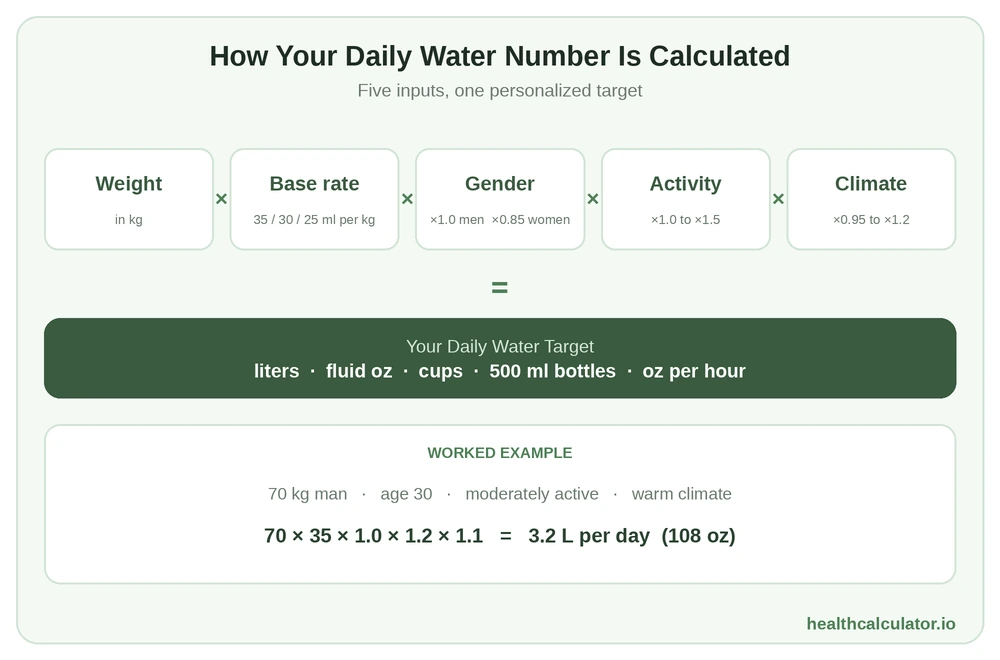
Base rate by age. Older adults carry less total body water and their kidneys concentrate urine less efficiently, so the per-kg rate eases down with age, following standard clinical fluid guidance:
| Your age | Base rate the calculator uses |
|---|---|
| 18 to 55 | 35 ml per kg |
| 56 to 65 | 30 ml per kg |
| 66 and older | 25 ml per kg |
Gender factor. Muscle holds more water than fat, and men carry more muscle on average, so a woman's baseline is set at 85% of a man's (a factor of 0.85 for women, 1.0 for men).
Activity factor. More training means more sweat, so the multiplier climbs with your weekly load: sedentary 1.0, lightly active 1.1, moderately active 1.2, very active 1.35, and extremely active (athlete or two sessions a day) 1.5.
Climate factor. Heat and dry air pull water out of you faster: temperate 1.0, warm or humid 1.1, hot or dry 1.2, and cold with indoor heating 0.95.
A Worked Example You Can Reproduce
Punch in a 70 kg man, age 30, moderately active, warm or humid climate:
70 × 35 × 1.0 × 1.2 × 1.1 = 3,234 ml, which rounds to 3.2 L per day.
The calculator then shows that as 108 fl oz, 14 cups, 6.4 bottles (500 ml each), and 6.8 oz per hour. Notice that 3.7 L lands right on the NASEM benchmark for adult men, which is a good sanity check that the formula is grounded in real guidance rather than guesswork. Switch the same person to female and the target eases to 2.7 L (91 oz), reflecting that 0.85 factor.
Your Result Category, Explained
After you calculate, the tool drops your number into one of four bands and moves the marker along the scale. Here is what each band means, using the same thresholds built into the calculator:
| Your daily target | Category | What it tells you |
|---|---|---|
| Under 1.5 L | Low Intake | On the low side. This usually shows up for lighter, older, or very sedentary users, so treat it as a floor, not a ceiling. |
| 1.5 to 2.5 L | Adequate | A solid hydration level for most average-build adults in a mild climate. |
| 2.5 to 4.0 L | Optimal | Well matched to a larger frame, an active lifestyle, or a warm environment. |
| 4.0 L and above | High Intake | Genuinely high. Make sure it lines up with heavy training or extreme heat rather than an over-estimate. |
Recommended Daily Water Intake by Weight, Age, and Gender
The NASEM figures below represent total daily fluid from all sources i-e beverages and food, for healthy sedentary adults in a temperate climate. Your personal target from this calculator will be higher if you exercise, live in a warm environment, or are above average body weight.
| Group | Total Daily Fluid | From Beverages |
|---|---|---|
| Men (19+) | 3.7 L (125 oz) | 3.0 L (101 oz) |
| Women (19+) | 2.7 L (91 oz) | 2.2 L (74 oz) |
| Pregnant | 3.0 L (101 oz) | 2.3 L (78 oz) |
| Breastfeeding | 3.8 L (128 oz) | 3.1 L (105 oz) |
The 2025 to 2030 Dietary Guidelines for Americans, released in January 2026, reinforce the same message: make water, still or sparkling, your default drink and skip the sugar-sweetened stuff.
How to Use Your Oz-Per-Hour Result to Pace Hydration
Why oz-per-hour matters: Drinking your daily quota in one sitting (or catching up at 9 PM) overwhelms your kidneys and dilutes blood sodium. Instead, spreading intake evenly across waking hours:
- Maintains steady blood hydration throughout the day
- Prevents "catch-up" spikes and stomach bloating
- Reduces nighttime bathroom trips
- Improves sustained energy and focus
Example: A 70 kg person, age 30, moderate activity, warm climate gets 3.2 L/day (108 oz). That's 0.4 L/hour or 6.8 oz/hour across 16 waking hours. Drink a glass (~12 oz) every hour, and you're done without effort. Compare this to "drink 107 oz today", vague and easy to mess up.
If you want to layer weight goals on top of hydration, our BMI calculator pairs naturally with this one.
Signs and Symptoms of Dehydration
Losing just 1% to 2% of your body weight in fluid is enough to dent your concentration, mood, and physical performance, and it often happens before you feel thirsty, according to the National Institutes of Health. That is the whole problem with waiting for thirst: it is a late alarm, not an early one.
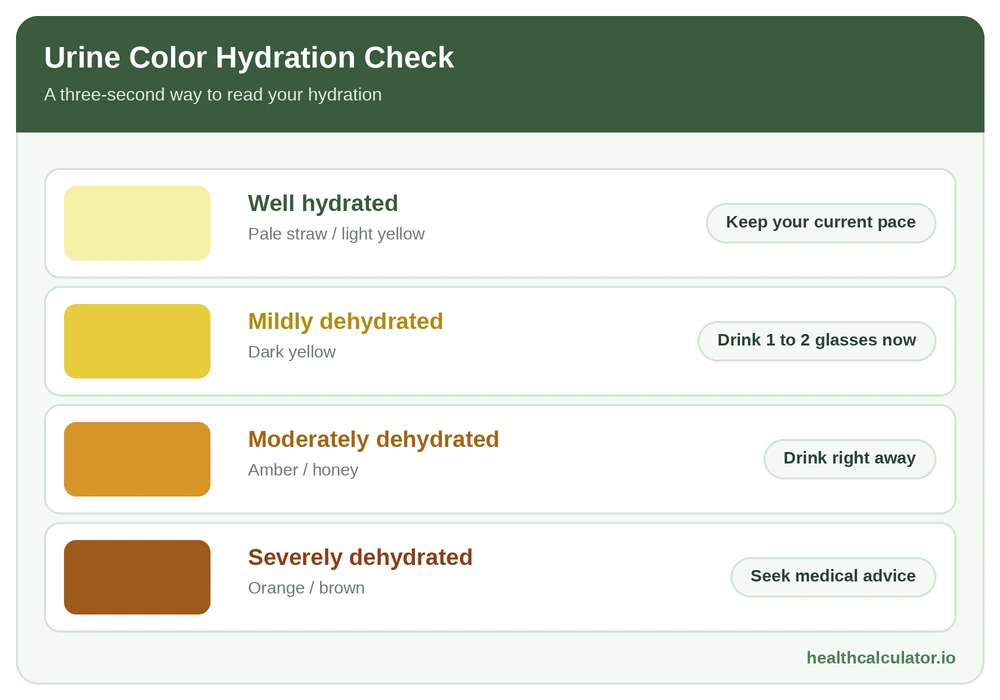
| Urine Color | Hydration Status | Action |
|---|---|---|
| Pale straw / light yellow | Optimally well-hydrated | Maintain intake |
| Dark yellow | Mildly dehydrated | Drink 1–2 glasses now |
| Amber/honey | Moderately dehydrated | Drink immediately |
| Orange / brown | Severely dehydrated | Seek medical advice |
Early Stage Symptoms
Early dehydration symptoms include thirst, fatigue, dry mouth, mild headache, and dizziness on standing. As fluid loss increases beyond 3–5% of body weight, symptoms progress to persistent headache, muscle cramps, rapid heartbeat, and reduced urination.
What Causes Low Daily Water Intake?
Common causes of low daily water requirement include relying on thirst alone, alcohol or excess caffeine, air travel (cabin humidity as low as 10–20%), and indoor heating. Uncontrolled diabetes (excess urination or polyuria), fever, and diuretic medications significantly increase hydration needs above the calculator baseline. Severe dehydration — confusion, no urination for 8+ hours, loss of consciousness is a medical emergency requiring immediate care.
Water Intake During Exercise: How Much Extra Do You Need?
When you exercise, fluid loss through sweat can reach 0.5–2 litres per hour, depending on intensity, temperature, and individual sweat rate. Failing to replace this fluid reduces blood volume and impairs performance even at 2% dehydration, per the American College of Sports Medicine (ACSM).
| When | How Much | Why |
|---|---|---|
| 2 hours before | 400–600 ml (14–20 fl oz) | Pre-loads fluid stores before sweat loss begins |
| Every 30 min during | 350 ml (12 oz) | Replaces active sweat loss; sip every 15–20 min |
| After — per 0.5 kg lost | 500 ml (16 oz) | Restores body weight fluid lost during session |
| Sessions over 60–90 min | Water + electrolytes | Plain water alone risks hyponatremia (low blood sodium) |
If you are dialing in performance nutrition, it is worth matching hydration to your fuel: our protein calculator helps you set intake around your training load.
Can Drinking More Water Help With Weight Loss?
Water will not melt fat on its own, but Yes, water is one of the most evidence-supported, zero-calorie tools for supporting weight management. A 2024 systematic review in JAMA Network Open pulled together 18 randomized trials and found that increasing water intake consistently produced greater weight loss than control conditions, especially when a glass came before meals. It works through three distinct mechanisms.
Mechanism 1: Pre-Meal Appetite Suppression
Drinking 500 ml (17 oz) 30 minutes before each meal reduces calorie intake at that meal. Studies show this can temporarily boost resting metabolic rate by 24–30% for up to 90 minutes after consumption.
Mechanism 2: Replacing Caloric Drinks
Swapping two sugary beverages per day with water saves 240–300 calories daily without changing food intake. Use our Starbucks calorie calculator to track your total energy balance.
Mechanism 3: Supporting Fat Metabolism
Water supports lipolysis (the metabolic breakdown of stored fat), a process that requires water molecules to function efficiently. Dehydration slows this process.
Bottom line: Water is not a standalone weight-loss solution, but it is a genuinely effective, zero-cost support strategy. Use this calculator alongside our BMI Calculator to track both hydration and weight-related health metrics.
Special Hydration Needs
If any of the following apply to you, treat your calculator result as a minimum starting point:
- Pregnancy — Blood volume increases by ~50%. Add at least 300 ml/day above your calculator result. Adequate fluid reduces the risk of UTIs, constipation, and premature contractions.
- Breastfeeding — Breast milk is ~88% water. Total daily need is approximately 3.8 L/day; add 700 ml–1.1 L above baseline and drink a full glass with every nursing session.
- Illness / Fever — Add approximately 200 ml per degree of temperature rise above normal. Use an oral rehydration solution (ORS) if vomiting or diarrhoea is present.
- Older Adults (51+) — Thirst sensitivity declines with age. Drink on a fixed schedule — a glass with each meal and one between meals — regardless of whether you feel thirsty.
- Kidney Health — If you have kidney disease or are concerned about kidney function, our GFR Calculator can assess filtration rate. Adequate hydration is the primary strategy for preventing kidney stones.
Water and Healthy Aging
Here is a finding worth knowing. An NIH study of more than 11,000 adults, published in eBioMedicine, found that people whose blood sodium ran high (a marker of running slightly under-hydrated over years) were biologically older than their age and carried up to a 64% higher risk of chronic conditions like heart failure, stroke, and diabetes, per the National Institutes of Health. The takeaway is not to flood yourself with water, but that hitting a sensible daily target consistently, year after year, is one of the simplest long-game habits for your health.
Tips for Meeting Your Daily Water Goal
- Start your morning with a full glass — you lose 400–500 ml overnight through breathing alone.
- Use your oz-per-hour result to pace intake evenly across waking hours instead of catching up at night.
- Carry a 500 ml measured bottle — it matches the bottle-per-day output your calculator shows.
- Drink before every meal — it supports digestion, reduces appetite, and builds a consistent habit.
- Hot days above 30°C (86°F) — add at least 500–750 ml above your standard daily target.
- Coffee and tea count toward your total at up to 3–4 cups/day, since a PLOS ONE study found moderate coffee hydrates about as well as water.
- Sparkling water without added sugar hydrates equally to still water and is a valid alternative.
Key Takeaways
- Your daily water requirement is personal — driven by weight, age, gender, activity, and climate. The "8 glasses a day" rule has no specific scientific basis for individuals.
- Men need ~3.7 L and women ~2.7 L of total daily fluid per NASEM guidelines — your calculator result adjusts this for your specific inputs.
- Thirst is a late dehydration signal — by the time you feel it, you may have already lost 1–2% of body weight in fluid.
- Pale straw urine = well hydrated. Amber or darker = drink water immediately.
- Add 12 oz per 30 minutes of exercise; use your oz-per-hour result to pace intake evenly all day.
- Severe dehydration with confusion, rapid heartbeat, or no urination for 8+ hours requires emergency medical care.
Medical Disclaimer: This calculator is for educational and screening purposes only and does not constitute medical advice, diagnosis, or treatment. Always consult a qualified healthcare professional for personalized medical guidance.
Frequently Asked Questions About Daily Water Intake
Most healthy adults need 2.7–3.7 litres (91–125 fl oz) of total daily fluid, per the National Academies of Sciences, Engineering, and Medicine (NASEM) — roughly 9–13 cups for women and 11–15 cups for men. Your personal target depends on body weight, activity, climate, and age. Use this calculator above for a personalized daily number.
A practical baseline is 30–35 ml per kg of body weight for sedentary adults in a temperate climate. Example: A 70 kg person needs approximately 2.1–2.45 L at baseline before adjusting for exercise or heat. This calculator refines that estimate using all your personal factors.
For many sedentary women in a cool climate, 2 litres is close to adequate. For most men, active individuals, or anyone in a warm environment, it falls short — the NASEM total of 2.7–3.7 L includes food fluid, meaning your weight and activity determines the answer.
Yes, caffeinated coffee and tea have a net positive hydration contribution at up to 3–4 cups per day. Plain water should remain your primary source, but you do not need to subtract coffee from your daily total.
Drink 400–600 ml two hours before exercise, 350 ml every 30 minutes during activity, and 500 ml per 0.5 kg of body weight lost afterward. For sessions over 60 minutes, add electrolytes alongside water to replace what is lost in sweat and prevent hyponatremia.
Drink 500 ml (17 oz) 30 minutes before each meal to reduce appetite and temporarily boost metabolic rate. Water also supports fat breakdown and saves 240–300 calories/day when it replaces sugary drinks.
In temperatures above 30°C (86°F), add at least 500–750 ml to your standard daily target — up to 1–2 litres more in extreme heat. Re-run this calculator with the "Hot / Dry" or "Warm / Humid" climate setting for an adjusted number.
Yes, excessive water intake can lead to hyponatremia (dangerously low blood sodium), which causes nausea, confusion, and in severe cases, seizures or coma. This is rare and typically occurs only with extreme intake (>10+ liters per day). Follow your calculator result and drink to thirst; you cannot accidentally over hydrate with normal amounts.