
Corrected Calcium Calculator
Last updated:

Muhammad Hamza is the founder of Health Calculator, dedicated to building accurate and easy-to-use health tools for everyone.

Dr. Farah Taqueer is a qualified Pediatrician based in Karachi. She reviews all health calculators on this site for clinical accuracy and medical correctness.
If your blood calcium came back low, low albumin is often the real reason, not a genuine calcium problem. This corrected calcium calculator uses the Payne formula to estimate what your total calcium would read if your albumin were normal, so you can tell a true calcium issue apart from a lab artifact called pseudohypocalcemia. Enter your total calcium and serum albumin in the calculator fields, pick mg/dL or mmol/L, and you get your corrected value instantly with a plain reading of where it falls.
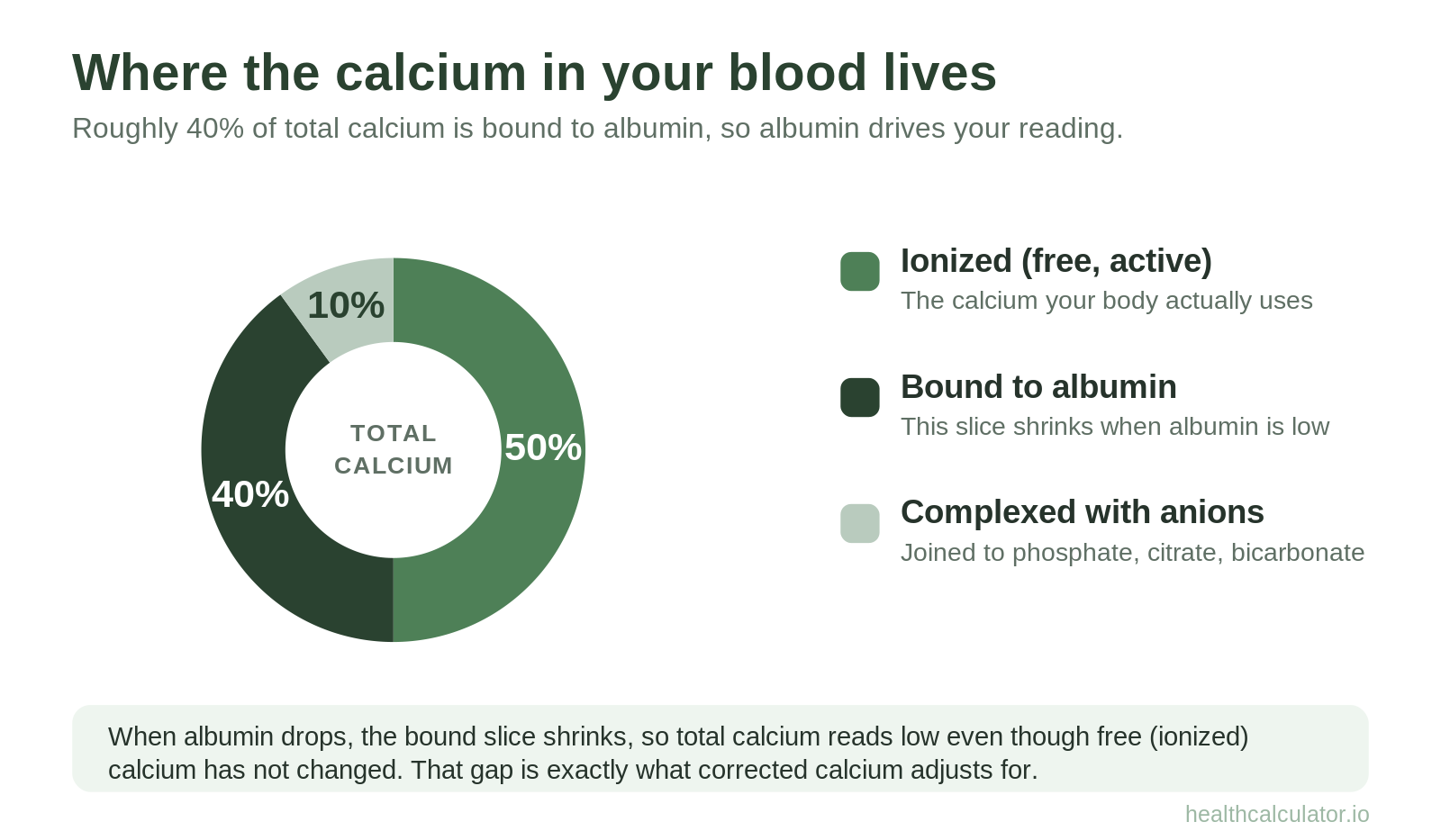
Here is the one fact that explains the whole thing: about 40% of the calcium in your blood is bound to albumin. When albumin drops, your total calcium reading falls with it, even when the active (ionized) calcium your body actually uses is perfectly fine.
What Is Corrected Calcium and Why It Matters
What is corrected calcium?
Corrected calcium is your total calcium adjusted for an abnormal albumin level. Because roughly 40% of blood calcium rides on albumin, a low albumin makes total calcium look lower than your body's active calcium really is. The Payne formula adds that missing amount back, estimating your calcium as if albumin sat at a normal 4.0 g/dL. It is the correction hospitals, nephrology teams, and internal medicine doctors reach for most often.
What is albumin, and why does it matter here?
Albumin is the most common protein in your blood, made by your liver, and it acts like a taxi for calcium, hormones, and medicines. Since it carries close to 40% of your calcium, your albumin level directly shapes your total calcium reading. Your liver builds albumin from the protein in your diet, so if you also track nutrition, our protein intake calculator is a useful companion. Normal albumin runs about 3.5 to 5.0 g/dL (35 to 50 g/L), and the calculator uses 4.0 g/dL as its reference point.
How corrected calcium affects your health
Calcium keeps your body running in ways you never notice until it drifts off. It supports your bones and muscle contraction, so low calcium can bring cramps and weakness. It steadies your heart rhythm, and an abnormal level raises the risk of arrhythmia. Calcium also carries nerve signals, and a real deficiency can trigger tingling or, rarely, seizures. Skip the correction and a low albumin can hide a genuine calcium problem or, just as costly, send someone toward treatment they never needed. Getting the corrected number right keeps those decisions grounded.
How to Calculate Corrected Calcium
The Payne formula explained
The Payne formula has anchored this calculation since R.B. Payne and colleagues published it in the British Medical Journal in 1973. They noticed that every 1 g/dL drop in albumin below 4.0 g/dL pulls total calcium down by roughly 0.8 mg/dL, and the formula simply adds that back:
Conventional units (mg/dL): Corrected calcium = Measured total calcium + 0.8 × (4.0 − serum albumin in g/dL)
SI units (mmol/L): Corrected calcium = Measured total calcium + 0.02 × (40 − serum albumin in g/L)
The normal albumin value baked into the formula is 4.0 g/dL (40 g/L). If your lab reports its own reference range, check with your doctor, since a different baseline shifts the corrected result.
Worked example (the exact numbers the tool shows you)
Say your labs come back like this, matching the sample values in the calculator:
- Total calcium: 8.2 mg/dL (looks borderline-low)
- Serum albumin: 2.8 g/dL (low)
Run the math:
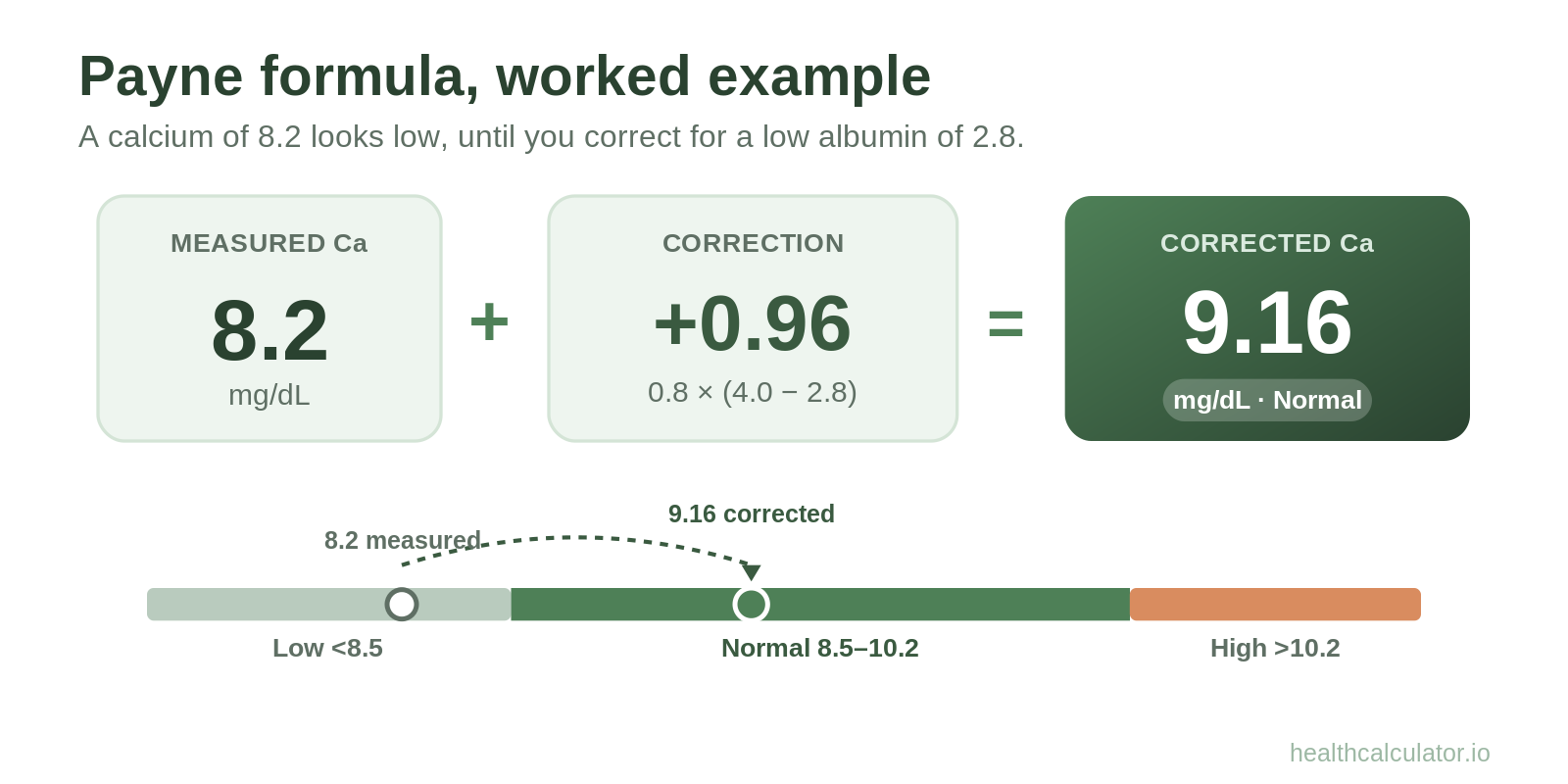
Corrected calcium = 8.2 + 0.8 × (4.0 − 2.8) = 8.2 + 0.8 × 1.2 = 8.2 + 0.96 = 9.16 mg/dL → Normal
That raw 8.2 looked like it was slipping under the line. Once you account for the low albumin, corrected calcium lands at 9.16, comfortably inside the normal 8.5 to 10.2 mg/dL band. The correction added +0.96, which is exactly what the tool displays: 9.16 as your result, 8.20 as measured calcium, and +0.96 as the correction.
Prefer SI units? The same case in mmol/L (calcium 2.05 mmol/L, albumin 28 g/L) works out to 2.05 + 0.02 × (40 − 28) = 2.29 mmol/L, again squarely normal.
Corrected Calcium vs Ionized Calcium
Corrected calcium is a calculated estimate. Ionized calcium is the free, biologically active calcium your body uses, measured directly. Here is how they compare:
| Corrected Calcium | Ionized Calcium |
|---|---|
| Calculated from total calcium and albumin | Measured directly in the lab |
| An estimate | Gold standard for accuracy |
| Low cost, on almost every basic panel | More expensive, needs special handling |
| Widely available | Not offered everywhere |
If your corrected result is borderline or your situation is complicated (kidney disease, critical illness, an acid-base problem), ionized calcium is the number to trust.
Corrected Calcium Levels: Categories, Symptoms, and Common Causes
Your calculator sorts the corrected result into one of four bands. Here is what each one means, matched to the reading the tool gives you:
| Corrected Ca (mg/dL) | mmol/L | Category | What you might notice | Common causes |
|---|---|---|---|---|
| Below 8.5 | Below 2.12 | Hypocalcemia (Low) | Tingling around the mouth or fingertips, muscle cramps or spasms, and in severe cases an irregular heartbeat or seizures | Vitamin D deficiency, hypoparathyroidism, kidney disease, malabsorption, low magnesium, certain medications |
| 8.5 to 10.2 | 2.12 to 2.55 | Normal | No calcium-related symptoms; normal nerve, muscle, heart, and bone function | Healthy parathyroid, kidney, and vitamin D balance |
| 10.2 to 12 | 2.55 to 3.0 | Hypercalcemia (High) | More thirst and urination, constipation, fatigue, and brain fog | Primary hyperparathyroidism, cancer, vitamin D excess, thiazide diuretics, long immobilization |
| Above 12 | Above 3.0 | Severe (Urgent) | Nausea, vomiting, confusion, marked weakness, irregular heartbeat | Usually hyperparathyroidism or malignancy; treat as urgent and seek care right away |
Reference ranges vary a little between labs, so match your result to your own report. Cleveland Clinic grades hypercalcemia as mild (10.5 to 11.9 mg/dL), moderate (12.0 to 13.9), and a hypercalcemic crisis at 14.0 and above. That is why the calculator flags anything over 12 mg/dL (3.0 mmol/L) as severe and tells you to seek immediate care.
Important Limitations of the Corrected Calcium Formula
The Payne formula is useful and everywhere, but it is an estimate, and recent research has been blunt about where it falls short.
It may not beat the raw number. In a 2025 population study of 22,658 adults published in JAMA Network Open, plain unadjusted total calcium actually tracked directly measured ionized calcium slightly better (R² of 71.7%) than the simplified Payne correction did (R² of 68.9%). The authors concluded that routine albumin adjustment adds cost and a real risk of misclassifying calcium status, often with little to gain. A 2021 Journal of Hospital Medicine review made the same point about relying on it out of habit.
It is unreliable in kidney disease. In chronic kidney disease (CKD) and end-stage renal disease, the formula performs poorly. If your kidneys are involved, ask your nephrologist about ionized calcium instead. You can gauge kidney function first with our GFR calculator.
It struggles in critical illness. In ICU patients, corrected calcium tracks true ionized calcium poorly (area under the curve around 0.69 for spotting critically low calcium), so intensive care teams measure ionized calcium directly.
It is a screening step, not a diagnosis. The formula cannot see your acid-base status, magnesium, phosphate, vitamin D, PTH, or kidney function. A real diagnosis needs those, your symptoms, and clinical judgment.
When Should You Seek Medical Attention?
Always read your corrected calcium next to your symptoms and history, not on its own. Get urgent medical help if an abnormal level comes with any of these:
- Seizures
- Confusion or a change in mental state
- Severe muscle cramps, spasms, or tetany
- Chest pain
- Palpitations or an irregular heartbeat
- Fainting or loss of consciousness
- Severe weakness or trouble breathing
Even with milder signs, check in with your provider if your corrected calcium sits outside the normal range, especially if you have kidney disease, liver disease, a parathyroid disorder, or take medications that affect calcium.
Why Use Our Corrected Calcium Calculator
It runs both conventional (mg/dL) and SI (mmol/L) units, so you can enter your labs exactly as they are printed. Results are instant, and every calculation happens in your browser, so nothing you type is sent anywhere or stored. There is no sign-up and no cost, and each result comes with a clear category and the same correction breakdown a clinician would read. Browsing other numbers from your panel? Our full set of health calculators covers kidney, metabolic, and nutrition metrics too.
Corrected Calcium Should Not Replace Medical Advice
This calculator is for informational and screening purposes only, not diagnosis. It cannot account for your acid-base status, magnesium, phosphate, vitamin D, PTH, or kidney function. If your corrected calcium comes back abnormal:
- Book a lab appointment and ask for ionized calcium if it is available
- Talk your symptoms through with your doctor
- Do not start calcium or vitamin D supplements on your own
- Always confirm with a qualified healthcare professional
Frequently Asked Questions
When albumin is low, most of the "missing" calcium is simply the unbound portion that rides on albumin. That drop lowers your total calcium reading without touching the free, ionized calcium your body actually uses. The corrected calcium formula estimates what your total would be at normal albumin. If your ionized calcium is normal but total calcium is low, that points to pseudohypocalcemia rather than a true deficiency, which is why direct ionized calcium is the gold standard.
No. Do not start supplements from a calculator result. If your corrected calcium is low and you have symptoms, see a doctor, who will find the cause (vitamin D deficiency, kidney disease, hypoparathyroidism, and others) and treat it properly. Taking more calcium than you need can raise your risk of kidney stones and may affect heart health.
Corrected calcium is a calculated estimate of what your total calcium would be at normal albumin, an indirect adjustment. Ionized calcium is the free, biologically active calcium in your blood, measured directly. Ionized calcium is more accurate and more physiologically relevant, especially in kidney disease, critical illness, and acid-base disorders. When it is available, doctors prefer it.
No. The Payne formula is unreliable in chronic kidney disease and end-stage renal disease. If you have kidney disease, ask your nephrologist or lab about ionized calcium or a correction method built for renal patients. Do not lean on the standard Payne formula alone in that setting.
Hypoalbuminemia is an abnormally low serum albumin, usually below 3.5 g/dL (35 g/L). Albumin is made by the liver and transports nutrients, medicines, and hormones. Low levels show up in liver disease, malnutrition, nephrotic syndrome, severe infection or sepsis, and chronic illness. Correcting calcium matters most here, because the gap between total and true calcium is widest when albumin is at its lowest.
No. This is a screening and educational tool. A real diagnosis needs clinical context: your symptoms, an exam, a full metabolic panel (including magnesium, phosphate, vitamin D, PTH, and kidney function), and sometimes ionized calcium. Always confirm with your healthcare provider.
Not always. Studies have shown that corrected calcium formulas often perform poorly in critically ill patients. Factors such as acid-base disturbances, sepsis, organ failure, fluid shifts, and severe hypoalbuminemia can alter the relationship between albumin and calcium. In intensive care settings, corrected calcium may not accurately reflect true calcium status. For this reason, ionized calcium measurement is generally preferred in ICU patients whenever available.
Nephrologists often prefer ionized calcium because it measures the biologically active form of calcium directly rather than estimating it from total calcium and albumin levels. In patients with chronic kidney disease (CKD), end-stage renal disease (ESRD), or significant metabolic abnormalities, corrected calcium formulas can be inaccurate and may overestimate calcium levels. Direct ionized calcium measurement provides a more reliable assessment and helps guide treatment decisions.
Yes. Low albumin can cause pseudohypocalcemia, a situation in which total calcium appears low even though ionized calcium remains normal. Because approximately 40% of calcium in the bloodstream is bound to albumin, a decrease in albumin reduces the measured total calcium concentration. Corrected calcium calculations help account for this effect, but ionized calcium testing remains the most accurate way to determine whether true hypocalcemia is present.
References
Reviewed by Dr. Farah Taqueer, MBBS (Pediatrician). All sources are primary or authoritative and were last checked July 2026.
- Desgagnés N, et al. Use of Albumin-Adjusted Calcium Measurements in Clinical Practice. JAMA Network Open. 2025. View on PubMed →
- Kenny CM, et al. Things We Do for No Reason: Calculating a "Corrected Calcium" Level. Journal of Hospital Medicine. 2021;16(8):499–501. View study →
- Predictive accuracy of serum total calcium for both critically high and critically low ionized calcium in critical illness. Journal of Clinical Laboratory Analysis. 2018;32(9). View on PMC →
- Payne RB, Little AJ, Williams RB, Milner JR. Interpretation of serum calcium in patients with abnormal serum proteins. British Medical Journal. 1973;4(5893):643–646. View on PMC →
- Cleveland Clinic. Hypercalcemia: Causes, Symptoms & Treatment. View article →