
BMI Calculator
Last updated:

Muhammad Hamza is the founder of Health Calculator, dedicated to building accurate and easy-to-use health tools for everyone.

Dr. Farah Taqueer is a qualified Pediatrician based in Karachi. She reviews all health calculators on this site for clinical accuracy and medical correctness.
Enter your height and weight in this BMI Calculator. You'll get your Body Mass Index, your weight category, and the healthy weight range for your height, in about three seconds. The number is worth knowing: 40.3% of US adults had obesity between August 2021 and August 2023, and a screening number like this one is how most of them first found out.
What is BMI and Why It Matters
What is BMI?
Body Mass Index (BMI) is your weight divided by your height squared, expressed in kg/m². It sorts you into one of four broad ranges: underweight, normal weight, overweight, or obesity. The CDC calls it a screening tool for weight status, not a diagnosis. We agree.
A first look, then. Not a verdict. BMI can't tell muscle from fat, and it says nothing about where your body stores weight. What it does well is flag a possible problem early, sometimes years before you'd notice anything yourself. Which is why almost every doctor's visit starts with the scale.
The scale of the thing is easy to miss. In 2022, 43% of adults worldwide were overweight and 16% were living with obesity, per the World Health Organization.
How BMI Impacts Your Health
A BMI outside the healthy range is linked with a higher risk of several conditions:
- Heart disease and stroke
- High blood pressure
- Type 2 diabetes
- Certain types of cancer
- Fatty liver disease and insulin resistance
Worldwide obesity has more than doubled since 1990, hitting 890 million adults in 2022. Numbers like that are why no clinician reads BMI on its own. They pair it with blood pressure and other markers to screen for metabolic risk. Our MAP calculator handles one of those companion numbers, mean arterial pressure.
Diet quality. Muscle mass. Sleep. Activity level. All of it counts, and none of it shows up in your BMI.
How to Calculate Your BMI
BMI Formula Explained
Simple enough to do on paper:
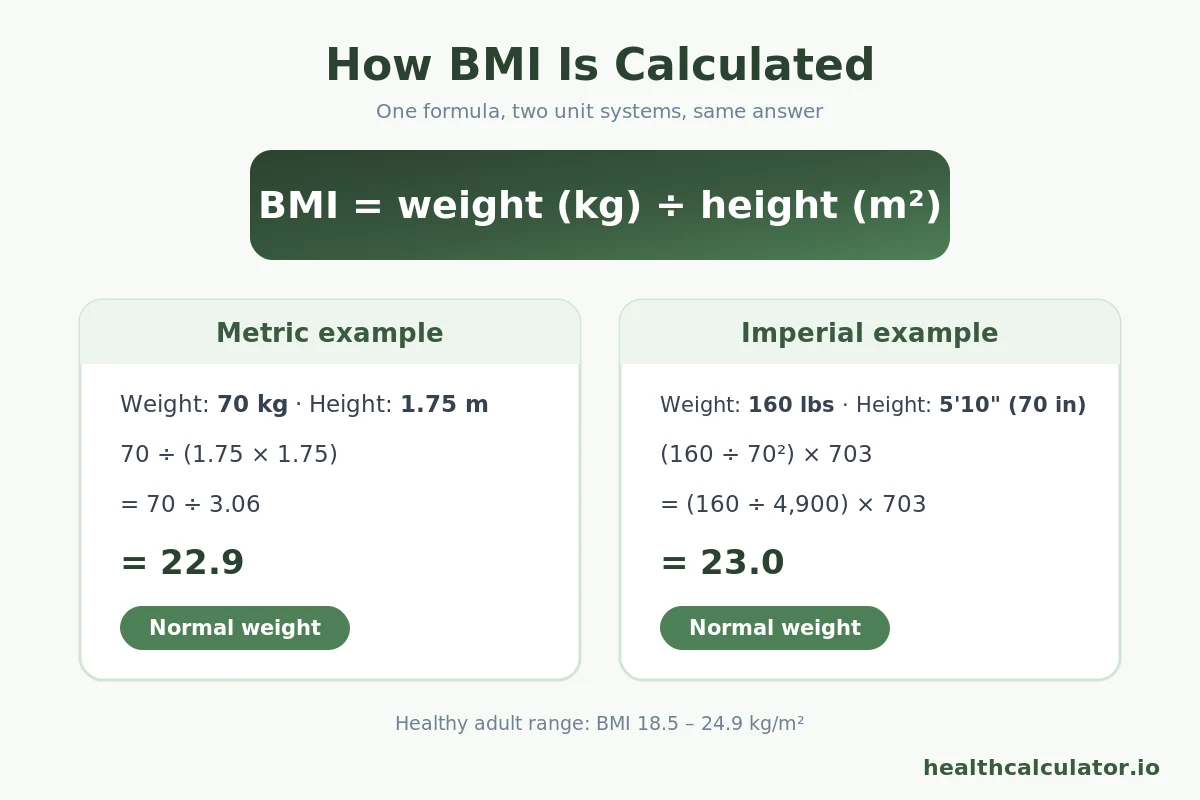
BMI = weight (kg) ÷ height (m²)
Say you're 1.75 m tall and weigh 70 kg:
70 ÷ (1.75 × 1.75) = 70 ÷ 3.0625 = 22.9 → Normal weight
That's the whole calculation. The tool above runs the same math, minus the rounding slips.
Metric vs Imperial
Working in pounds and inches? Add a conversion factor of 703.
BMI = (weight in lbs ÷ height in inches²) × 703
Someone 5'10" (70 inches) at 160 lbs:
(160 ÷ 4,900) × 703 = 23.0 → Normal weight
Same body, same answer, different units. Toggle metric or imperial at the top of the tool and it converts for you.
BMI Categories and What They Mean
Once you have your number, here's how it's classified for adults aged 20 and over. Our calculator uses these exact ranges:
| Category | BMI Range (kg/m²) |
|---|---|
| Underweight | Below 18.5 |
| Normal weight | 18.5 – 24.9 |
| Overweight | 25 – 29.9 |
| Obesity Class I | 30 – 34.9 |
| Obesity Class II | 35 – 39.9 |
| Obesity Class III (Severe) | 40 and above |
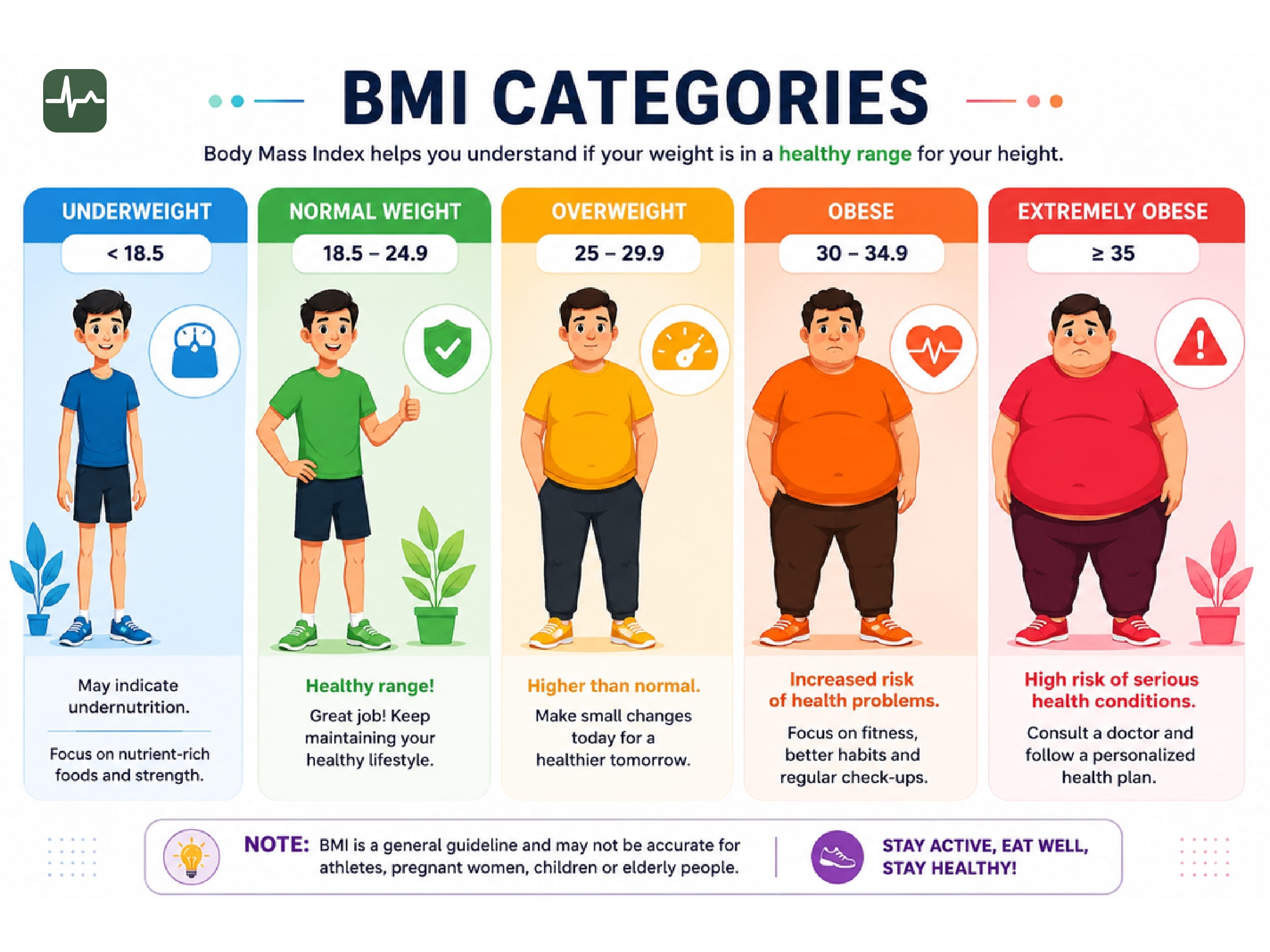
Those upper classes matter. Between 2013 and 2023, severe obesity in US adults climbed from 7.7% to 9.7% while overall obesity held roughly flat, and risk rises sharply as you move up the classes. So the calculator names your class instead of lumping everything above 30 into one word.
Limitations of BMI: When It Can Be Misleading
BMI is useful. It also has blind spots, and pretending otherwise wouldn't help you.
- It can't tell muscle from fat. A muscular athlete can score "overweight" with very low body fat.
- It ignores fat distribution. Belly fat is riskier than fat carried elsewhere, and BMI can't see the difference.
- It misreads certain groups. Older adults can have a normal BMI with high body fat, and pregnancy needs different measures entirely.
Medicine is already moving. In January 2025 a Lancet Commission proposed splitting obesity into clinical and preclinical forms, measured with waist circumference and waist-to-height ratio rather than BMI alone.
The evidence keeps stacking up. Tracking 2,721 Brazilian adults for about five years, the ELSA-Brasil study found waist-to-height ratio was the only body measurement that independently predicted new coronary artery calcium, even after adjusting for BMI. Work presented at Heart Failure 2025 pointed the same direction for heart failure risk. The rule of thumb is easy to remember: waist under half your height.
Start with BMI. Then add context. Our body fat calculator estimates body fat percentage from waist, neck and height, which covers the exact gap BMI leaves.
Why Use Our BMI Calculator?
Plenty of BMI tools exist. A few things ours does that most don't:
- Instant results with your specific obesity class, not just "obese"
- A personalized healthy weight range, plus exactly how much to lose or gain to reach it
- Metric and imperial in one tap
- Everything runs in your browser. Nothing is sent to a server, nothing is stored
- No sign-up, no ads between you and your result, works on any device
It's sitting at the top of the page. Takes about three seconds.
BMI for Adults vs Children
Adults (20 and older): the fixed ranges in the table above apply. Same at 25, same at 75.
Children and teens (2 to 19): fixed ranges don't work, because kids are still growing. BMI gets compared against age and sex percentiles instead. Overweight starts at the 85th percentile, obesity at the 95th, severe obesity at 120% of the 95th.
Not just an American problem, either. Over 390 million children and adolescents aged 5 to 19 were overweight in 2022, 160 million of them living with obesity. If you're checking a child, use the CDC's calculator or ask your pediatrician. The tool above is built for adults.
Health Risks of High BMI
A high BMI raises your risk of cardiovascular disease, type 2 diabetes, hypertension, fatty liver disease, stroke and insulin resistance. Risk climbs with each obesity class. It climbs with age too: obesity affects 46.4% of US adults aged 40 to 59, more than any other age group.
Now the part that usually gets buried. Losing just 3% to 5% of your current weight already lowers triglycerides, blood glucose and your risk of type 2 diabetes, and going beyond that improves blood pressure and cholesterol, according to the National Heart, Lung, and Blood Institute. A perfect BMI was never the price of entry.
Health Risks of Low BMI
Underweight gets less attention. It shouldn't. A BMI below 18.5 can signal nutritional deficiencies, weakened immunity, muscle loss, hormonal imbalance or reduced bone density, and it can slow recovery from illness and surgery.
If your result came back underweight and you weren't trying to lose weight, take that to your doctor.
BMI Should Not Replace Medical Advice
This calculator is for informational and screening purposes only and does not constitute medical advice or diagnosis. Your BMI is one data point. Muscle mass, age, ethnicity, activity level and medical history all shape what it actually means for you. Always consult a qualified healthcare professional for personalized guidance.
Frequently Asked Questions
A healthy BMI for most adults falls between 18.5 and 24.9 kg/m², according to the CDC's classification. This range is linked with the lowest risk of weight-related health conditions. Below 18.5 counts as underweight, and 25 or above counts as overweight.
No. BMI cannot separate muscle from fat, so athletes often score overweight despite low body fat, and older adults can score normal despite high body fat. That's why the 2025 Lancet Commission recommends pairing BMI with waist measurements for a fuller picture.
The formula and the adult categories are identical for men and women. Body composition differs, though: at the same BMI, women typically carry a higher body fat percentage while men carry more muscle. Our calculator notes this for you if you select your sex, and the ranges themselves stay the same.
Not with adult ranges. For ages 2 to 19, BMI is interpreted through age and sex percentiles because children are still growing. The 95th percentile or above counts as obesity. Use the CDC's child and teen calculator, not an adult tool, for anyone under 20.
The adult formula and ranges are the same from age 20 onward, but interpretation shifts with age. Older adults naturally lose muscle and gain fat, so the same BMI can mean more body fat at 70 than at 30. If you're over 65, ask your doctor how your BMI fits your overall health picture.
Since BMI is weight divided by height squared, lowering it means losing weight through a sustained calorie deficit: better diet quality, more physical activity, and enough sleep. Our calculator shows exactly how many kilograms or pounds separate you from a BMI of 24.9. For a personalized plan, talk to your doctor or a registered dietitian.
Don't panic, and don't self-diagnose. BMI is a screening number, not a verdict. Bring the result to a healthcare professional, who will look at your diet, activity, waist measurement, and medical history before deciding whether anything needs to change. One number outside the range is a prompt for a conversation, nothing more.
Sources
Every figure on this page is drawn from government health statistics or peer-reviewed research. Last verified July 2026.
- Emmerich SD, Fryar CD, Stierman B, Ogden CL. Obesity and Severe Obesity Prevalence in Adults: United States, August 2021–August 2023. NCHS Data Brief No. 508. National Center for Health Statistics; 2024.
- Centers for Disease Control and Prevention. About Body Mass Index (BMI). CDC.
- World Health Organization. Obesity and Overweight Fact Sheet. WHO; updated 2025.
- Rubino F, Cummings DE, Eckel RH, et al. Definition and diagnostic criteria of clinical obesity. The Lancet Diabetes & Endocrinology. 2025;13(3):221-262.
- Mendes TB, Generoso G, Fabiano RC, et al. Waist-to-height ratio and coronary artery calcium incidence: the Brazilian Longitudinal Study of Adult Health (ELSA-Brasil). The Lancet Regional Health – Americas. 2025;52:101281. doi:10.1016/j.lana.2025.101281.
- European Society of Cardiology. Waist-to-height ratio predicts heart failure incidence. ESC Press Office; Heart Failure 2025 congress.
- Centers for Disease Control and Prevention. Child and Teen BMI Calculator. CDC; reviewed June 2024.
- National Heart, Lung, and Blood Institute. Heart-Healthy Living: Aim for a Healthy Weight. National Institutes of Health; updated December 2025.